

Hundreds of thousands of people in France have rushed to set up Covid-19 vaccination appointments after President Emmanuel Macron warned that those who are unvaccinated would face restrictions aimed at curbing the fast spread of the Delta variant.
Mr Macron said that vaccination would not be compulsory but that new restrictions would focus on those who are not vaccinated.
From August, anyone wanting to go out to eat or drink, visit a shopping centre, attend a festival, explore a museum, or go to the theatre or cinema, must show proof of vaccination or a negative test.
He also announced mandatory Covid-19 vaccinations for healthcare workers from September 15.
The prospect of having to take a test for every meal out appeared to have an instant effect on the unvaccinated.
Stanislas Niox-Chateau, who heads Doctolib, one of the country's biggest websites to book vaccine appointments, said a total of 1.3 million had made a booking after the presidential announcement.
“We recorded 20,000 appointments per minute, an absolute record since the start of the campaign, and it's continued during the night and into this morning,” he said.
More than 900,000 booked on Monday and the number continued to rise the morning after the announcement.

Health Minister Olivier Veran defended the government against criticism that it was forcing people to get vaccinated against their wishes, saying the health pass was “not a sanction, it's not blackmail".
“Almost a million vaccine appointments have been booked, which means thousands of lives have been saved,” he told BFM TV.
Mr Macron said the health pass would also berequired to board long-distance trains and planes, giving a further incentive for people to get vaccinated as the summer holiday season kicks in.
A slowdown in vaccination rates and a sharp upturn in new infections due to the highly contagious and now dominant Delta variant prompted the government to rethink its strategy.
“The virus is doubling every five days. We are talking about low figures which quickly become high,” he said.
“What we want is to avoid an epidemic wave and [get] protection for everyone. We're not taking this decision lightly.”
After falling from more than 42,000 per day in mid-April to less than 2,000 per day in late June, the average number of new infections per day in France has crept back up again, to nearly 4,000.
“Our country is facing a surge in the epidemic across our territory, in mainland France as well as overseas,” Mr Macron said.
“The situation is under control, but if we do not act now the number of cases will increase significantly and will lead to a rise in hospitalisations.”
-
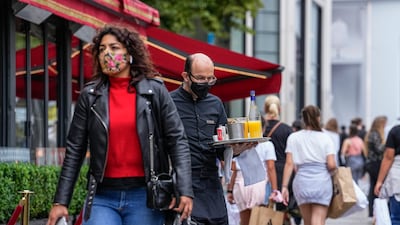
A waiter wearing a face mask serves customers on Champs Elysees, in Paris. France warned its citizens against travelling to Spain and Portugal because of a surge in Covid cases caused by the Delta variant. . -

A medical technician administers nasal swabs at a mobile testing site in Paris. French President Emmanuel Macron has announced the widening of a 'Covid pass' system. -

A man wearing a face masks crosses the Champs Elysees in Paris. -

A face mask sits discarded in front of the Old Opera in Frankfurt. Germany recently banned incoming travellers from Portugal, where the Delta variant is now dominant. Only German citizens or residents are allowed in from Portugal and they must quarantine for two weeks upon arrival.. -

Pupils take part in a 'Extra time to learn' project during the school summer holiday in Duesseldorf, Germany. As a result of the prolonged lockdown, many are significantly behind in learning. -

Health workers test people for Covid-19 before they enter the Cruilla music festival in Barcelona. Spain has reintroduced some Covid-19 social restrictions.. -

Healthcare workers prepare syringes to be filled with doses at a vaccination centre in Ronda, Spain. -

A woman uses a fan on a hot summer day after receiving her Covid-19 vaccine in Ronda, Spain. The high number of cases among the country's under 30s is slowly pushing up the rate of hospital admissions. -

Police patrol empty streets in the centre of Utrecht, the Netherlands. The Dutch cabinet has tightened coronavirus measures once again after a rise in case numbers. -

People queue to be vaccinated at Gostinny Dvora exhibition centre in Moscow. The banner reads ‘Let's beat Covid-19 together!’.


Mr Macron said the government's aim was to recognise the civic responsibility of those who had been vaccinated while “putting in restrictions on the non-vaccinated rather than on everyone".
Roland Heguy, head of the Union of Hospitality Trades and Industries, said the new measures would take a "sledgehammer" to the industry.
"The season was shaping up very well and there we have this brake coming," he said.
The Louvre Museum in Paris said they would devise new safety policies for visitors, staff and contractors in the wake of Mr Macron's announcement, but added: "We are still awaiting clear instructions from the Ministry of Culture."
Mr Macron said tests, which are now free, will have to be paid for from September “to encourage vaccination instead of taking many tests”.
About 35.5 million people, just over half of France's population, have received at least one vaccine dose so far, while 27 million have had two.
At the start of the pandemic, France had some of the highest levels of vaccine scepticism in the developed world.
The announcements represent a change in direction for the government after several months of progressively lifting restrictions, and they underline concern about the effect a fourth wave of infections could have.
France's move to make vaccinations compulsory for all healthcare workers spurred debate in Germany over whether people in some professions should be forced to get a shot, but German Chancellor Angela Merkel said on Tuesday that would not happen.
"There will be no compulsory vaccination," she said, adding that forcing people to get the shot could undermine public trust in the vaccination campaign.
A panel of scientists who advise the French government on health warned last Friday that as many as 95 per cent of people may need to be vaccinated to stop the spread of the Delta variant.
“We need to head towards vaccinating every French person because it's the only way of returning to a normal way of life,” Mr Macron said.
He said the idea of making vaccination mandatory for everyone would need to be studied.
The Delta strain of Covid-19 already accounts for half of new infections in France and is believed to be about 60 per cent more infectious.
However, although the number of new cases in France has jumped to about 4,200 a day, according to the latest available official figures, the number of deaths in hospital — four in the past 24 hours — is low.
About 7,000 people with Covid are in hospital in France, about a quarter of the peak of the third wave in March and April.
France's latest measures underscore the different strategies being followed in most European countries compared with Britain.
The UK government said on Monday that it would press ahead with “Freedom Day” next week by lifting most restrictions in England.

