


Is the pandemic getting worse?
The pandemic shows no signs of easing as new hotpots emerge and previous outbreaks flare up.
On Monday, World Health Organisation chief Tedros Adhanom Ghebreyesus warned the situation will get "worse and worse and worse" unless governments adopt a comprehensive strategy to tackle the virus. Regardless, "there will be no return to the 'old normal' for the foreseeable future," he said.
While some countries have reduced their number of new daily infections, worldwide the caseload continues to climb.
Since the start of July, nearly 2.5 million new cases have been registered across the globe, with the number of cases doubling over the past six weeks.
Are lockdowns back?
The easing of lockdowns in June has been swiftly followed by a new raft of restrictions as countries contend with fresh outbreaks of Covid-19.
On Tuesday, millions of people went into new lockdowns amid a surge in coronavirus cases, which have now passed 13.2 million with more than 576,000 deaths worldwide.
Tokyo is on its highest coronavirus alert after a spike in infections, and in Melbourne about 5 million people have gone back into a six-week lockdown as Australian authorities battle a fresh outbreak.
Bars, gyms, and beauty salons closed again in Hong Kong on Wednesday and a ban on gatherings of more than four people came into force as the city battles a fresh outbreak following months of success against the virus.
On Thursday, the Indian state of Bihar goes into a 15-day virus lockdown while the country’s IT hub Bangalore has already begun a week-long shutdown.
In South Africa, a nationwide curfew has been reimposed to prevent a "coronavirus storm" from ravaging the continent's hardest-hit nation, where new infections have topped 12,000 a day.
And California has drastically rolled back its reopening plans, ordering indoor restaurants, bars and cinemas to close again as cases soar across the US's richest and most populous state.
How far off is a vaccine?
The most optimistic projections say a vaccine could be ready by autumn but estimates vary.
In late-June, Dr Anthony Fauci, the top US infectious disease expert, expressed cautious hope there would be a Covid-19 vaccine by the end of the year or early 2021.
Possible progress comes from US biotech firm Moderna, which said on Tuesday it will enter the final stage of human trials for its Covid-19 vaccine on July 27.
The announcement comes after the publication of promising earlier trials, which showed the first 45 participants all developed antibodies to the virus. The last-stage trials are scheduled to run through October 2022, with researchers expecting preliminary results well before then.
Another leading candidate is the experimental vaccine being trialled by British pharmaceutical giant AstraZeneca. Large-scale, mid-stage human trials have already begun on the vaccine, known as AZD1222, which is being developed by researchers at the University of Oxford.
Sarah Gilbert, who is heading up the University of Oxford team has said she is “80 per cent confident” the vaccine will be effective in stopping people from developing Covid-19 and could be ready as early as September.
These are the two leading contenders but other vaccine developers, including CanSino Biologics, are also making progress. The Chinese vaccine company said on Saturday that it is in talks with Russia, Brazil, Chile and Saudi Arabia to launch a Phase III trial of its experimental Covid-19 vaccine.
But scientists have cautioned that the first vaccines to come to market may not be the most effective or safest. Until a vaccine is ready, experts have advised governments to continue lockdowns and social distancing measures in some form to prevent the virus from gaining further momentum.
-
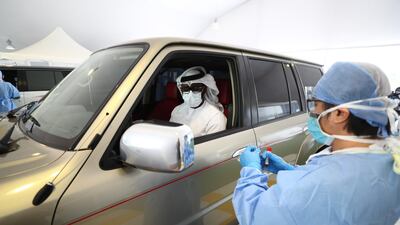
A health worker takes swab sample at a coronavirus drive-through screening centre in Abu Dhabi. -
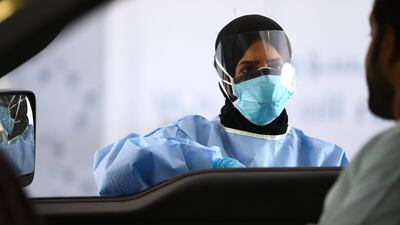
A health worker collects a swab sample. -
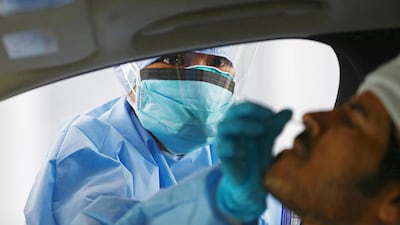
A health worker wearing protective clothing administers a swab test. -
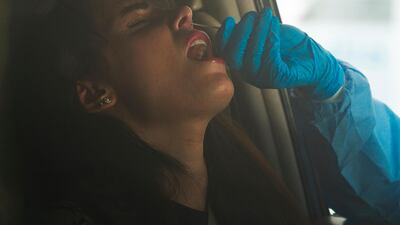
A woman undergoes a nasal swab. -
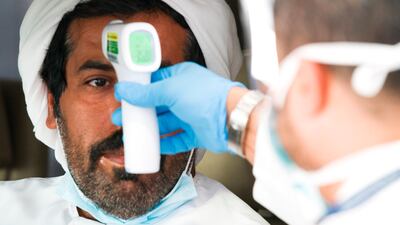
A health worker checks a man's temperature before conducting a coronavirus test at a drive-through testing centre. -
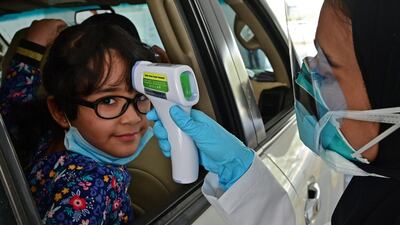
A nurse measures the body temperature of a small girl. -
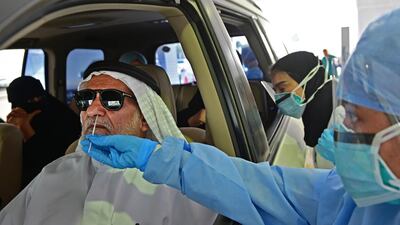
A nurse collects a swab sample at the drive-through centre. -
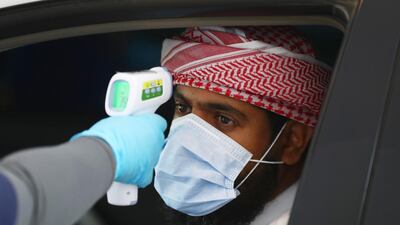
A man has his temperature checked. -
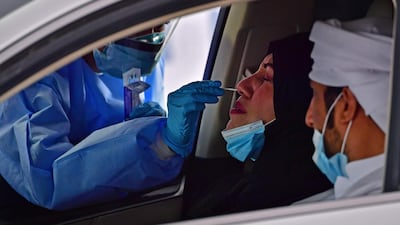
A nurse administers a swab test. -
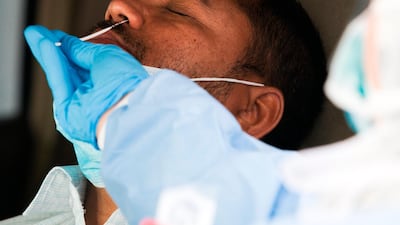
A technician takes a nasal swab. -

Cars line up as people wait to enter the drive-through testing centre.


Who will get them first?
Despite a lot of noise about poor countries getting equal access to Covid-19 vaccines, wealthy nations have been quick to secure large orders for the first batches when they become available.
In May, the British government provided an additional £65.5 million (Dh304m) funding to AstaZeneca, which will work to make up to 30 million doses available by September for people in the UK, as part of an agreement to deliver 100 million doses in total.
The company has agreed manufacturing deals globally to meet its target of producing 2 billion doses of the vaccine, including with two Bill Gates-backed ventures and a more than a billion-dollar agreement with the US government, which will receive 300 million doses of the vaccine as early as October.
Several other countries have raced to place orders and Europe’s Inclusive Vaccines Alliance, a group formed by France, Germany, Italy and the Netherlands, has secured up to 400 million doses of the vaccine.
Orders are also lining up for Moderna’s experimental vaccine. The Massachusetts-based biotech firm has partnered with drugmaker Catalent Inc to prepare an initial 100 million doses for the United States, beginning in the third quarter of this year.
The company has also agreed a 10-year collaboration with Swiss contract drugmaker Lonza Group AG with the aim of producing 500 million doses this year and 1 billion doses by the beginning of 2021.
Israel in June also signed an agreement with Moderna for the future purchase of its potential Covid-19 vaccine, without disclosing financial details.
The World Health Organisation is drafting guidelines for the ethical distribution of Covid-19 vaccines worldwide and the vaccine alliance GAVI is among several groups working to ensure access for poor countries.
AstraZeneca has agreed to license its vaccine to India’s Serum Institute for the production of 1 billion doses and Brazil recently struck a $287 million deal with the firm to buy doses and ingredients for as many as 100 million shots to produce locally.

