People around the world are buying up protective face masks in hopes of keeping the new virus from China at bay. Some companies have required them for employees. Schools in South Korea have told parents to equip their children with masks and hand sanitiser when they return from winter vacation.
But do the masks work? It depends.
All viruses are small enough to get through a typical strap-on medical mask, but the germs don't generally spread through the air one at a time, said Dr Mark Denison of Vanderbilt University Medical Centre in Nashville. He studies Sars and Mers, which are coronaviruses, the same family as the new virus.
Instead, viruses ride from person to person on droplets from a sneeze or cough. Those droplets land on hands and other surfaces, where they are touched by others, who then touch their own eyes, noses or mouths.
Masks can block large droplets from a sneeze or cough. That means they have some value, Dr Denison said.
Also, someone in a mask can't touch their own nose and mouth. That can prevent the wearer from picking up germs left on surfaces by someone who is sick, he said.
Masks are “a very sensible precaution" while scientists work to study exactly how the new virus is transmitted, said University of Oxford researcher Trudie Lang.
None of this, however, is based on rigorous research. Nobody has compared groups of masked and unmasked people by exposing them to the new germ, Dr Denison said. A 2017 review of studies in health care workers suggested masks offer some protection against Sars, but the authors noted “existing evidence is sparse and findings are inconsistent".
The best way to avoid getting sick from the new virus is to wash your hands with soap and water. If soap and water aren't available, use an alcohol-based hand sanitiser. That's the same advice for avoiding regular cold and flu viruses.
The Centres for Disease Control and Prevention recommends masks for people being evaluated for the new virus, people confirmed to have it, household members and caregivers. Airline crew should offer a face mask to a sick traveller, the CDC said.
Health care workers treating patients with the new virus are advised by the CDC to take additional precautions such as goggles or face shields.
-
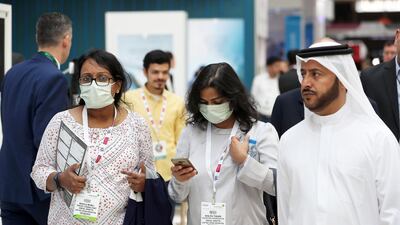
Visitors wear protective face masks at the Arab Health conference at Dubai World Trade Centre. Pawan Singh / The National -

Mohammed Al Ghamdi from Saudi Diagnostics wears a face mask at the Arab Health conference at Dubai World Trade Centre in Dubai. Pawan Singh / The National -

Doctors say the masks offer limited protection and the public are at little risk. Pawan Singh / The National -
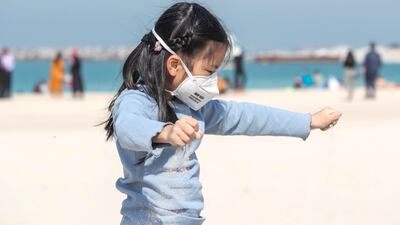
Tourists wear face masks on Sunset Beach near the Burj Al Arab hotel on Wednesday, hours after the country declared its first case. Antonie Robertson / The National -
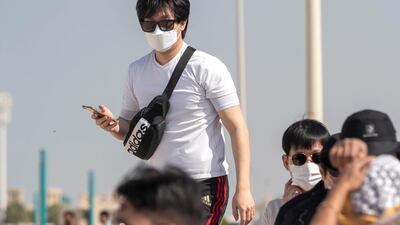
Masks were selling out in stores in Dubai and Abu Dhabi on Wednesday. Doctors say they offer limited protection and urged the public not to panic over a single reported case. Antonie Robertson / The National -

The masks were popular with Chinese tourists even before the Wuhan outbreak and are commonly seen being worn in airports. Antonie Robertson / The National -
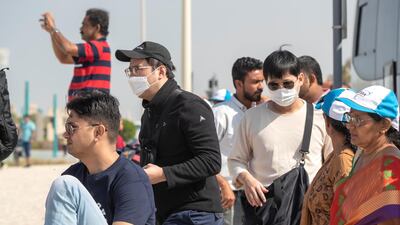
A tour group, some of whom covered their faces, take photos next to the Burj Al Arab in Dubai on Wednesday. Antonie Robertson / The National -

A medical worker checks the body temperature of a driver at a checkpoint outside the city of Yueyang, Hunan province, near the border with Hubei province, which is in lockdown. Reuters -

A woman wearing a face mask passes a health notice warning passengers arriving at London's Heathrow Airport about the virus. AFP -
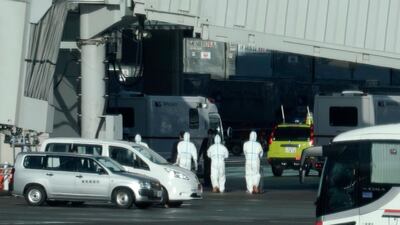
Tokyo quarantine officers wearing full protective gear approach a charted flight, believed to be carrying Japanese citizens repatriated from Wuhan, at Haneda airport in Tokyo. EPA -

A Kenyan health worker screens a passenger wearing face mask after they arrived from China, at Jomo Kenyatta International Airport in Nairobi. EPA -
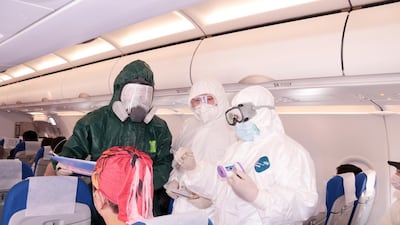
Medical personnel take temperature tests of passengers on board a plane at the airport in Zhoushan City, Zhejiang province, China. EPA -
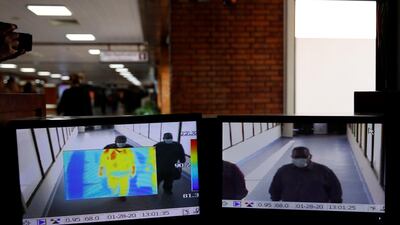
Passengers are seen on a thermal screen upon their arrival at the Tribhuvan International Airport after Nepal confirmed the first case of coronavirus in the country. Reuters -
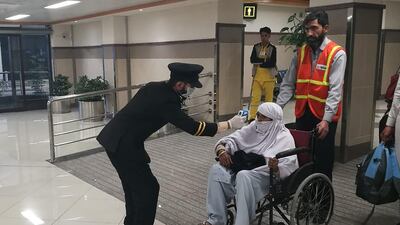
An airport official checks the temperature of a passenger upon his arrival at the Bacha Khan International Airport in Peshawar. AFP -
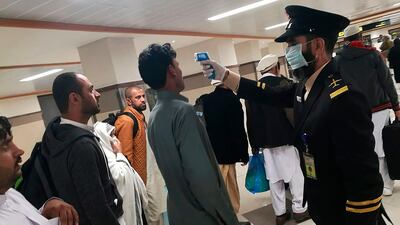
An airport official checks the temperature of a passenger upon his arrival at the Bacha Khan International Airport in Peshawar. AFP -

Disinfection workers wearing masks spray antiseptic solution at Incheon International Airport in Incheon, South Korea. Getty Images


Unicef said on Wednesday it has shipped six metric tonnes of respiratory masks and protective suits to China for use by health workers.
In Tokyo, 21-year-old hotel employee Hasumi Tsuchida said she wears a mask.
“I work in a hotel where many guests are from China," she said. “I worry a bit when foreign guests arrive.”
Masks have been commonly used in some countries when wearers are sick, fighting allergies or on days when air pollution is bad. The new virus has fueled demand for them around the world.
Respilon, a Czech company that makes its “nanofiber” masks in China, sold 700,000 of them last year worldwide. Since last week, it received orders for 7 million more. The problem: it cannot make any because the Chinese government extended the Lunar New Year holiday in a bid to contain the virus’ spread.
In Taiwan, where the holiday is over, factories are up and running. Premier Su Tseng-chang said the government had already distributed 23 million masks and that Taiwan will be able to produce four million more a day.
A mask factory in Shanghai has gone into overdrive despite the holiday.
“We are now working 24 hours, two shifts a day, 12 hours shift,” said Liao Huolin, president of the mask company.
“We violated labour law,” Liao said, “but the workers understand.”

