Coronavirus cases have now passed 5 million globally, according to figures from John Hopkins University, as the World Health Organisation said that Tuesday broke the record for the largest number of new cases worldwide.
It's the latest milestone for the worst pandemic in a century that has upended every aspect of modern life and hammered the global economy.
The number of infections worldwide has doubled over the past month and more than 1.6 million new cases have been recorded in the last 20 days as the world struggles to contain the fast-spreading disease.
"We still have a long way to go in this pandemic," Tedros Adhanom Ghebreyesus, Director General of the WHO told an online briefing yesterday.
"We're very concerned about the rising numbers of cases in low and middle-income countries."
The first 41 cases of coronavirus were confirmed in Wuhan, China, on January 10 and it took the world until April 1 to reach its first million cases. Since then, about 1 million new cases are reported every two weeks, according to a Reuters tally.
At more than 5 million cases, the virus has infected more people in under six months than the annual total of severe flu cases, which the World Health Organization estimates is around 3 million to 5 million globally.
The pandemic has claimed over 326,000 lives, though the true number is thought to be higher as testing is still limited and many countries do not include fatalities outside of hospitals. Over half of the total fatalities have been recorded in Europe.
Many countries continue to report rising daily tolls, with Brazil and Russia witnessing rapidly increasing caseloads in recent weeks.
Brazil has now overtaken the UK to become the world's third-worst-affected country in terms of infections, with 291,579 cases and 18,859 deaths, behind Russia with 308,705 cases and a reported death toll of 2,972. But experts say that with the current trajectory, Brazil is on course to surge into second place behind the United States.
President Jair Bolsonaro has been widely criticized for his handling of the outbreak. The far-right former army captain has long snubbed social-distancing measures, arguing instead for the reopening the economy.
-
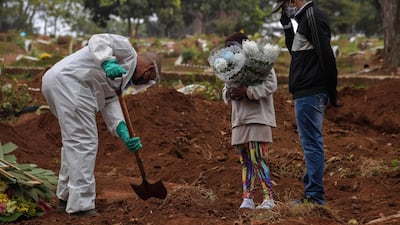
An employee digs next to relatives of a person who died from Covid-19 at the Vila Formosa cemetery, on the outskirts of Sao Paulo, Brazil. AFP -
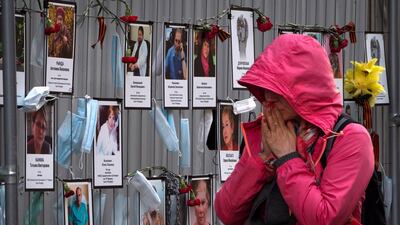
A woman reacts as she walks past portraits of St Petersburg's medical workers who have died from coronavirus, hanging at a unofficial memorial in front of the local health department, Russia. AP Photo -
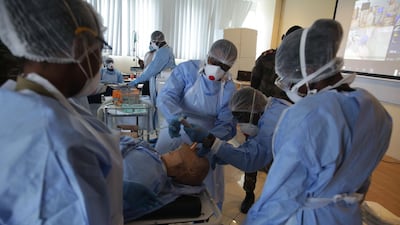
Medical staff members during training for resuscitation techniques at the School of Military Health Enforcement in Libreville, France. AFP -

Piedrangel funeral worker Alexander Carballo, of Venezuela, enters a home to remove the body of a person who is suspected to have died from coronavirus, in Lima, Peru. AP Photo -
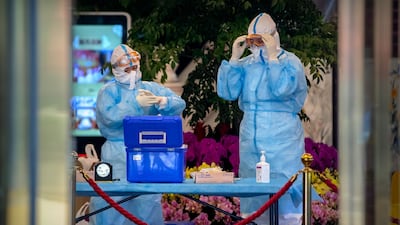
Workers put on protective suits before giving Covid-19 tests to foreign journalists covering a press conference for China's National People's Conference at a hotel in Beijing. AP Photo -

People in their cars attend a pop-up drive-in movie night at Bel Air Diner in Queens, New York City, US. AFP -
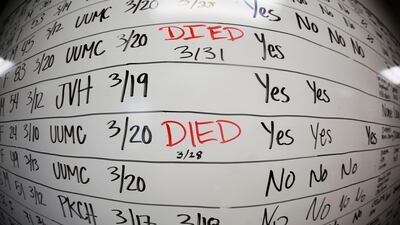
A list of the confirmed Covid-19 cases in Salt Lake County at the Salt Lake County Health Department, Utah, US. AP Photo -

A cyclist bikes past a public service billboard against the spread of coronavirus that reads in Spanish "Save lives, Stay at home," as well as instructions on who to contact if Covid-19 symptoms are found, in Mexico City. AP Photo -

A security guard wearing a vest reading "Social Distancing Ambassador" rides on an escalator inside Megaworld Corp.'s Uptown Mall in Bonifacio Global City in Metro Manila, the Philippines. Bloomberg -
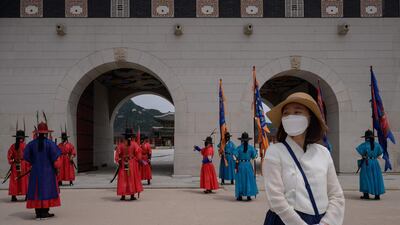
Costumed royal guards take part in a 'changing of the guards' ceremony at Gyeongbokgung palace in Seoul, South Korea. AFP -
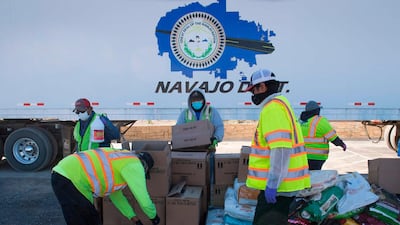
Volunteers from the Navajo Nation prepare care boxes at the town of Casamero Lake in New Mexico. The Navajo Nation now has the highest Covid-19 infection rate in the US after surpassing New York. AFP -
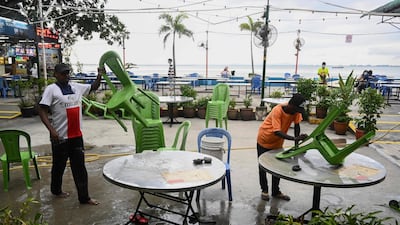
Workers clean chairs and tables at a food centre as businesses reopened in Penang, Malaysia. AFP -

A Colombian Huitoto indigenous man sails on a raft along the Takana river in Leticia, department of Amazonas, Colombia. AFP


He has also become an increasingly strong advocate for the malaria drug chloroquine as a possible remedy for Covid-19, despite warnings from health experts.
On Wednesday, the Health Ministry issued new guidelines for wider use of anti-malarial drugs in mild coronavirus cases.
Interim Health Minister Eduardo Pazuello, an active-duty army general, authorized the modified protocol after two trained doctors left the ministry's top job under pressure to promote the early use of chloroquine and hydroxychloroquine.
"We are at war. Worse than defeat would be the shame of not putting up a fight," Mr Bolsonaro tweeted about the government decision to put forward the drugs without proof of their effectiveness.
Gonzalo Vecina Neto, the former head of Brazil's health regulator, Anvisa, called the new measures a "barbarity" that could cause more harm than good because of the dangerous potential side effects of the drug.
"It has no scientific evidence," Vecina Neto told Reuters. "[It is] unbelievable that in the 21st century, we are living off magical thinking."
The US remains the worst-affected country with more than 1.5 million cases and 93,439 people reported to have died from Covid-19.
On Tuesday, the World Health Organisation announced the biggest daily rise in global cases since the start of the pandemic, with 106,662 new infections reported worldwide.
Countries have been increased their testing programmes, but figures show the pandemic is still unfolding.
Latin America accounted for around a third of the 91,000 cases reported earlier this week. Europe and the United States each accounted for just over 20 per cent.
Coupled with the human toll, the strict lockdowns and closure of borders to try and contain the pandemic is taking a huge toll on the global economy.
A potential $1 trillion could be lost from growth around the world as female workers fall out of the workforce during the coronavirus, according to a new analysis by Citigroup Inc.

