• Members of the World Health Organisation (WHO) team investigating the origins of coronavirus wear protective gear during their visit to the Hubei Center for animal disease control and prevention in Wuhan, China's central Hubei province. AFP
    Members of the World Health Organisation (WHO) team investigating the origins of coronavirus wear protective gear during their visit to the Hubei Center for animal disease control and prevention in Wuhan, China's central Hubei province. AFP
  • Security personnel hold hands to prevent journalists from getting close to the Wuhan Centre for Disease Control and Prevention during the World Health Organisation team's field trip in Wuhan in central China's Hubei province. AP
    Security personnel hold hands to prevent journalists from getting close to the Wuhan Centre for Disease Control and Prevention during the World Health Organisation team's field trip in Wuhan in central China's Hubei province. AP
  • Security personnel keep watch outside the Wuhan Institute of Virology during the visit by the WHO team tasked with investigating the origins of coronavirus in Wuhan, Hubei province. Reuters
    Security personnel keep watch outside the Wuhan Institute of Virology during the visit by the WHO team tasked with investigating the origins of coronavirus in Wuhan, Hubei province. Reuters
  • Peter Ben Embarek and other members of the WHO team investigating the origins of the Covid-19 coronavirus, leave the Hubei Centre for animal disease control and prevention in Wuhan, China's central Hubei province. AFP
    Peter Ben Embarek and other members of the WHO team investigating the origins of the Covid-19 coronavirus, leave the Hubei Centre for animal disease control and prevention in Wuhan, China's central Hubei province. AFP
  • Members of the WHO team arrive at the Wuhan centre for disease control and prevention in Wuhan, China's central Hubei province. AFP
    Members of the WHO team arrive at the Wuhan centre for disease control and prevention in Wuhan, China's central Hubei province. AFP
  • Security personnel stand outside the closed Huanan Seafood wholesale market during the visit. AFP
    Security personnel stand outside the closed Huanan Seafood wholesale market during the visit. AFP
  • Security personnel check people's temperature during the visit by members of the World Health Organisation team. Reuters
    Security personnel check people's temperature during the visit by members of the World Health Organisation team. Reuters
  • Members of the World Health Organisation team visit the closed Huanan Seafood wholesale market in Wuhan, China's central Hubei province. AFP
    Members of the World Health Organisation team visit the closed Huanan Seafood wholesale market in Wuhan, China's central Hubei province. AFP

WHO: 'extremely unlikely' coronavirus escaped from Chinese lab


  • English
  • Arabic

The World Health Organisation (WHO) said that the coronavirus originated in animals, but found it 'unlikely' that it was introduced to humans directly by bats.

It also said it was 'extremely unlikely' that the virus escaped from a Chinese lab.

Transmission could have also taken place beyond the wet market in Wuhan, central China, where the virus was thought to have emerged.

"The first cases were reported at the market. However, in other areas of Wuhan, transmission was also occurring," Liang Wannian, an expert with China’s Health Commission, said as the WHO's findings in Wuhan after a near month-long visit were announced.

Mr Liang said there was no substantial spread of the virus in Wuhan before the 2019 outbreak.

The WHO said that bats were not necessarily directly responsible for transmitting the virus to humans.

“All the work that has been done on the virus and trying to identify its origin continue to point towards a natural reservoir of the virus in bat populations," said Peter Karim Ben Embarek, programme manager at the WHO.

"But since Wuhan is not an environment for bats, the direct jump from a bat to the city of Wuhan is unlikely, so we have looked to see what other species could have introduced the virus in particular in the market."

Mr Liang said the coronavirus was circulating before the initial cases were reported in Wuhan.

The WHO also said that a laboratory being responsible for the virus' spread to humans was extremely unlikely.

There was no indication of coronavirus transmission before December 2019, the WHO said.

There is evidence of some spread at the seafood market in December but it’s “not the whole story,” said the WHO, which mapped the spread of the virus among earlier cases linked to the market and used genetic sequencing to identify the nature of the transmission.

“We know there was a spread of the virus among individuals who were not linked to the market so the picture is not clear… But the spread through frozen foods is not ruled out as some of the frozen wild animals are known reservoirs of Covid.”

While lab accidents do happen, they are extremely rare, Mr Embarek said. “We also looked at the Wuhan Institute of Virology and the state of that laboratory and it was very unlikely that anything could escape from such a place.”

"The findings suggest that the laboratory incident hypothesis is extremely unlikely in explaining the introduction of the virus into the human population, therefore, we do not suggest further work into that hypothesis for understanding the virus," Mr Embarek said.

Members of the WHO team investigating the origins of the coronavirus join Liang Wannian, the head of a panel on coronavirus response at China's National Health Commission, at a news conference in Wuhan, central China. Reuters

Investigations showed that the virus was spreading beyond Wuhan and that these cases were missed.

"Based on research done on the virus from other studies around the world, the data suggests there was circulation preceding the initial cases and those cases that were missed were already circulating in other regions," Mr Liang said.

"We have also conducted research among 233 health institutions in Wuhan by searching records of those who had been sick based on their symptoms in the period of October 1 to December 10, 2019 and have reviewed the testing of blood obtained from the data banks and tested antibodies in blood samples," he said.

Around 50,000 samples from 30 species of wild animals have also been tested and all were negative, he added.

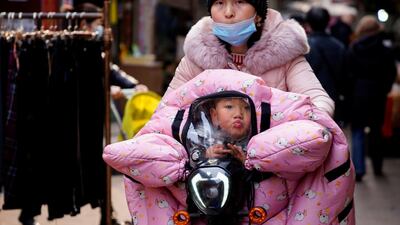
  • A woman wearing a face mask rides a bicycle with a child, following an outbreak of the coronavirus disease in Wuhan, Hubei province, China. Reuters
    A woman wearing a face mask rides a bicycle with a child, following an outbreak of the coronavirus disease in Wuhan, Hubei province, China. Reuters
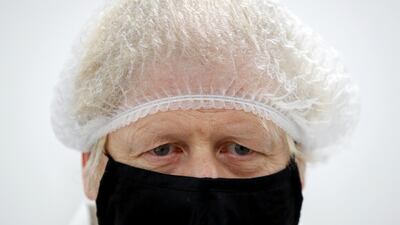
  • Britain's Prime Minister Boris Johnson visits SureScreen Diagnostics, amidst the coronavirus disease outbreak, in Derby, Britain. Reuters
    Britain's Prime Minister Boris Johnson visits SureScreen Diagnostics, amidst the coronavirus disease outbreak, in Derby, Britain. Reuters
  • Choir members sing during the Sunday mass without wearing masks and social distancing at Ufunuo na Uzima Church in Dar es Salaam. For more than six months, Tanzania has tried to convince the world it has been cured of the coronavirus, through prayer, while refusing to take measures to curb its spread. However dissent is mounting along with deaths attributed to "pneumonia", with even a politician in semi-autonomous Zanzibar admitting he has the virus. AFP
    Choir members sing during the Sunday mass without wearing masks and social distancing at Ufunuo na Uzima Church in Dar es Salaam. For more than six months, Tanzania has tried to convince the world it has been cured of the coronavirus, through prayer, while refusing to take measures to curb its spread. However dissent is mounting along with deaths attributed to "pneumonia", with even a politician in semi-autonomous Zanzibar admitting he has the virus. AFP
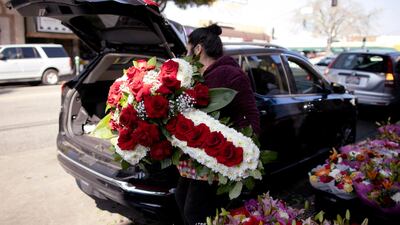
  • A woman lifts a funeral display into a car in the flower district as the coronavirus disease (COVID-19) outbreak continues, ahead of Valentine's Day in Los Angeles, California, U.S. Reuters
    A woman lifts a funeral display into a car in the flower district as the coronavirus disease (COVID-19) outbreak continues, ahead of Valentine's Day in Los Angeles, California, U.S. Reuters
  • French Health Minister Olivier Veran receives a dose of the AstraZeneca-Oxford Covid-19 vaccine at the South Ile-de-France Hospital Group, in Melun, on the outskirts of Paris, during an AstraZeneca vaccine injections campaign for people under the age of 65. AFP
    French Health Minister Olivier Veran receives a dose of the AstraZeneca-Oxford Covid-19 vaccine at the South Ile-de-France Hospital Group, in Melun, on the outskirts of Paris, during an AstraZeneca vaccine injections campaign for people under the age of 65. AFP
  • A patient is given a Covid-19 vaccination in a pop-up vaccination site at the Abyssinian Baptist Church in the Harlem neighborhood of New York, New York, USA. According to data about New York State vaccination rates released last week, thirteen percent of the state's 65-years-old or older population is African-American, but only 4 percent have received the COVID-19 vaccine, numbers that Governor Andrew Cuomo has connected to less access to vaccinations and a distrust in government vaccinations. EPA
    A patient is given a Covid-19 vaccination in a pop-up vaccination site at the Abyssinian Baptist Church in the Harlem neighborhood of New York, New York, USA. According to data about New York State vaccination rates released last week, thirteen percent of the state's 65-years-old or older population is African-American, but only 4 percent have received the COVID-19 vaccine, numbers that Governor Andrew Cuomo has connected to less access to vaccinations and a distrust in government vaccinations. EPA
  • A woman thanks god after being vaccinated against covid-19 at a drive-in center in Sao Paulo, Brazil. A drive-in center to vaccinate elders against covid-19 went into operation at the Pacaembu stadium in Sao Paulo, as part of a health program against the pandemic. EPA
    A woman thanks god after being vaccinated against covid-19 at a drive-in center in Sao Paulo, Brazil. A drive-in center to vaccinate elders against covid-19 went into operation at the Pacaembu stadium in Sao Paulo, as part of a health program against the pandemic. EPA
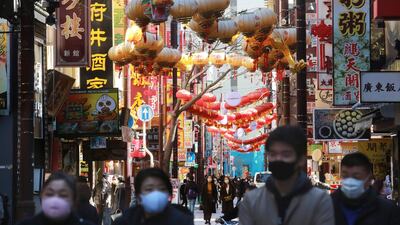
  • People wearing face masks to protect against the spread of the coronavirus walk through China Town in Yokohama, Kanagawa prefecture, near Tokyo. AP
    People wearing face masks to protect against the spread of the coronavirus walk through China Town in Yokohama, Kanagawa prefecture, near Tokyo. AP
  • Contest winners celebrate at the end of a competition where they were selected as this year's Carnival characters: Pepino, right, Chola, center, and Chuta, all of whom represent gaiety in La Paz, Bolivia. The winning trio of Carnival must be adept at spreading happiness and never tire of dancing, however due to the COVID-19 pandemic, their performances will be broadcast online, and parades have also been canceled. AP
    Contest winners celebrate at the end of a competition where they were selected as this year's Carnival characters: Pepino, right, Chola, center, and Chuta, all of whom represent gaiety in La Paz, Bolivia. The winning trio of Carnival must be adept at spreading happiness and never tire of dancing, however due to the COVID-19 pandemic, their performances will be broadcast online, and parades have also been canceled. AP
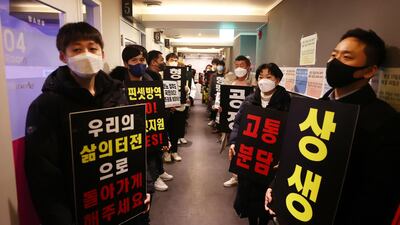
  • A group of operators of coin-operated unmanned karaoke rooms, called 'coin noraebang', stages a protest against the government's quarantine guidelines in Seou, South Korea. Protesters called for the lifting of curbs on their businesses amid the COVID-19 pandemic. EPA
    A group of operators of coin-operated unmanned karaoke rooms, called 'coin noraebang', stages a protest against the government's quarantine guidelines in Seou, South Korea. Protesters called for the lifting of curbs on their businesses amid the COVID-19 pandemic. EPA

Russia's Muslim Heartlands

Dominic Rubin, Oxford

Benefits of first-time home buyers' scheme
  • Priority access to new homes from participating developers
  • Discounts on sales price of off-plan units
  • Flexible payment plans from developers
  • Mortgages with better interest rates, faster approval times and reduced fees
  • DLD registration fee can be paid through banks or credit cards at zero interest rates
Indika
%3Cp%3E%3Cstrong%3EDeveloper%3A%3C%2Fstrong%3E%2011%20Bit%20Studios%3Cbr%3E%3Cstrong%3EPublisher%3A%3C%2Fstrong%3E%20Odd%20Meter%3Cbr%3E%3Cstrong%3EConsole%3A%3C%2Fstrong%3E%20PlayStation%205%2C%20PC%20and%20Xbox%20series%20X%2FS%3Cbr%3E%3Cstrong%3ERating%3A%3C%2Fstrong%3E%204%2F5%3C%2Fp%3E%0A