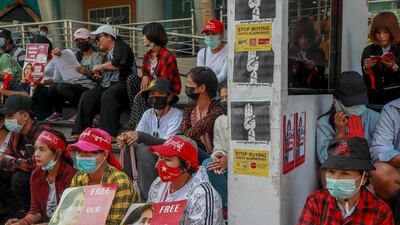
Protesters sitting next to signs to boycott Myanmar military-linked business, display pictures of deposed Myanmar leader Aung San Suu Kyi in Yangon, Myanmar on Tuesday, Feb. 23, 2021. AP

Western nations pile pressure on Myanmar junta as protests continue


  • English
  • Arabic

The EU warned it is considering sanctions on Myanmar while the US penalised two more generals for links to the military coup, as western countries sought to press the junta to avoid a violent crackdown after weeks of protests.

A general strike shut businesses in the southeast Asian country on Monday as huge crowds gathered peacefully despite a warning from authorities that confrontation could get people killed.

UN Special Rapporteur Tom Andrews said millions had marched in a "breathtaking" turnout, despite the junta's threat.

"The generals are losing their power to intimidate and with it, their power. It is past time for them to stand down, as the people of Myanmar stand up," Mr Andrews said on Twitter.

More protests are planned for Tuesday.

Overnight, EU governments showed support for those seeking to reverse the February 1 coup and the release of elected leader Aung San Suu Kyi.

"We are not prepared to stand by and watch," German Foreign Minister Heiko Maas said in Brussels.

Sanctions could follow if diplomacy failed, he said.

The EU is considering sanctions that would target businesses owned by the army, but the bloc ruled out any curtailing of its trade preferences to avoid hurting poor workers.

Myanmar's security forces have shown more restraint since the coup than in earlier confrontations with those pushing for democracy in almost half a century of direct military rule.

Even so, three protesters have been killed – two shot dead in the second city of Mandalay on Saturday, and a woman who died on Friday after being shot more than a week earlier in the capital, Naypyidaw.

The army has said one policeman died of injuries sustained during the protests. It has accused protesters of provoking violence.

Late on Sunday, state-owned media MRTV warned that confrontation could cost lives.

Military-run Myawaddy News reported that junta chief General Min Aung Hlaing had said the military was following a democratic path and, referring to rubber bullets, that it wanted to use minimal force.

The army seized power after alleging fraud in November 8 elections in which Ms Suu Kyi's party trounced a pro-military party, detaining her and much of the party leadership. The electoral commission dismissed the fraud complaints.

In Naypyidaw, where the military is headquartered, police with a water cannon truck and a fleet of other vehicles broke up a procession of chanting protesters on Monday.

Videos showed protesters being chased and manhandled by security forces and a rights group said dozens had reportedly been detained there.

Overall, 684 people had been arrested, charged or sentenced since the coup, the group said.

The US on Monday imposed sanctions on two members of the junta – Lieutenant General Moe Myint Tun and General Maung Maung Kyaw – and warned it could take more action.

The administration of President Joe Biden has previously imposed sanctions on the acting president of Myanmar and several military officers, as well as three companies in the jade and gems sector.

"The military must reverse its actions and urgently restore the democratically elected government," the US Treasury Department's Office of Foreign Assets Control said.

Britain, Germany and Japan have also condemned the violence in Myanmar and UN Secretary-General Antonio Guterres urged the military to stop repression.

Myanmar has denounced interference in its affairs.

Indonesia is pushing Southeast Asian neighbours to agree on a plan that would keep the junta to its promise of holding elections, with monitors to ensure they are fair and inclusive, three sources familiar with the proposal said.

Indonesian Foreign Minister Retno Marsudi has been rallying support among Association of South East Asian Nations members for a special meeting on the crisis.

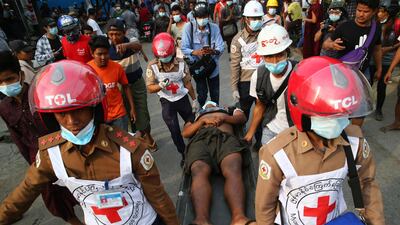
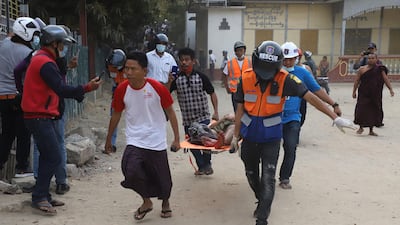
  • Red Cross workers carry a man on a stretcher in Mandalay, Myanmar. AP
    Red Cross workers carry a man on a stretcher in Mandalay, Myanmar. AP
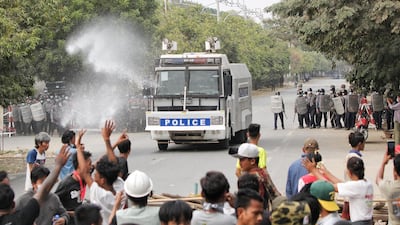
  • Police officers stand in front of people who protest against the military coup, in Mandalay, Myanmar. Reuters
    Police officers stand in front of people who protest against the military coup, in Mandalay, Myanmar. Reuters
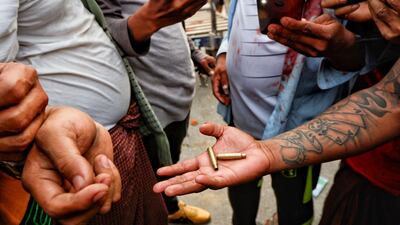
  • A person shows bullet shells during a protest against the military coup, in Mandalay, Myanmar. Reuters
    A person shows bullet shells during a protest against the military coup, in Mandalay, Myanmar. Reuters
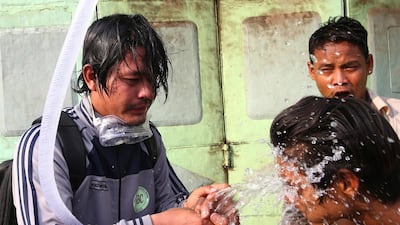
  • People rinse their faces with water after tear gas was used to disperse a protest in Mandalay, Myanmar. AP
    People rinse their faces with water after tear gas was used to disperse a protest in Mandalay, Myanmar. AP
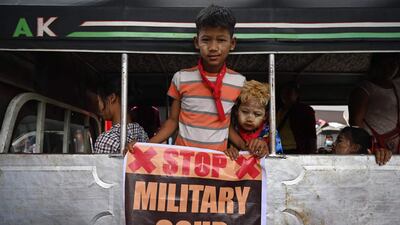
  • Young protesters hold a sign during a demonstration against the military coup in Yangon. AFP
    Young protesters hold a sign during a demonstration against the military coup in Yangon. AFP
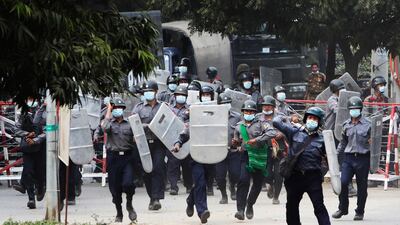
  • Police charge forward to disperse protesters in Mandalay, Myanmar. AP
    Police charge forward to disperse protesters in Mandalay, Myanmar. AP
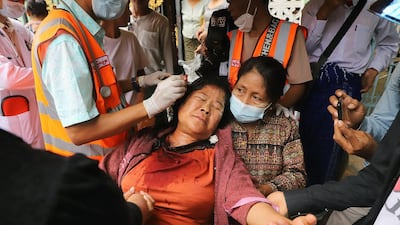
  • A protester has a wound on her head treated after being beaten by security forces during a demonstration against the military coup in Mandalay. AFP
    A protester has a wound on her head treated after being beaten by security forces during a demonstration against the military coup in Mandalay. AFP
  • A wounded man is carried on a stretcher by a medical team after security forces opened fire on protesters during a demonstration against the military coup in Mandalay. AFP
    A wounded man is carried on a stretcher by a medical team after security forces opened fire on protesters during a demonstration against the military coup in Mandalay. AFP
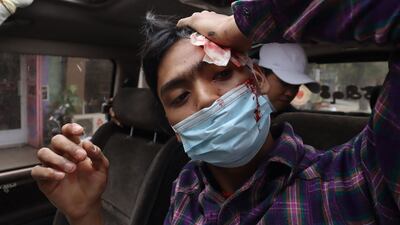
  • A wounded man holds a bandage to his bleeding head following a demonstration against the military coup where security forces fired on and beat protesters in Mandalay. AFP
    A wounded man holds a bandage to his bleeding head following a demonstration against the military coup where security forces fired on and beat protesters in Mandalay. AFP
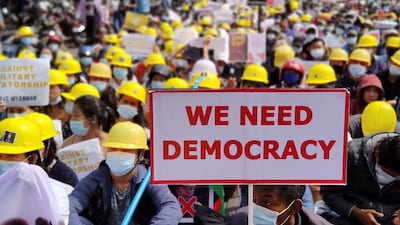
  • Protesters wearing hard hats and helmets hold up signs as they rally in protest against the military coup in the northern town of Myitkyina, the capital of Kachin state, Myanmar. Reuters
    Protesters wearing hard hats and helmets hold up signs as they rally in protest against the military coup in the northern town of Myitkyina, the capital of Kachin state, Myanmar. Reuters

But the plan from the biggest regional nation would fall short of protester demands for the immediate release of Ms Suu Kyi and recognition of the November election result.

"This is complete denial of the will of Myanmar people. Have they not seen enough of the protests?" said one Twitter user identified as Zaw Min.

Social media users said a protest was planned in front of Indonesia's embassy in Myanmar on Tuesday.


Groom and Two Brides

Director: Elie Semaan

Starring: Abdullah Boushehri, Laila Abdallah, Lulwa Almulla

Rating: 3/5

Countries recognising Palestine

France, UK, Canada, Australia, Portugal, Belgium, Malta, Luxembourg, San Marino and Andorra


Which honey takes your fancy?

Al Ghaf Honey

The Al Ghaf tree is a local desert tree which bears the harsh summers with drought and high temperatures. From the rich flowers, bees that pollinate this tree can produce delicious red colour honey in June and July each year

Sidr Honey

The Sidr tree is an evergreen tree with long and strong forked branches. The blossom from this tree is called Yabyab, which provides rich food for bees to produce honey in October and November. This honey is the most expensive, but tastiest

Samar Honey

The Samar tree trunk, leaves and blossom contains Barm which is the secret of healing. You can enjoy the best types of honey from this tree every year in May and June. It is an historical witness to the life of the Emirati nation which represents the harsh desert and mountain environments

Points Classification after Stage 1

1. Geraint Thomas (Britain / Team Sky) 20

2. Stefan Kueng (Switzerland / BMC Racing) 17

3. Vasil Kiryienka (Belarus / Team Sky) 15

4. Tony Martin (Germany / Katusha) 13

5. Matteo Trentin (Italy / Quick-Step) 11

6. Chris Froome (Britain / Team Sky) 10

7. Jos van Emden (Netherlands / LottoNL) 9

8. Michal Kwiatkowski (Poland / Team Sky) 8

9. Marcel Kittel (Germany / Quick-Step) 7

10. Edvald Boasson Hagen (Norway / Dimension Data) 6

MATCH INFO

World Cup 2022 qualifier

UAE v Indonesia, Thursday, 8pm

Venue: Al Maktoum Stadium, Dubai

Global state-owned investor ranking by size

1.

United States

2.

China

3.

UAE

4.

Japan

5

Norway

6.

Canada

7.

Singapore

8.

Australia

9.

Saudi Arabia

10.

South Korea

Key figures in the life of the fort

Sheikh Dhiyab bin Isa (ruled 1761-1793) Built Qasr Al Hosn as a watchtower to guard over the only freshwater well on Abu Dhabi island.

Sheikh Shakhbut bin Dhiyab (ruled 1793-1816) Expanded the tower into a small fort and transferred his ruling place of residence from Liwa Oasis to the fort on the island.

Sheikh Tahnoon bin Shakhbut (ruled 1818-1833) Expanded Qasr Al Hosn further as Abu Dhabi grew from a small village of palm huts to a town of more than 5,000 inhabitants.

Sheikh Khalifa bin Shakhbut (ruled 1833-1845) Repaired and fortified the fort.

Sheikh Saeed bin Tahnoon (ruled 1845-1855) Turned Qasr Al Hosn into a strong two-storied structure.

Sheikh Zayed bin Khalifa (ruled 1855-1909) Expanded Qasr Al Hosn further to reflect the emirate's increasing prominence.

Sheikh Shakhbut bin Sultan (ruled 1928-1966) Renovated and enlarged Qasr Al Hosn, adding a decorative arch and two new villas.

Sheikh Zayed bin Sultan (ruled 1966-2004) Moved the royal residence to Al Manhal palace and kept his diwan at Qasr Al Hosn.

Sources: Jayanti Maitra, www.adach.ae

Milestones on the road to union

1970

October 26: Bahrain withdraws from a proposal to create a federation of nine with the seven Trucial States and Qatar. 

December: Ahmed Al Suwaidi visits New York to discuss potential UN membership.

1971

March 1:  Alex Douglas Hume, Conservative foreign secretary confirms that Britain will leave the Gulf and “strongly supports” the creation of a Union of Arab Emirates.

July 12: Historic meeting at which Sheikh Zayed and Sheikh Rashid make a binding agreement to create what will become the UAE.

July 18: It is announced that the UAE will be formed from six emirates, with a proposed constitution signed. RAK is not yet part of the agreement.

August 6:  The fifth anniversary of Sheikh Zayed becoming Ruler of Abu Dhabi, with official celebrations deferred until later in the year.

August 15: Bahrain becomes independent.

September 3: Qatar becomes independent.

November 23-25: Meeting with Sheikh Zayed and Sheikh Rashid and senior British officials to fix December 2 as date of creation of the UAE.

November 29:  At 5.30pm Iranian forces seize the Greater and Lesser Tunbs by force.

November 30: Despite  a power sharing agreement, Tehran takes full control of Abu Musa. 

November 31: UK officials visit all six participating Emirates to formally end the Trucial States treaties

December 2: 11am, Dubai. New Supreme Council formally elects Sheikh Zayed as President. Treaty of Friendship signed with the UK. 11.30am. Flag raising ceremony at Union House and Al Manhal Palace in Abu Dhabi witnessed by Sheikh Khalifa, then Crown Prince of Abu Dhabi.

December 6: Arab League formally admits the UAE. The first British Ambassador presents his credentials to Sheikh Zayed.

December 9: UAE joins the United Nations.

How it works

Booklava works on a subscription model. On signing up you receive a free book as part of a 30-day-trial period, after which you pay US$9.99 (Dh36.70) per month to gain access to a library of books and discounts of up to 30 per cent on selected titles. You can cancel your subscription at any time. For more details go to www.booklava.com