


It’s a different world behind the thick iron gates on a grey, dusty road in west Kabul, an otherwise crowded neighbourhood of coffee shops and street vendors, university students and child labourers.
Here, in a courtyard of colourful shipping containers stacked up on top of one another, Afghanistan’s first circus for children is taking kids off the streets – and into safety.
For now, their activities are suspended due to the coronavirus outbreak, with 1,026 cases reported in the country by Monday. But prior to the pandemic, and when restrictions are lifted, the circus is an opportunity to juggle tennis balls, walk on tightropes, learn the hula hoop or practise stand-up comedy – away from hard labour and street harassment.
Of the four million people in the Afghan capital, an estimated 60,000 are street-working children, according to Unicef, with hundreds of thousands of minors labouring throughout the country, many of them compromising their education to substitute their family's income.
Afghanistan has had four decades of war, and many families are struggling to cope. A 2018 government survey found that more than half of the population lives below the poverty line, with rapid population growth and violence further contributing to the scale.
At least a quarter of Afghans between the ages of five and 14 work to support themselves and their families, Human Rights Watch said, with only half of them attending school.
Kabul’s mobile mini circus for children is trying to change that, first by providing a fun alternative to roaming the streets, later by strategically placing kids in local schools and making sure their families have the means to survive.
-
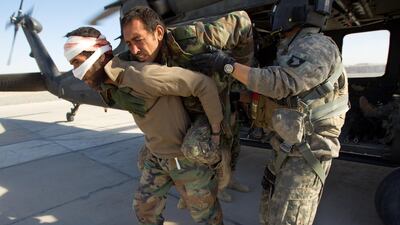
Sergeant Jay Kenney, 26, with the 101st Airborne Division, Task Force Destiny, assists wounded Afghan National Army (ANA) soldiers off the Blackhawk UH-60A helicopter after they were rescued in an air mission in Kandahar on December 12, 2010 in Kandahar province, Afghanistan. Getty Images -
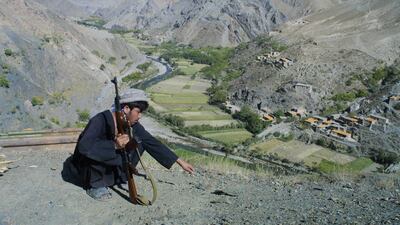
An Afghan Northern Alliance fighter mans the front line against the Taliban on October 2, 2001 near Jabul os Sarache, 30 miles north of Kabul. Getty Images -
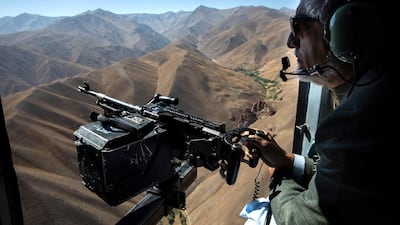
Abdullah Abdullah, chief executive of Afghanistan travelling via helicopter for the final campaign rally in Bamiyan, Afghanistan on September 25, 2019. Afghans will head to the polls on Saturday, September 28th. Getty Images -
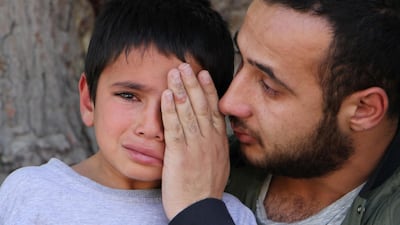
Mustafa Tamanna, 10, son of Afghan reporter Zabihullah Tamanna, weeps during the funeral ceremony in Kabul, Afghanistan on June 7, 2016. Tamanna was killed by a rocket-propelled grenade fired by the Taliban. Getty Images -
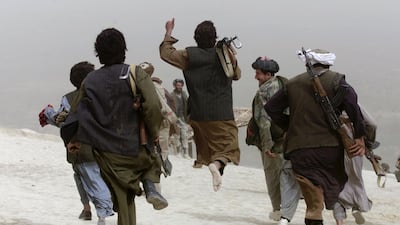
Northern Alliance soldiers come back from the front line after a battle near Charatoy town in the north of Afghanistan on October 10, 2001. REUTERS -
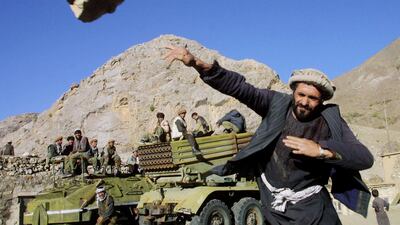
A Northern Alliance fighter throwing rocks as part of a popular national game yards away from a multiple Grad missile launcher in October 12, 2001 in the Salang Gorge in Northern Afghanistan. Getty Images -
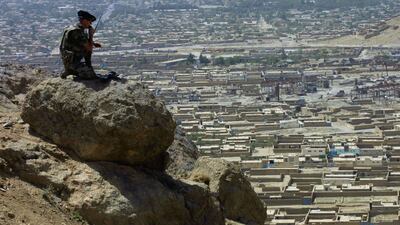
A French soldier from the 7th Mountain Regiment, part of the International Security and Assistance Force (ISAF) stands on a boulder overlooking Kabul during a patrol August 3, 2002 in Afghanistan. The ISAF has been patrolling Kabul since January 2002, working with the government and a new police force to prevent the violence and lawlessness that threatened to engulf the city after a U.S.-led coalition forced the Taliban from power. Getty Images -
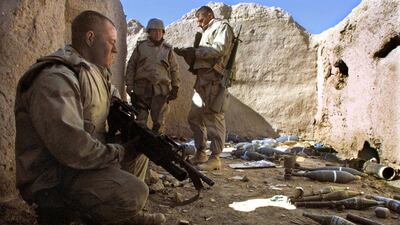
US Marine Sgt. Jerry Brown (L) of Jacksonville, North Carolina watches over a weapons cache found during a patrol near the American military compound at Kandahar Airport in January 16, 2002 in Kandahar, Afghanistan. The Marines recovered mortars, rockets, rocket-propelled grenades and artillery rounds discovered in various caches near the base while on the patrol. Getty Images) -
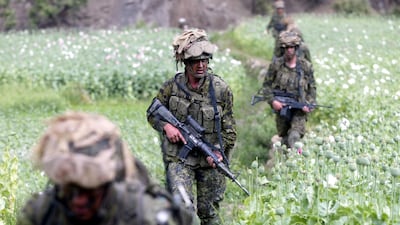
Members of the Princess Patricia's Canadian Light Infantry patrol through poppy fields in the village of Markhanai in May 6, 2002 in the Tora Bora valley region of Afghanistan. Getty Images -
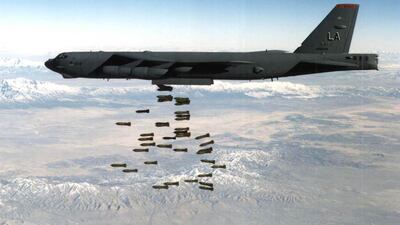
The United States and Britain on October 7, 2001 launched a first wave of air strikes against Afghanistan. President George W. Bush said the action heralded a "sustained, comprehensive and relentless" campaign against terrorism. REUTERS -
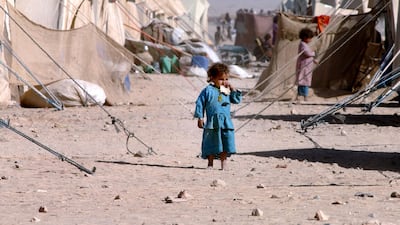
A young Afghan girl eats a piece of bread at the Chaman refugee camp on November 8, 2001 on the Pakistan border with Afghanistan. The UNHCR has estimated that since September 11, 2001 over 135,000 Afghans have crossed the border into Pakistan, adding to the already millions of refugees living in the country. Getty Images -
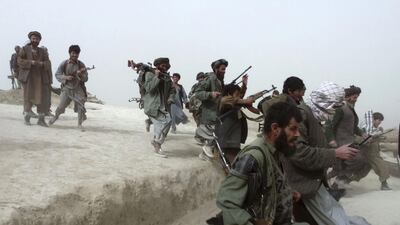
Afghan opposition Northern Alliance soldiers leap over a trench as they return from front line positions after battle near the town of Charatoy in the north of Afghanistan October 10, 2001. REUTERS -
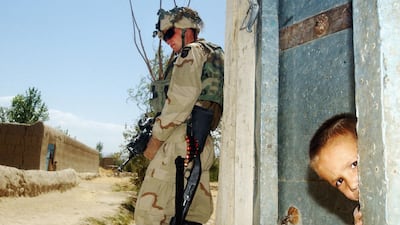
An Afghan child peeks out from the doorway of his family's home as a US Army soldier from the 101st Airborne stands guard in the eastern Afghan village of Hesarak on July 16, 2002 during what the Army refers to as a 'sensitive site exploitation' mission or 'SSE'. Getty Images -
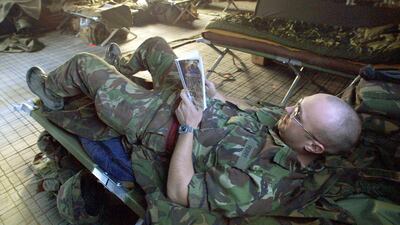
Fred Perry, a British Royal Engineer soldier, reads the book "Black Hawk Down" inside his tent after a day of work on January 29, 2002 at the International Security Assistance Force (ISAF) barracks at the Kabul airport in Kabul, Afghanistan. Getty Images -
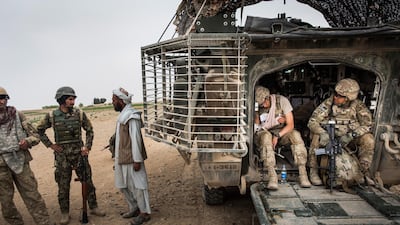
Afghan soldiers (L) speak to a local Afghan, while a medic in the U.S. Army's 1st Battalion, 36th Infantry Regiment, Charlie Company (R) monitors a soldier who has just survived a blast from an improvised explosive device (IED) while driving a vehicle during a mission near Command Outpost Pa'in Kalay, on March 19, 2013 in Kandahar Province, Maiwand District, Afghanistan. Getty Images -

Marines on a light armored vehicle prepare for patrol as an AH1W "Super Cobra" helicopter flies by on December 28, 2001 at the U.S. Marine Corps Base in Kandahar, Afghanistan. Getty Images -
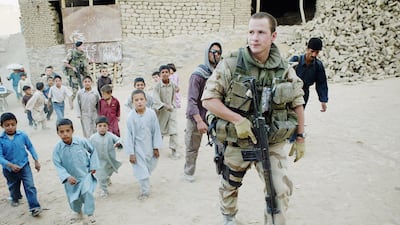
A Norwegian ISAF (International Security Assistance Force)soldier from Recce Squadron 3 patrols on October 4, 2004 in Kabul, Afghanistan as election officials get ready for the Presidential elections. Getty Images -
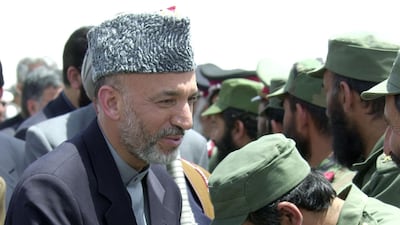
Interim Afghan leader Hamid Karzai (L) is greeted by a group of Afghan military officers on his arrival to Kandahar airbase on May 04, 2002 in Southern Afghanistan. Getty Images -
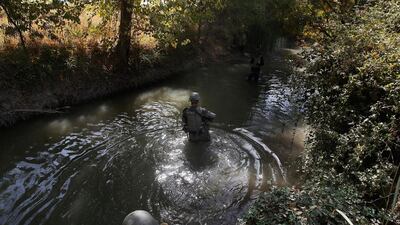
Soldiers in the U.S. Army's 101st Airborne Division wade though a creek to avoid buried insurgent bombs while on patrol October 16, 2010 in Zhari district west of Kandahar, Afghanistan. Getty Images -

British commandos descend from a mountain observation post overlooking the beginning of the Helmand River at the Kajaki hydroelectric dam on March 13, 2007 in Afghanistan's southern Helmand province. Getty Images -
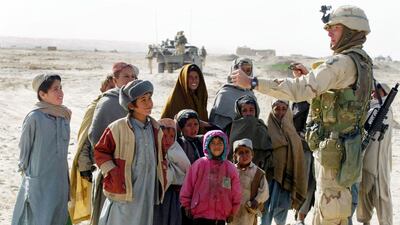
101st Airbornes 1st Sgt. Kerry Black from Westmoreland, Tennessee uses an Afghan child's sling shot on February 6, 2002 as children crowd around him while he patrols on the outskirts of Kandahar, Afghanistan. Getty Images -

Marine Cpl. Jonathan Eckert of Oak Lawn, IL attached to India Battery, 3rd Battalion, 12th Marine Regiment works his improvised explosive device (IED) sniffing dog Bee as they secure a compound during a patrol near Forward Operating Base (FOB) Zeebrugge on October 11, 2010 in Kajaki, Afghanistan. Getty Images -
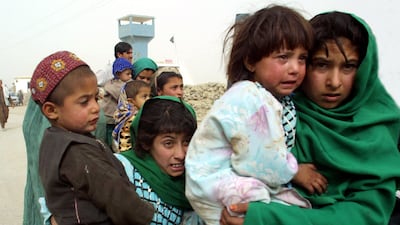
Afghan refugees walk across the border into Pakistan on October 11, 2001 as they leave Afghanistan at the Chaman crossing point on the 4th day of U.S.-led air strikes against the ruling Taliban and terrorist networks in the country. Getty Images -

Anti-Taliban Afghan fighters watch several explosions from U.S. bombings in the Tora Bora mountains in Afghanistan on December 16, 2001. -
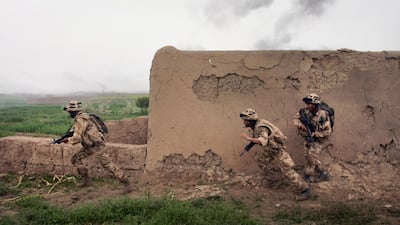
British Marines run under fire from the Taliban during a morning operation on March 18, 2007 near Kajaki in the Afghan province of Helmand. Getty Images -

Afghan Army troops prepare to board a British chinook helicopter from their base at Shorabak on March 12, 2007 in Southern Helmand province, Afghanistan. Getty Images -
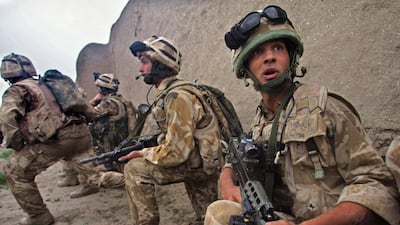
British Marine Joe Harvey from Stafford, England (R), watches as British forces come under fire by Taliban insurgents on March 18, 2007 near Kajaki in the Afghan province of Helmand. Getty Images -

U.S. Army 101st Airborne 3-187 "Bravo" company soliders pass through a corn field while conducting a sensitive site exploitation (SSE) mission July 23, 2002 near the town of Narizah in Southeastern Afghanistan. Getty Images -
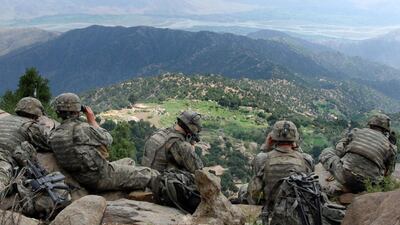
Scouts from 2nd Battalion, 503rd Infantry Regiment (Airborne), pull overwatch during Operation Destined Strike while 2nd Platoon, Able Company searches a village below the Chowkay Valley in Kunar Province, Afghanistan on August 22, 2006. US Army


Fardeen Barekzai, 25, who joined the circus when it started in 2002, a year after the Taliban’s fall and US-led invasion, experienced just that.
“I was working as a shoeshine boy, sold toilet paper or cleaned cars,” he recalls. “Kabul was going through massive changes after the Taliban left the city, and my parents were poor. I spent most of my childhood outside, working. Back when the circus started, I was pretty much picked up from the streets.”
It all started with a Danish journalist who came up with the idea 18 years ago. Since then the project has been Afghan-led and, over the years, had more than 2.7 million children participating throughout the country. Dozens still attend Kabul’s circus daily.
Barekzai, who now manages the circus, was able to finish his own education and later went on to university in Europe. When he was a child, the circus organisers made sure his family was coping without needing him to work.
Years later, upon his return to Afghanistan, there was little question of what he’d do. “Working on the streets robbed me of my childhood. I don’t want the same to happen to more children today,” he says. “That’s why I knew I wanted to get involved with the circus full-time.”
It’s a daily burst of colour as dozens of children run through the courtyard, practising stunts and performances, chasing one another or collaborating to work on paintings and crafts. Anyone is welcome here, as long as their parents agree.
Rabia, 15, is one of them. She went from working to support her family to becoming Afghanistan’s best juggler. Today she’s competing internationally and showing off her skills. She’s travelled to Italy and Germany on several occasions and has performed more than a hundred times.
At the circus, she stands on a gymnastic ball, focused on balancing five clubs or seven balls. Growing up in a crowded Kabul neighbourhood, she passed the circus’s colourfully painted shipping containers one day and heard loud voices of children on the other side of the gate. It piqued her curiosity.
Rabia’s smile is contagious as she details what happened next. She’s worked hard on her juggling skills but has also been able to attend school. Travelling to Italy two years ago was her first visit abroad; since then she’s been on the road regularly.
"It's not always easy for girls in Afghanistan," Rabia told The National, "so there's one thing I want to do: I want to show other girls that anything is possible if you fight for it."
Life for both girls and women is often difficult in Afghanistan, with 30 to 40 per cent of girls married before the age of 18, according to Unicef. The peace deal between Washington and the Taliban that could lead to a complete withdrawal of US troops in the next 14 months makes many girls and women worry about their future.
The agreement was supposed to pave the way for direct negotiations between the militants and the Afghan government, but Afghans worry that a return of the Taliban could bring bleak times. There still is no date for direct talks between the two sides.
“It’s difficult. The country is dangerous and there are few spaces for children – especially for girls – to come together,” Barekzai explains. “We’ve created a rare, fun and positive environment for all children. It’s a creative approach, it’s different from anything else we’ve seen in the country, but we’re teaching children to respect each other and to treat each other as equals.”
Smaller circuses have mushroomed across Afghanistan since the start of the mobile mini circus for children in Kabul. “We regularly tour the country’s provinces and perform, and many have copied our model,” Barekzai says.
Ahmed, 10, who has taken up tightrope walking, says Rabia is who he strives to be like. He has come to the circus every day for the past year, leaving his job selling plastic bags in one of Kabul’s most crowded markets. “It was scary,” he admitted. “Sometimes people would beat us and yell at us. Sometimes we heard gunshots and explosions.”
Rabia has made it far, he says, and he hopes to do the same.
“Before coming here, making money for my family was the only thing on my mind,” he says. “This has changed. I have many dreams for the future.”

