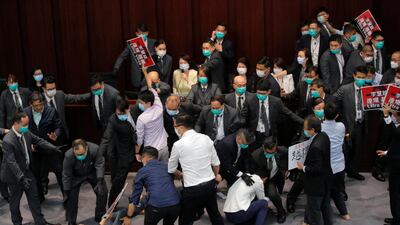
Rival Hong Kong politicians clashed on Friday inside the city's legislature which has been paralysed for seven months as pro-democracy politicians attempt to scupper a controversial law that bans insulting China's national anthem.
The chaotic scenes come weeks after Beijing sparked a constitutional row by calling for filibustering opposition politicians to be removed from office.
Pro-democracy lawmakers are trying to stop bills progressing to a vote in order to scuttle the anthem law.
The delays triggered angry denunciations last month from the Liaison Office, which represents Beijing in the semi-autonomous city.
Friday's clashes were sparked by a row over who gets to control the House Committee, which scrutinises bills before they go to the floor and has been without a committee leader since October.
For months pro-democracy politicians have halted the election of a president – one of the few weapons in their arsenal in the partly elected legislature that is deliberately stacked in Beijing's favour.
On Friday afternoon prominent pro-Beijing politician Starry Lee took the leader's seat after legal advice from government lawyers said she was empowered to break the deadlock.
But pro-democracy politicians, armed with their own rival legal advice, accused her of breaching the rules.
Mayhem ensued with security guards and pro-Beijing lawmakers surrounding Ms Lee as their opponents tried to access the rostrum – with one even trying to climb a wall behind them.
Security officials later dragged a number of pro-democracy lawmakers from the chamber as both camps thrust live-streaming phones and protest placards in each others' faces.
Beijing has been incensed by the paralysis and last month suggested pro-democracy politicians should be prosecuted.
Those comments sparked accusations the Liaison Office had breached a provision in the city's constitution banning the Chinese government from interfering in how Hong Kong runs itself.
The Liaison Office promptly announced it was not bound by the constitution, raising political tensions further.
The argument comes as protests begin to bubble up in Hong Kong once more.
The city was upended by seven months of violent pro-democracy protests last year. But mass arrests and the coronavirus pandemic imposed four months of comparative calm.
Shortly after the Liaison Office statements small flashmob protests rekindled, including a lunchtime rally on Friday in an upmarket mall. The latest gatherings have been swiftly put down by riot police.
Hong Kong is in a deep political crisis over its future.
Large chunks of the population fear Beijing is eroding the city's freedoms and have hit the streets in their millions asking for universal suffrage.
Beijing has dismissed those demands and the growing public anger, portraying the political unrest as a foreign-sponsored plot to destabilise the Chinese Communist Party.

Ten tax points to be aware of in 2026
1. Domestic VAT refund amendments: request your refund within five years
If a business does not apply for the refund on time, they lose their credit.
2. E-invoicing in the UAE
Businesses should continue preparing for the implementation of e-invoicing in the UAE, with 2026 a preparation and transition period ahead of phased mandatory adoption.
3. More tax audits
Tax authorities are increasingly using data already available across multiple filings to identify audit risks.
4. More beneficial VAT and excise tax penalty regime
Tax disputes are expected to become more frequent and more structured, with clearer administrative objection and appeal processes. The UAE has adopted a new penalty regime for VAT and excise disputes, which now mirrors the penalty regime for corporate tax.
5. Greater emphasis on statutory audit
There is a greater need for the accuracy of financial statements. The International Financial Reporting Standards standards need to be strictly adhered to and, as a result, the quality of the audits will need to increase.
6. Further transfer pricing enforcement
Transfer pricing enforcement, which refers to the practice of establishing prices for internal transactions between related entities, is expected to broaden in scope. The UAE will shortly open the possibility to negotiate advance pricing agreements, or essentially rulings for transfer pricing purposes.
7. Limited time periods for audits
Recent amendments also introduce a default five-year limitation period for tax audits and assessments, subject to specific statutory exceptions. While the standard audit and assessment period is five years, this may be extended to up to 15 years in cases involving fraud or tax evasion.
8. Pillar 2 implementation
Many multinational groups will begin to feel the practical effect of the Domestic Minimum Top-Up Tax (DMTT), the UAE's implementation of the OECD’s global minimum tax under Pillar 2. While the rules apply for financial years starting on or after January 1, 2025, it is 2026 that marks the transition to an operational phase.
9. Reduced compliance obligations for imported goods and services
Businesses that apply the reverse-charge mechanism for VAT purposes in the UAE may benefit from reduced compliance obligations.
10. Substance and CbC reporting focus
Tax authorities are expected to continue strengthening the enforcement of economic substance and Country-by-Country (CbC) reporting frameworks. In the UAE, these regimes are increasingly being used as risk-assessment tools, providing tax authorities with a comprehensive view of multinational groups’ global footprints and enabling them to assess whether profits are aligned with real economic activity.
Contributed by Thomas Vanhee and Hend Rashwan, Aurifer
Essentials
The flights
Etihad and Emirates fly direct from the UAE to Delhi from about Dh950 return including taxes.
The hotels
Double rooms at Tijara Fort-Palace cost from 6,670 rupees (Dh377), including breakfast.
Doubles at Fort Bishangarh cost from 29,030 rupees (Dh1,641), including breakfast. Doubles at Narendra Bhawan cost from 15,360 rupees (Dh869). Doubles at Chanoud Garh cost from 19,840 rupees (Dh1,122), full board. Doubles at Fort Begu cost from 10,000 rupees (Dh565), including breakfast.
The tours
Amar Grover travelled with Wild Frontiers. A tailor-made, nine-day itinerary via New Delhi, with one night in Tijara and two nights in each of the remaining properties, including car/driver, costs from £1,445 (Dh6,968) per person.
RACE CARD
6.30pm: Maiden (TB) Dh82,500 (Dirt) 1,200m
7.05pm: Maiden (TB) Dh82,500 (D) 1,900m
7.40pm: Handicap (TB) Dh102,500 (D) 2,000m
8.15pm: Conditions (TB) Dh120,000 (D) 1,600m
8.50pm: Handicap (TB) Dh95,000 (D) 1,600m
9.25pm: Handicap (TB) Dh87,500 (D) 1,400m
