


India and the US failed to clinch a new trade agreement after President Donald Trump concluded a whirlwind visit but a $3 billion military equipment deal was signed.
Mr Trump was given a rousing welcome by Prime Minister Narendra Modi in his home state of Gujarat on Monday, with the leaders praising each other in front of a crowd of more than 100,000 crowd at the world’s biggest cricket stadium.
The leaders held talks on Tuesday and said they had made “tremendous progress” on a comprehensive trade deal.
But they gave no details or deadlines amid a simmering trade war in which each has imposed tariffs.
"If they want to deal with us and they will, they are going to just like China," Mr Trump said in New Delhi.
He said the two countries were aiming for a deal that would be “of great importance to both the countries” and called Mr Modi a “terrific leader” with whom he shares a “really great relationship”.
But behind the bonhomie, there are ongoing tensions.
Mr Trump has penalised India in recent months by imposing tariffs on steel and aluminium, and scrapping decades-old duty-free access to US markets in a bid to close a $25bn (Dh91.83bn) trade deficit with world’s fifth largest economy.
Commentators predicted the visit would be high on pomp and pageantry, despite the leaders pulling out all stops to show a personal camaraderie that goes beyond ceremonial courtesy.
But the lack of trade deal did not deter the two countries from deepening their military and strategic relationship as they look to control China’s growing influence in the region.
Mr Trump said New Delhi agreed to buy US military equipment worth more than $3bn, including attack helicopters and naval reconnaissance planes.
New Delhi has become a cornerstone of US policy in the region as it seeks to curb Beijing's expansion, including in the South China Sea, which is a key channel for global trade.
"The strengthening in defence ties between India and the US is an important aspect of our partnership," Mr Modi said in New Delhi.
Agreements on mental health, medical products and a pact between India's state oil giant and Exxon Mobil for transporting natural gas were also signed to boost relations.
Both leaders said they resolved to fight terrorism to secure the lives of their citizens.
Mr Trump praised himself for unparalleled success in the fight against ISIS while calling on other countries, including Iran and Russia, to take on the radicals.
“Iran hates ISIS. And they should do it,” he said.
But Mr Trump called dead Iranian top commander Qassem Suleimani the “father and king of roadside bombs”, and said he maimed thousands of young people with “coward bombs”.
Suleimani was killed in a US missile attack in Iraq’s capital Baghdad last January amid allegations that he was planning attacks on American assets in Syria and Iraq.
Mr Trump said US troops had done a "big favour" in arresting tens of thousands of ISIS fighters, who are under Kurdish custody in Syria, and asked European countries to take their nationals back.
On Afghanistan, he said he did not want to kill millions of innocent people to win the war and expressed his satisfaction with the planned peace deal and the prospect of seeing American soldiers leave the country.
Mr Trump described the country as a hotbed of problems and said it would remain under US watch. He said he would hit the Taliban hard if they breached any deal.
He also repeated his offer to mediate between India and Pakistan over Kashmir, and said he was working productively with Islamabad to confront militants operating on its soil.
India accuses Pakistan of supporting militants in Kashmir, which is claimed by both countries. India has refused third-party negotiations.
-

US President Donald Trump and First Lady Melania Trump visit the Taj Mahal in Agra, India. AFP -
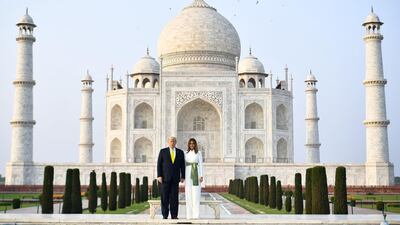
US President Donald Trump and First Lady Melania Trump pose in front of Taj Mahal. AFP -
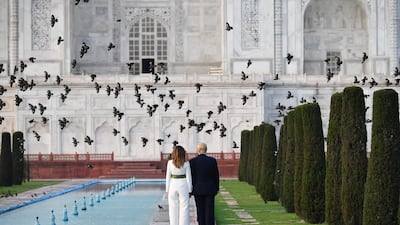
US President Donald Trump and First Lady Melania Trump visit the Taj Mahal. AFP -
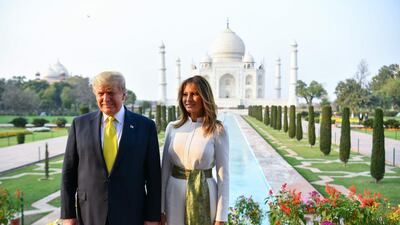
US President Donald Trump and First Lady Melania Trump pose in front of Taj Mahal. -

US President Donald Trump and First Lady Melania Trump tour the Taj Mahal. Reuters -
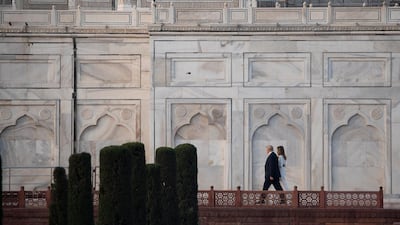
US President Donald Trump and First Lady Melania Trump tour the Taj Mahal. AP Photo -
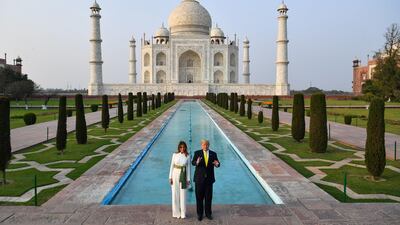
US President Donald Trump and First Lady Melania Trump stand in front of Taj Mahal.


Mr Trump said he was "awed by the majesty of India and the exceptional generosity and kindness of the Indian people" during the tour, on which he is was accompanied by his wife Melania.
The couple began the trip with a ceremonial welcome at the Presidential House and laid a wreath at the memorial of Mahatma Gandhi in New Delhi. The Trumps flew to the capital city late on Monday after a sunset visit to the Taj Mahal.
The first lady then attended "happiness classes" at a government school in New Delhi on Tuesday and interacted with the pupils as part of her "Be Best" campaign.
The school visit was just miles from the site of deadly clashes between Hindus and Muslims, which have killed at least 13 people, including a policeman.
Scores of homes, businesses and vehicles have been torched by mobs in violence that started on Sunday after right-wing Hindu groups objected to a protest march by a largely Muslim crowd over a controversial citizenship law.
Mr Modi passed the law in December to help non-Muslim minorities take up Indian citizenship.
Opponents say the law is against India's secular image and is part of a larger plot by Mr Modi's Hindu nationalist party to turn India into a Hindu state.
Hundreds of thousands have since rallied across India, with at least 30 people killed in December during clashes with police.
Mr Modi has accused opponents of stoking fears about the law and Muslim groups of fomenting street violence.
Mr Trump said he raised the issue of religious freedom in the world’s second most populous nation and said Mr Modi “wants people to have religious freedom”.
He refused to answer questions on the controversial law and violence, saying he would “leave that to India and hopefully they will make the right decision for the people".

