
An Indian hospital is demanding Muslim patients and their attendants get coronavirus clearance certificates before being admitted for treatment as cases of religious discrimination and bigotry against the community rise during the global pandemic.
India has seen a growing number of cases in which Muslims are being discriminated against and attacked. The violence stems from a widespread but unfounded belief among the majority Hindu population that the minority Muslim community is “deliberately” spreading the virus to derail the country’s efforts to stem the infection.
Valentis Cancer hospital in the northern city of Meerut issued a newspaper advertisement last Thursday announcing it will not admit Muslim patients unless they produce medical certificates confirming they are free of the virus.
“Hospital administration requests new Muslim patients to get themselves and their attendants checked and only come to the hospital for treatment when their report comes back negative,” read the advertisement in a widely circulated Hindi newspaper of the northern Uttar Pradesh state.
The 11-point notice argued that the measure was needed to ensure the safety and security of staff, following allegations that Muslims were hiding symptoms of the infectious disease and in some cases attacking healthcare providers.
Days earlier, the government-run Ahmedabad Civil Hospital in western Gujarat state was accused of segregating coronavirus patients on the basis of their religion.
But in a tweet, Prime Minister Narendra Modi's office said: “Covid-19 does not see race, religion, colour, caste, creed, language or borders before striking. Our response and conduct thereafter should attach primacy to unity and brotherhood."
Officials and several right-wing Hindu television news channels have vociferously campaigned against Tablighi Jamaat, a Muslim group accused of holding a massive gathering in Delhi in defiance of government orders.
A hate campaign on mainstream and social media that likened Muslims to "human bombs" and accused them of "corona jihad" has led to physical attacks on the community and calls for a social and economic boycott in India as it recovers from deadly religious riots that pitted the two groups against each other and killed more than 50 people – most of them Muslims – in February.
Videos purportedly showing Muslim vegetable vendors licking their produce or injecting food with saliva have been circulated on social media along with calls to stop doing business with the community. Fact-checking websites confirmed that many of the spitting videos are either old or from other countries.
Several Muslim vendors have been beaten by Hindu residents or banned from entering localities as local gangs encourage Hindu vendors to attach saffron-coloured flags to pushcarts to identity themselves as non-Muslims.
"Because of Tablighi Jamaat, some people were not coming out… our Muslim brothers and sisters are being misguided, they are not coming forward and so this virus has spread in certain communities," Dr Vijay Gupta, an oncologist and spokesman for the private cancer hospital, told The National.
Thousands of Jamaat members attended a religious congregation at their headquarters in mid-March despite health warnings and social distancing protocols, making it one of the single biggest sources of infection cases in the country, the government claimed.
-

A motorist rides past graffiti painted on a road to raise awareness about coronavirus. AFP -
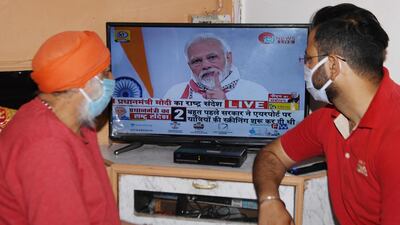
Residents wearing face masks watch Mr Modi's address to the nation r. AFP -
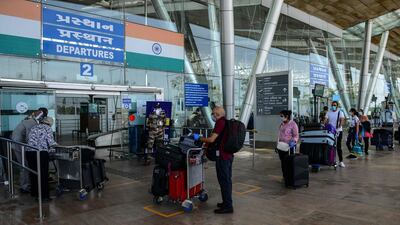
British nationals queue up outside a departures terminal before boarding a special British Airways flight at the Sardar Vallabhbhai Patel International (SVPI) airport in Ahmedabad. AFP -

Deserted commercial hub Connaught Place as India remains under an unprecedented lockdown. Getty -
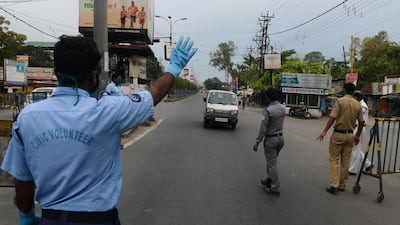
Police personnel and civic volunteers stop a vehicle at a checkpoint during a government-imposed nationwide lockdown in Siliguri. AFP -
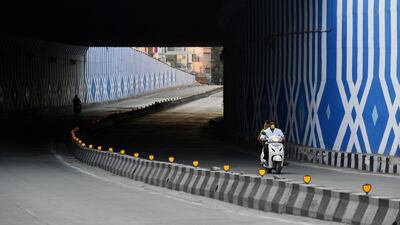
Motorists ride along a deserted road during the government-imposed nationwide lockdown against the spread of coronavirus, in Bangalore. AFP -
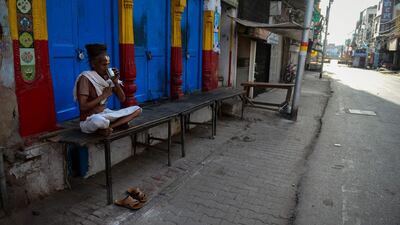
A man drinks tea outside his home during the lockdown n Allahabad. AFP -
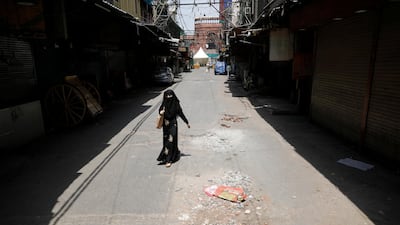
A woman walks on a deserted street in the old quarters of Delhi, India. Reuters -
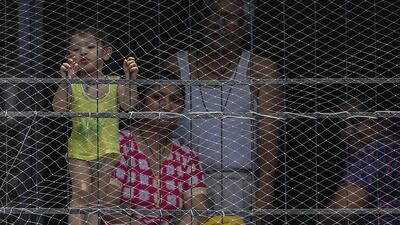
Maharashtra state announced lockdown to stem the widespread of the SARS-CoV-2 coronavirus, which causes the COVID-19 disease. EPA -

A Kashmiri laborer pushes a hand card filled with cooking gas cylinders before delivering them during a lockdown in Srinagar. AP -

People walk along a street of a residential area during a government-imposed nationwide lockdown as a preventive measure against the Covid-19 coronavirus, in Siliguri. AFP


Officials say more than 4,200 attendees and their contacts are among the country’s 17,265 positive cases and several of the attendees have died. India's coronavirus death toll stood at 559 on Monday, with 17,615 confirmed cases of the disease.
Police charged the chief cleric of Tablighi Jamaat with manslaughter and many members were arrested across the country on charges of hiding their medical and travel history from the congregation.
Incidents of health workers being attacked or pelted with stones and spat at by Muslims have also been reported in the country, where tensions between Hindus and Muslims have been rising since Prime Minister Narendra Modi came to power in 2014.
Critics have accused Mr Modi and his Hindu nationalist government of pursing a majority-centric policy and marginalising the 200 million Muslim community.
The United States Commission on International Religious Freedom condemned the segregation of the patients in a Ahmedabad hospital, which is in Mr Modi’s home state of Gujarat.
Hindu and Muslim coronavirus patients were reportedly assigned to separate hospital wards, but the government has denied any discrimination in a statement following the news report.
Hospital sources said the patients were placed in wards according to their place of residence, which could naturally segregate patients based on their faith in a country where communities live in distinct localities.
"There is no religious segregation of patients. We are admitting people based on their location," Dr Devang Raval, head of community medicine at Ahmedabad Civil Hospital told The National.
Commentators say the trend shows that Hindu majoritarianism has gripped the country during the pandemic but said they are more worried that health professionals are denying medical care to Muslims in violation of the Hippocratic Oath.
“Unethical is a small word, it is criminal… Majoritarianism has become a trend and it is dangerous for the social fabric of the country,” said Dr Shah Alam Khan, professor of Orthopaedics in New Delhi and a commentator on Muslim affairs.
“The community has its own intrinsic problems like poverty and illiteracy there is no doubt, but if the community is not behaving well, do you want to kill the community? Discriminate against it, annihilate it? No.”

