


In June, India began using cheaper, faster but less accurate tests to scale up its fight against the coronavirus, but scientists said it might be missing cases and leading to a spread of clusters.
The warnings came as India on Sunday passed 3 million cases of Covid-19 and the virus marches through impoverished rural areas in the north and the wealthier but older populations of the south.
Health authorities reported 10,339 more cases and 912 deaths, taking the total to 3,044,940. The number of new infections reported on Sunday marked a sharp decline from the previous 18 days, when India had reported more than 60,000 cases daily.
India has the third-highest caseload after the United States and Brazil, and its 56,706 fatalities are the fourth-highest in the world.
The rapid tests improved India’s screening levels nearly five-fold within two months. But government numbers suggested that some parts might have become over-reliant on the faster tests, which can miss infections. Scientists said that using them safely required frequent retesting, something that was not always taking place.
Cases surged faster than labs could increase testing once India’s strict lockdown was relaxed. So far, authorities have rationed the use of the more precise molecular tests that detect the genetic code of the virus. But on June 14, India decided to bolster these with faster kinds that screen for antigens, or viral proteins.
While less accurate, these tests are cheap and yield results in minutes. Most do not require a lab for processing or any specialised equipment or trained personnel. The plan was to rapidly increase testing to identify infected people and prevent them from spreading the virus. Use of both increased from 5.6 million in mid-June to 26 million two months later, and nearly a third of all tests conducted daily were now the antigen kind, health officials said.
But India’s experience also highlighted the inherent pitfalls of relying too heavily on antigen tests at the expense of the more accurate. The danger is that the tests may falsely clear many who are infected with Covid-19, contributing to spread of the virus.
Rapid test results can be augmented with more accurate laboratory procedures, but these are slower and expensive. Scientists said that since the two types vary in accuracy, they need to be interpreted separately to properly assess the spread of infection – something India is not doing.
-
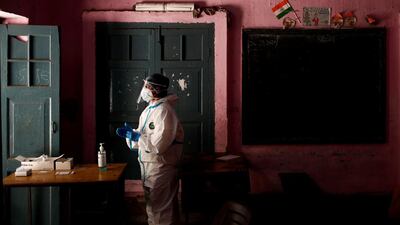
A medical worker waits for the next person to get tested at a school turned into a centre to conduct tests for coronavirus in New Delhi, India. Reuters -
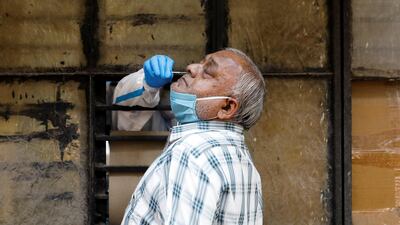
A medical worker collects a sample from a man at a school turned into a centre in New Delhi. Reuters -
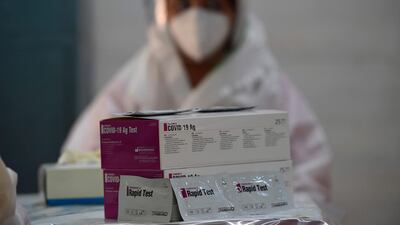
A medical worker waits for people to be tested with rapid antigen test (RAT) for the Covid-19 coronavirus in New Delhi. AFP -
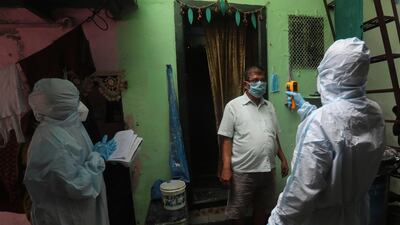
A doctor checks the temperature of a man during a free medical camp in Dharavi, one of Asia's largest slums, in Mumbai. AP -
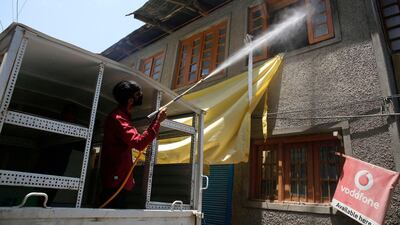
A government municipal worker sprays disinfectant in area during a funeral in Srinagar. EPA -
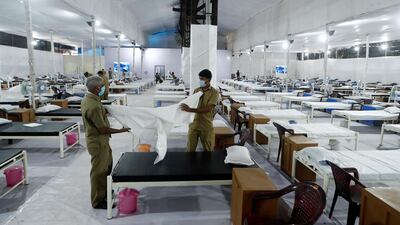
Workers prepare a bed at a recently constructed quarantine facility for patients diagnosed with the Covid-19 in Mumbai. Reuters -

A Hindu devotee performs rituals in Mumbai. AP -
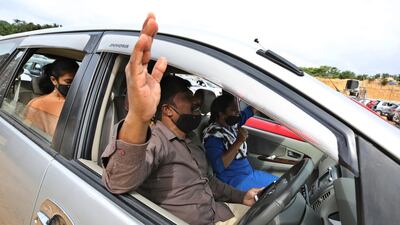
Faithful attend a drive-in mass in an open area of Bethel AG Church as part of maintaining social distancing to prevent the spread of coronavirus in Bengaluru. AP -
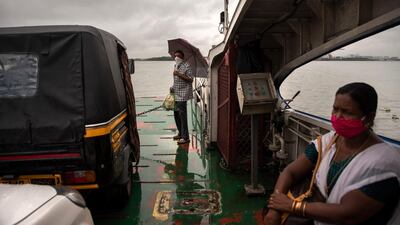
Commuters travel in a ferry during rain in Kochi, Kerala state. AP -
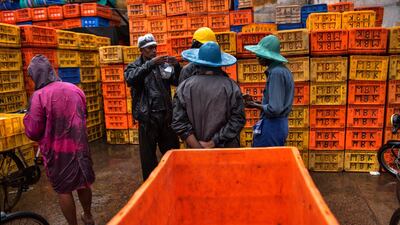
A man prepares to wear his mask as fish vendors chat on a rainy day in Kochi, Kerala state. AP -

A boy exercises at a park after a few restrictions were relaxed during a lockdown in Mumbai. Reuters -
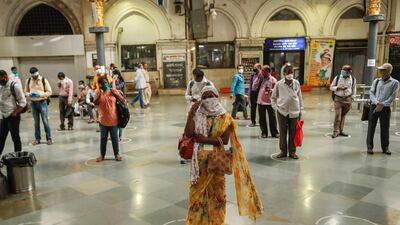
Commuters stand inside circles to maintain social distancing as they wait to board a train at a railway station after some restrictions were lifted in Mumbai. Reuters -
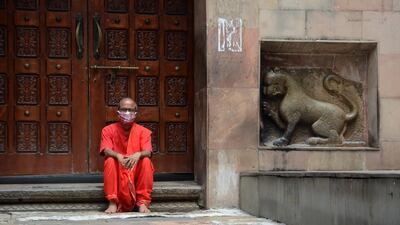
The President of Kamakhya Temple Committee in front of the main entrance gate of Kamakhya temple. AFP


The US faces a similar need to strike a balance between speed and precision, with laboratories struggling to keep pace with the outbreak. Researchers at Harvard University proposed developing a $1 saliva-based antigen test for all Americans to test themselves daily, which has not yet been approved by the Food and Drug Administration.
Harvard’s Dr Michael Mina said antigen tests do not catch as many patients early in the infection, when virus levels are low. But these people were not considered the greatest threat to spreading the disease because it is only after virus levels surge that they become more infectious, and by then they will be picked up by antigen tests, he said.
Because a negative antigen test does not guarantee a person is virus free, people should be called in regularly, said Dr Ashish Jha, director of Harvard’s Global Health Institute. “If their symptoms change, you want to think about retesting those people.”
India’s strategy is different. Health officials have asked for those who are found coronavirus negative with antigen tests but have symptoms to be reassessed with the more accurate laboratory tests.
But India has largely been opaque about how many negatives were retested, and what methods were used.
Delhi state, which includes the Indian capital of New Delhi, and where the High Court is monitoring testing, was among the first to aggressively use antigen tests to screen patients free of charge. Centres were created in dispensaries, schools and government offices. But only 0.5 per cent, or 1,365 of more than 260,000 people who were found to be negative from June 18 to July 29, were retested, court documents showed. Delhi conducted more than 280,000 tests in this period.
“That is abysmally low,” said Dr SP Kalantri, a public health specialist in Maharashtra, India’s worst-hit state. He said the decline in use of more precise lab tests by nearly half, from a capacity of 11,000 daily to 5,400 per day, was a worrying trend.
Under guidelines set by the World Health Organisation, India should be conducting around 140 daily tests per million people in order to safely relax coronavirus restrictions.
Rajesh Bhushan, India’s senior health official, has pointed to India’s cumulative total of the two types of test to assert that it is exceeding the WHO standard. Authorities also used this to calculate the percentage of samples proving positive, which is a key metric for judging performance.
But Dr Jha said combined data from the two types cannot be used to conclude that infections in India are going down, since using less accurate kinds would automatically drive down the number of positive results.
Scientists feared that over-reliance on antigen tests without retesting could impede efforts to contain the virus as it spreads to states with fragile health care systems, like Bihar and Uttar Pradesh, with a combined population of 300 million.
The two states now conduct about 100,000 tests daily, the most in India. But only a fraction – 6,100 in Bihar and 30,000 in Uttar Pradesh – use laboratory tests.
Dr Jha said the antigen tests were a way to expand the assessment of people who do not have access to laboratory tests, but that did not mean use of the more accurate version should decrease.
“I want both,” he said. The rapid test “isn’t a perfect substitute”.

