• Police at a traffic intersection wearing headgear themed on the Covid-19 coronavirus urge people to adopt safety protocols during an awareness drive in Hyderabad. AFP
    Police at a traffic intersection wearing headgear themed on the Covid-19 coronavirus urge people to adopt safety protocols during an awareness drive in Hyderabad. AFP
  • A health worker inoculates a woman with a dose of the Covishield vaccine against Covid-19 during a special vaccination programme at a government school in Hyderabad. AFP
    A health worker inoculates a woman with a dose of the Covishield vaccine against Covid-19 during a special vaccination programme at a government school in Hyderabad. AFP
  • People wait to receive food during a lockdown imposed against the spread of Covid-19, at Saint Marys Basilica in Secunderabad, the twin city of Hyderabad. AFP
    People wait to receive food during a lockdown imposed against the spread of Covid-19, at Saint Marys Basilica in Secunderabad, the twin city of Hyderabad. AFP
  • A girl carries food distributed for people in need during a coronavirus lockdown, at Saint Marys Basilica in Secunderabad, India. AFP
    A girl carries food distributed for people in need during a coronavirus lockdown, at Saint Marys Basilica in Secunderabad, India. AFP
  • Circles on the ground delimit physical distancing as people wait to register for a special vaccination programme against Covid-19 at a government school in Hyderabad. AFP
    Circles on the ground delimit physical distancing as people wait to register for a special vaccination programme against Covid-19 at a government school in Hyderabad. AFP
  • A doctor passes a banner in Hyderabad announcing a special vaccination programme against Covid-19. AFP
    A doctor passes a banner in Hyderabad announcing a special vaccination programme against Covid-19. AFP
  • Volunteers Akshaya, 22, right, a law student, and Esther Mary, 41, a lecturer, carry the body of a Covid-19 victim for burial at a cemetery in Bengaluru, India. Reuters
    Volunteers Akshaya, 22, right, a law student, and Esther Mary, 41, a lecturer, carry the body of a Covid-19 victim for burial at a cemetery in Bengaluru, India. Reuters
  • Family members of Vijay Raju, who died because of Covid-19, at his cremation in Giddenahalli village on the outskirts of Bengaluru, India. Reuters
    Family members of Vijay Raju, who died because of Covid-19, at his cremation in Giddenahalli village on the outskirts of Bengaluru, India. Reuters
  • A patient receiving treatment at a free Covid-19 centre in New Delhi displays a placard asking for help from volunteers. The centre is run by a Sikh voluntary organisation. AP Photo
    A patient receiving treatment at a free Covid-19 centre in New Delhi displays a placard asking for help from volunteers. The centre is run by a Sikh voluntary organisation. AP Photo
  • A health worker checks the body temperature of a traveller at a train station in Mumbai, India. AP Photo
    A health worker checks the body temperature of a traveller at a train station in Mumbai, India. AP Photo
  • People maintain physical distancing protocols while waiting to register for a vaccination programme against Covid-19 in Hyderabad. AFP
    People maintain physical distancing protocols while waiting to register for a vaccination programme against Covid-19 in Hyderabad. AFP

India's Covid-19 immunisation drive falters amid vaccine shortages


  • English
  • Arabic

India’s Supreme Court has criticised the government’s coronavirus vaccination programme as it continues to struggle with chronic vaccine shortages amid ongoing devastation from a severe wave of infections.

The country’s top court questioned the Modi government’s vaccine procurement policy, which has left vulnerable Indian states to fend for themselves in local and global markets amid a dramatic shortfall in local production.

“We are asking you to please wake up and smell the coffee and see what’s happening across the country,” the court told the government during a hearing on the Covid-19 crisis on Monday.

The three-judge bench asked the second highest law officer of the country whether it was the policy of the federal government to let states compete with each other in procuring vaccines.

“You can't just say that you're the centre and you know what's right. We have a strong arm to come down on this," Justice Dhananjaya Chandrachud told Tushar Mehta, the Solicitor General of India.

A day earlier, the government had promised to provide 120 million vaccine doses in June, but experts said it would not be enough to boost the vaccination drive among India's massive population.

The country of nearly 1.4 billion people had a meagre 80 million vaccine doses available in May, forcing many regions to curtail the immunisation drive that is considered key to defeating the raging pandemic.

Covid-19 has killed nearly 150,000 people in India since March.

India's government in January promised to give free vaccines to about 300 million people by the end of July – mostly health workers and those above the age of 45.

But the government rushed to roll out vaccinations for nearly 600 million people between the ages of 18 and 44 in May as the brutal wave of infections threatened to overwhelm the country’s healthcare system.

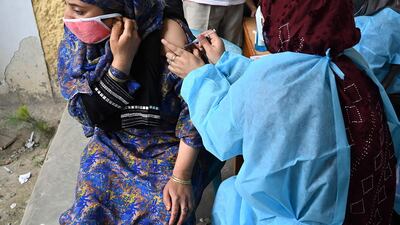
  • A health worker administers a dose of the Covaxin coronavirus vaccine to a woman at a centre in Srinagar, Jammu and Kashmir. AFP
    A health worker administers a dose of the Covaxin coronavirus vaccine to a woman at a centre in Srinagar, Jammu and Kashmir. AFP
  • A man with a pet parrot on his shoulder among senior citizens and health workers waiting to receive their first dose of Russia's Sputnik V vaccine in Caracas, Venezuela. Reuters
    A man with a pet parrot on his shoulder among senior citizens and health workers waiting to receive their first dose of Russia's Sputnik V vaccine in Caracas, Venezuela. Reuters
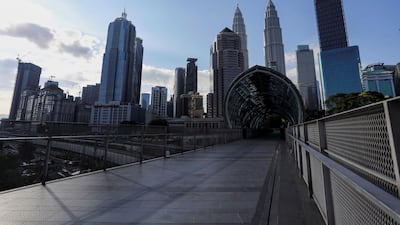
  • A bridge stands deserted during a lockdown imposed in Kuala Lumpur as Malaysia fights the coronavirus pandemic. Reuters
    A bridge stands deserted during a lockdown imposed in Kuala Lumpur as Malaysia fights the coronavirus pandemic. Reuters
  • A performer wears a face shield to guard against the virus during a ceremony at the Bangkok National Museum to celebrate the return of two ancient relics from the US which were believed to have been stolen from Thailand 60 years ago. Reuters
    A performer wears a face shield to guard against the virus during a ceremony at the Bangkok National Museum to celebrate the return of two ancient relics from the US which were believed to have been stolen from Thailand 60 years ago. Reuters
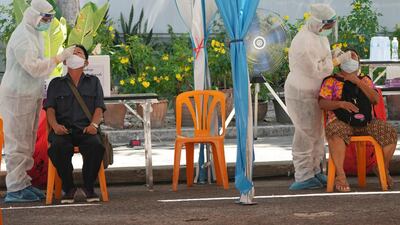
  • Health workers test residents for the coronavirus in Bangkok, Thailand. AP Photo
    Health workers test residents for the coronavirus in Bangkok, Thailand. AP Photo
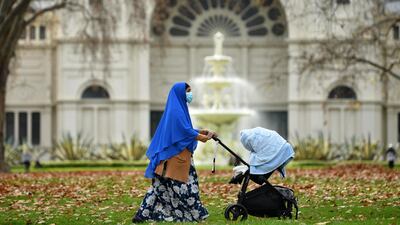
  • A woman wears a face mask in Melbourne, Australia. The state of Victoria recorded three new cases of coronavirus in the past 24 hours. EPA
    A woman wears a face mask in Melbourne, Australia. The state of Victoria recorded three new cases of coronavirus in the past 24 hours. EPA
  • A man receives a dose of Covid-19 vaccine in his vehicle at a drive-through vaccination center in Kuwait City, Kuwait. EPA
    A man receives a dose of Covid-19 vaccine in his vehicle at a drive-through vaccination center in Kuwait City, Kuwait. EPA

Experts say the knee-jerk announcement was taken without accounting for the availability of vaccines and derailed the vaccination programme.

The world's leading vaccine manufacturer, India has only administered 212 million shots, with only 44 million people having received both doses, according to health ministry data.

"Considering the vaccine supply was already short for those above 45 years of age, it was not wise to open up for the entire population. India should have waited before doing that," said Dr Chandrakant Lahariya, an independent Delhi-based vaccinologist.

Dr Lahariya told The National the 120 million doses for the month of June will help the country inoculate four million people a day but was still far below the target of 8-10 million daily vaccinations needed to help curb the raging pandemic.

Although infection rates have ebbed in recent days after hitting a peak of more than 400,000 new daily cases in early May, tens of thousands of new patients are being identified each day.

Despite being the world's largest producer of vaccines, India has only inoculated a small part of the population. AFP

On Monday, the country reported more than 150,000 cases, its lowest daily rise in nearly 50 days, with 3,100 deaths in 24 hours.

India's case tally exceeded 28 million, while the death toll since the pandemic beganpassed 325,000 amid fears of a third wave.

Experts say one of the major reasons for the crisis is that the local vaccine makers could not increase production to meet the huge demand when the federal government expanded the programme in May and asked states to procure doses on their own.

The country is administering two indigenously produced vaccines – Oxford-AstraZeneca’s Covishield produced by the Serum Institute of India (SII) and Bharat Biotech’s Covaxin – after they were given emergency approval in January.

The SII produces 65 million doses a month, while Bharat Biotech makes 20 million monthly, according to a government affidavit submitted to the Supreme Court.

"We will ramp up our production to 90 million by June and 100 million by July," a company official confirmed to The National.

India has also introduced Sputnik V on a smaller scale, with local production of the Russian vaccine due to begin in the coming months.

The country is also seeking vaccines from Pfizer and Moderna amid mounting pressure from critics, health experts and opposition parties.

Pfizer has shown interest in an arrangement for 50 million shots but the deal is being delayed over indemnification and other clauses, while Moderna is expected to enter the Indian market next year.

India's vaccine scramble comes months after Prime Minister Narendra Modi "gifted" about 66 million doses to other countries under its controversial "vaccine diplomacy" programme. The country stopped exporting doses in April, however.

Whether we will be able to keep to the timeline announced by the government and complete most vaccinations by the end of this year remains to be seen

India's External Affairs Minister Subrahmanyam Jaishankar last week flew to the US to seek its co-operation and iron out issues surrounding the import of Covid-19 vaccines and the raw materials needed to make them.

Last week, the government said it would provide two billion doses between August and December without giving a breakdown of the procurement plans.

But health experts say the government’s ambitious new target to vaccinate close to a billion people will face serious challenges, both in terms of production and procurement.

"Whether we will be able to keep to the timeline announced by the government and complete most vaccinations by the end of this year remains to be seen, because of the challenges of availability of vaccines and enough vaccination centres," Dr K Srinath Reddy, President, Public Health Foundation of India, a health charity, told The National.

"We would all want the scale and pace to be increased but we do not know how much is available in the international market so we have to try to both produce more and procure more vaccines."


Ten tax points to be aware of in 2026

1. Domestic VAT refund amendments: request your refund within five years

If a business does not apply for the refund on time, they lose their credit.

2. E-invoicing in the UAE

Businesses should continue preparing for the implementation of e-invoicing in the UAE, with 2026 a preparation and transition period ahead of phased mandatory adoption. 

3. More tax audits

Tax authorities are increasingly using data already available across multiple filings to identify audit risks. 

4. More beneficial VAT and excise tax penalty regime

Tax disputes are expected to become more frequent and more structured, with clearer administrative objection and appeal processes. The UAE has adopted a new penalty regime for VAT and excise disputes, which now mirrors the penalty regime for corporate tax.

5. Greater emphasis on statutory audit

There is a greater need for the accuracy of financial statements. The International Financial Reporting Standards standards need to be strictly adhered to and, as a result, the quality of the audits will need to increase.

6. Further transfer pricing enforcement

Transfer pricing enforcement, which refers to the practice of establishing prices for internal transactions between related entities, is expected to broaden in scope. The UAE will shortly open the possibility to negotiate advance pricing agreements, or essentially rulings for transfer pricing purposes. 

7. Limited time periods for audits

Recent amendments also introduce a default five-year limitation period for tax audits and assessments, subject to specific statutory exceptions. While the standard audit and assessment period is five years, this may be extended to up to 15 years in cases involving fraud or tax evasion. 

8. Pillar 2 implementation 

Many multinational groups will begin to feel the practical effect of the Domestic Minimum Top-Up Tax (DMTT), the UAE's implementation of the OECD’s global minimum tax under Pillar 2. While the rules apply for financial years starting on or after January 1, 2025, it is 2026 that marks the transition to an operational phase.

9. Reduced compliance obligations for imported goods and services

Businesses that apply the reverse-charge mechanism for VAT purposes in the UAE may benefit from reduced compliance obligations. 

10. Substance and CbC reporting focus

Tax authorities are expected to continue strengthening the enforcement of economic substance and Country-by-Country (CbC) reporting frameworks. In the UAE, these regimes are increasingly being used as risk-assessment tools, providing tax authorities with a comprehensive view of multinational groups’ global footprints and enabling them to assess whether profits are aligned with real economic activity. 

Contributed by Thomas Vanhee and Hend Rashwan, Aurifer