• A Covid-19 patient rests in the intensive care ward of a hospital in the southern Indian city of Bengaluru.
    A Covid-19 patient rests in the intensive care ward of a hospital in the southern Indian city of Bengaluru.
  • A health worker takes photograph of a patient holding a Covid-19 positive certificate at a hospital in India’s north-eastern city of Guwahati.
    A health worker takes photograph of a patient holding a Covid-19 positive certificate at a hospital in India’s north-eastern city of Guwahati.
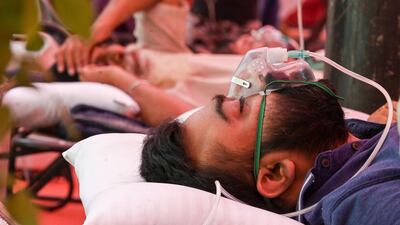
  • A suspected Covid-19 patient is comforted by a relative as he is given oxygen at a Sikh shrine, or gurdwara, on the outskirts of Delhi, India.
    A suspected Covid-19 patient is comforted by a relative as he is given oxygen at a Sikh shrine, or gurdwara, on the outskirts of Delhi, India.
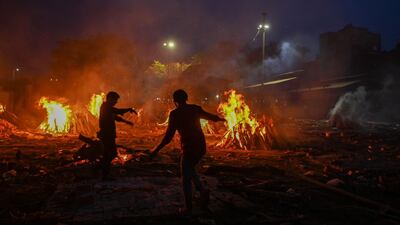
  • A worker walks past a funeral pyre of a person who died of Covid-19, at a cremation ground in India’s northern city of Allahabad.
    A worker walks past a funeral pyre of a person who died of Covid-19, at a cremation ground in India’s northern city of Allahabad.
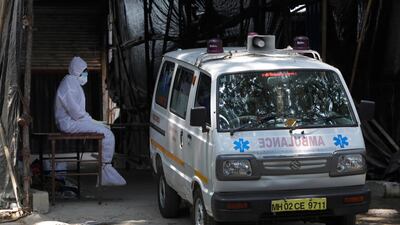
  • An ambulance delivers the body of a Covid-19 victim to a makeshift crematorium inside a disused granite quarry on the outskirts of the southern Indian city of Bengaluru.
    An ambulance delivers the body of a Covid-19 victim to a makeshift crematorium inside a disused granite quarry on the outskirts of the southern Indian city of Bengaluru.
  • A health worker takes a mouth swab sample of a boy to test for Covid-19 in Srinagar, in Indian-controlled Kashmir.
    A health worker takes a mouth swab sample of a boy to test for Covid-19 in Srinagar, in Indian-controlled Kashmir.
  • People queue to refill oxygen cylinders for Covid-19 patients at a centre in India's capital New Delhi.
    People queue to refill oxygen cylinders for Covid-19 patients at a centre in India's capital New Delhi.
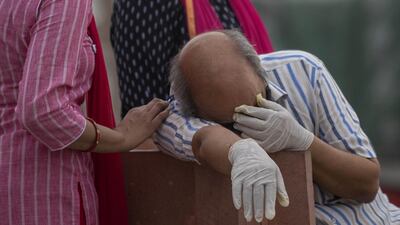
  • A relative wearing personal protective equipment mourns during the last rites of a Covid-19 victim at a makeshift cremation ground in New Delhi, India.
    A relative wearing personal protective equipment mourns during the last rites of a Covid-19 victim at a makeshift cremation ground in New Delhi, India.
  • Farmers urge a shopkeeper to open her shop in the north-west Indian city of Amritsar, as they take part in a protest against the weekend coronavirus lockdown imposed by the Punjab state government.
    Farmers urge a shopkeeper to open her shop in the north-west Indian city of Amritsar, as they take part in a protest against the weekend coronavirus lockdown imposed by the Punjab state government.

India reports record daily Covid-19 death toll and over 400,000 new cases


  • English
  • Arabic

Daily coronavirus deaths in India climbed to a record of more than 4,000 as the pandemic intensified in the world’s worst-hit nation.

There were 4,187 deaths, even as experts feared official data are grossly underestimated.

The country now accounts for nearly half of the world's new known cases and its death toll stands at 238,270.

India added 401,078 new cases as the capital New Delhi and other big metro cities continue to report new infections.

Tamil Nadu, a southern state, joined a growing list of provinces to announce a lockdown to curb the spread and ease pressure on the health system.

Hospitals around the country have been overwhelmed by the latest wave of infections with oxygen supplies running short in medical facilities amid the sudden surge in demand.

Meanwhile, EU’s pressure mounted on Washington to end vaccine export limits and offer a concrete plan to lift patents.

"I call very clearly on the United States to put an end to export bans not only on vaccines but on vaccine ingredients, which prevent production," French President Emanuel Macron told reporters at an EU summit in Porto.

He was referring to a de facto US ban on the export of vaccine raw materials.

German Chancellor Angela Merkel said the EU had exported much of its own production and the US should follow suit.

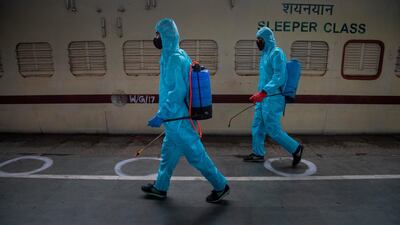
  • Health workers disinfect a train converted to a Covid-19 care centre after a surge in the number of positive coronavirus cases in Guwahati, India. AP
    Health workers disinfect a train converted to a Covid-19 care centre after a surge in the number of positive coronavirus cases in Guwahati, India. AP
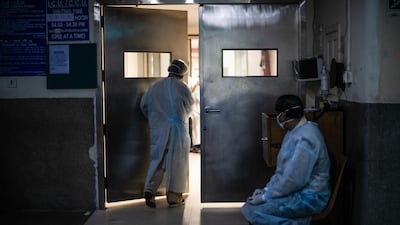
  • A worker caring for Covid-19 patients takes a break in the ICU ward at the Holy Family hospital in New Delhi, India. Getty
    A worker caring for Covid-19 patients takes a break in the ICU ward at the Holy Family hospital in New Delhi, India. Getty
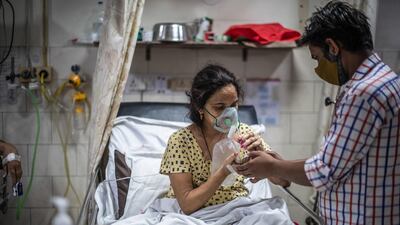
  • A worker attends to a patient in the emergency ward at the Holy Family hospital. Getty
    A worker attends to a patient in the emergency ward at the Holy Family hospital. Getty
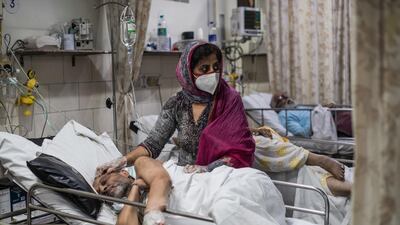
  • Covid-19 patients in the emergency ward at the Holy Family hospital. Getty
    Covid-19 patients in the emergency ward at the Holy Family hospital. Getty
  • Volunteers help with the funeral pyres at a cremation ground in New Delhi. The capital's crematoriums and burial grounds have been overwhelmed during the second wave of the pandemic. AFP
    Volunteers help with the funeral pyres at a cremation ground in New Delhi. The capital's crematoriums and burial grounds have been overwhelmed during the second wave of the pandemic. AFP
  • A Covid-19 patient breathes with the help of oxygen provided by a gurdwara, a place of worship for Sikhs. The tent along the roadside in Ghaziabad is helping people who need oxygen support. AFP
    A Covid-19 patient breathes with the help of oxygen provided by a gurdwara, a place of worship for Sikhs. The tent along the roadside in Ghaziabad is helping people who need oxygen support. AFP
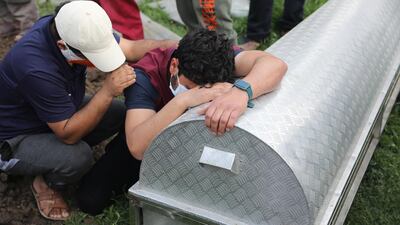
  • Kashmiris mourn over the coffin of a relative who died of Covid-19 at a graveyard on the outskirts of Srinagar. EPA
    Kashmiris mourn over the coffin of a relative who died of Covid-19 at a graveyard on the outskirts of Srinagar. EPA
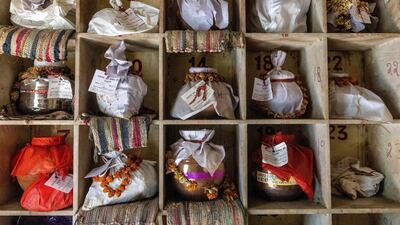
  • Urns containing ashes of dead people, including those who died of Covid-19. The urns are kept at a crematorium in New Delhi and will be immersed after the lockdown. Reuters
    Urns containing ashes of dead people, including those who died of Covid-19. The urns are kept at a crematorium in New Delhi and will be immersed after the lockdown. Reuters
  • A distraught relative of a coronavirus victim at a cremation ground on the banks of the River Ganges at Garhmukteshwar in the northern state of Uttar Pradesh. Reuters
    A distraught relative of a coronavirus victim at a cremation ground on the banks of the River Ganges at Garhmukteshwar in the northern state of Uttar Pradesh. Reuters
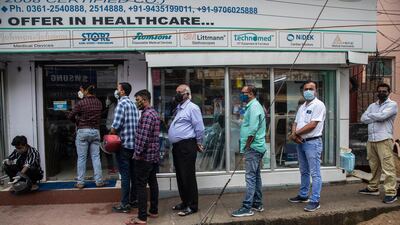
  • Masked customers line up outside a pharmacy to buy medicines in Guwahati. AP
    Masked customers line up outside a pharmacy to buy medicines in Guwahati. AP
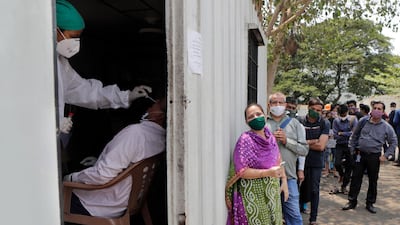
  • A health worker takes a nasal swab sample to test for Covid-19 as others wait their turn outside a field hospital in Mumbai. AP
    A health worker takes a nasal swab sample to test for Covid-19 as others wait their turn outside a field hospital in Mumbai. AP
  • A health worker takes a break outside a field hospital in Mumbai, India. AP
    A health worker takes a break outside a field hospital in Mumbai, India. AP

"I do not think that a patent waiver is the solution to make more vaccines available to more people," she said in Berlin.

"Rather, I think that we need the creativity and the power of innovation of companies – and to me, that includes patent protection."

Earlier, Pope Francis had focused on his desire to see patent waivers to "allow universal access to the vaccine".

He called for the temporary suspension of intellectual property rights, condemning the "virus of individualism" that "makes us indifferent to the suffering of others".

The call for waivers has gained momentum after the US announced surprise support for such a scheme to enable adequate vaccine supplies to fight Covid-19.

In an AFP interview, World Health Organisation's chief scientist Soumya Swaminathan said "early signs were missed [in India] until it reached the point at which it was taking off vertically", meaning "it's multiplying at a rate at which it's very difficult to stop".

India's western neighbour Pakistan began a nine-day shutdown from Saturday targeting travel and tourist hotspots, mobilising its military to help enforce the restrictions.

The aim is to stop its outbreak from snowballing during the coming Eid celebrations at the end of the month of Ramadan.