
Pakistan and India will hold their first high-level talks in years next week after Prime Minister Imran Khan wrote to his Indian counterpart saying he wanted to restart dialogue.
The meeting foreign ministers on the sidelines of the United Nations General Assembly will come nearly three years after previous dialogue broke down following a militant assault on an Indian airbase.
The meeting came to light a day after Mr Khan visited Saudi Arabia and the UAE on his first foreign tour since taking office in August.
While in the UAE, Mr Khan spoke to Sheikh Mohammed bin Zayed, Crown Prince of Abu Dhabi and Deputy Supreme Commander of the Armed Forces, on his desire for peace and stability in the region and especially for dialogue with India to resolve of all disputes, particularly Kashmir, Pakistan's foreign ministry said.
Diplomats told The National that Islamabad had been putting out feelers to try to rekindle high-level diplomatic dialogue with New Delhi even before Mr Khan took office. Ties are at a low over Kashmir, which is divided between the two countries and is claimed by both, and Islamabad's alleged failure to crack down on Pakistan-based militant groups carrying out attacks in India.

Despite India agreeing to the meeting at the UN's New York headquarters, New Delhi remains highly sceptical of a positive outcome, sources said
“The Pakistanis have been more active on this than the Indians,” a western official said.
“They have been putting out feelers for a while on how you de-escalate and start talking again.
“There's a long history of back channel talks, but the Indians are very nervous.”
Mr Khan's letter to Narendra Modi said he wanted to resume a formal talks process held under his predecessor, Nawaz Sharif, called the Comprehensive Bilateral Dialogue.
Those talks raised hopes for progress as Mr Modi travelled to Pakistan in December 2015 to discuss their differences.
But the process ended in recriminations days later when militants attacked India's Pathankot airbase, killing seven security personnel and a civilian in an assault that lasted four days.
New Delhi subsequently blamed the Pakistan-based Islamist militant group Jaish-e-Mohammed, and accuses Islamabad of failing to take action despite being given a dossier of evidence.
India has interpreted the attack as a deliberate attempt by Pakistan's security apparatus to derail the talks process and has since largely cut off diplomatic contact.
India also blames Pakistan for financing the deadly 2008 militant attacks in Mumbai.
______________
Read more:
Pakistan PM Imran Khan offers citizenship to Afghan refugees
Imran Khan sacks economic adviser after pressure from Islamists
Twitter fanatic and father of four takes office as Pakistan's new president
______________
Mr Modi is wary of committing to talks before a general election next spring, fearing a domestic backlash if he reaches out only for there to be another militant attack on Indian soil. It is also unclear if Pakistan's powerful military, which considers the country under constant threat from India, will endorse a rapprochement.
“I just don't see that going anywhere before the Indian elections,” the western official said.
India has also been suspicious of Mr Khan, a former national cricketer turned politician whose alleged tolerance of Islamist extremism has earned him the nickname "Taliban Khan".
Tensions are so high that former Indian cricket star Navjot Singh Sidhu faced criticism at home for travelling to Islamabad to attend the inauguration ceremony of his old friend.
-

Sheikh Mohammed bin Zayed Al Nahyan, Crown Prince of Abu Dhabi Deputy Supreme Commander of the UAE Armed Forces, receives Imran Khan, Prime Minister of Pakistan, during a reception at the Presidential Airport. Hamad Al Kaabi / Crown Prince Court - Abu Dhabi -

The UAE and Pakistan delegations meet at the Presidential Airport Reception. Hamad Al Kaabi / Crown Prince Court - Abu Dhabi -
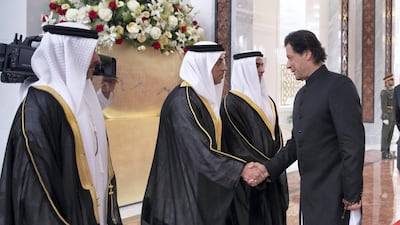
Sheikh Mansour bin Zayed, UAE Deputy Prime Minister and Minister of Presidential Affairs, greets Imran Khan. Seen with Sheikh Hamed bin Zayed, Chairman of the Crown Prince Court of Abu Dhabi and Abu Dhabi Executive Council Member, left, and Sheikh Saif bin Zayed, UAE Deputy Prime Minister and Minister of Interior. Saeed Al Neyadi / Crown Prince Court - Abu Dhabi -
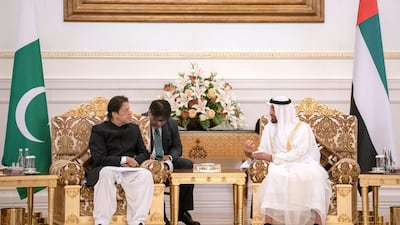
Sheikh Mohammed bin Zayed and Imran Khan holds talks. Hamad Al Kaabi / Crown Prince Court - Abu Dhabi -
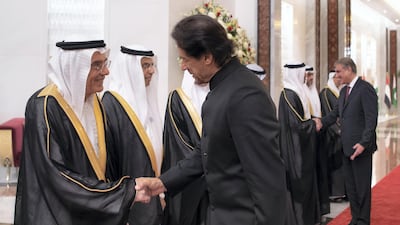
Zaki Nusseibeh, Minister of State, greets Imran Khan. Saeed Al Neyadi / Crown Prince Court - Abu Dhabi -

Sheikh Saif bin Zayed meets Imran Khan. Saeed Al Neyadi / Crown Prince Court - Abu Dhabi -

The Pakistan prime minister is on his first foreign trip since becoming the country's leader. Hamad Al Mansouri for Crown Prince Court - Abu Dhabi -

Hamad Al Zaabi, UAE Ambassador to Pakistan, left, meets Imran Khan. Hamad Al Kaabi / Crown Prince Court - Abu Dhabi -
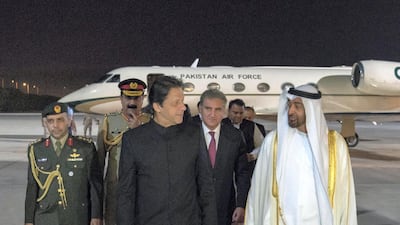
The Pakistan prime minister is welcomed off his plane after visiting Riyadh earlier in the day. Hamad Al Kaabi / Crown Prince Court - Abu Dhabi -
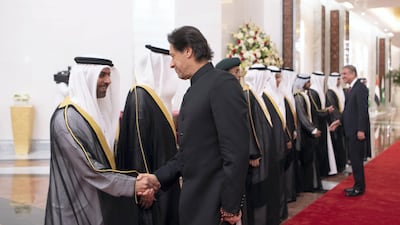
Saeed Al Neyadi / Crown Prince Court - Abu Dhabi -

Saeed Al Neyadi / Crown Prince Court - Abu Dhabi


Mr Khan used his victory speech after the July 25 general election to say India had portrayed him as a Bollywood villain, but he wanted to reset ties.
"If the Indian leadership takes one step towards Pakistan, we are ready to take two steps towards India. Right now it is one-sided where India is constantly just blaming us. We must resolve the main issue [Kashmir] with dialogue," he said.
India's external affairs ministry said the New York meeting between Sushma Swaraj and Pakistan's Shah Mehmood Qureshi did not represent a shift in New Delhi's relations with Islamabad.
"This does not indicate any change in our policy on cross-border terrorism," spokesman Raveesh Kumar said.

