• Indian fishermen jointly push a fishing boat to anchor it near the Arabic Sea shore at the Uttan village, near Mumbai, India. EPA
    Indian fishermen jointly push a fishing boat to anchor it near the Arabic Sea shore at the Uttan village, near Mumbai, India. EPA
  • People make way for a man on a wheelchair to pass during an evacuation of a slum on the outskirts of Mumbai, India. Reuters
    People make way for a man on a wheelchair to pass during an evacuation of a slum on the outskirts of Mumbai, India. Reuters
  • NDRF personnel clear fallen trees from a road in Alibag town of Raigad district. AFP
    NDRF personnel clear fallen trees from a road in Alibag town of Raigad district. AFP
  • A boat is lifted by a crane as cyclone Nisarga makes its landfall on the outskirts of the city, in Mumbai, India. Reuters
    A boat is lifted by a crane as cyclone Nisarga makes its landfall on the outskirts of the city, in Mumbai, India. Reuters
  • People help elderly citizens during an evacuation from a slum on the outskirts of the city, in Mumbai, India. Reuters
    People help elderly citizens during an evacuation from a slum on the outskirts of the city, in Mumbai, India. Reuters
  • Satellite image released by Nasa shows cyclone Nisarga heading towards the western coast of India. AP
    Satellite image released by Nasa shows cyclone Nisarga heading towards the western coast of India. AP
  • Lifeguards sit at the Juhu beach on the Arabian Sea coast in Mumbai, India. AP Photo
    Lifeguards sit at the Juhu beach on the Arabian Sea coast in Mumbai, India. AP Photo
  • A municipal employee makes an announcement by the shore of the Arabian Sea in Mumbai, India. AP Photo
    A municipal employee makes an announcement by the shore of the Arabian Sea in Mumbai, India. AP Photo
  • Medical staff wearing personal protective equipment oversee Covid-19 patients boarding an ambulance as they are shifted from a field hospital to a another centre ahead of a cyclonic storm that may hit the north Maharashtra and Gujarat coast, in Mumbai. AFP
    Medical staff wearing personal protective equipment oversee Covid-19 patients boarding an ambulance as they are shifted from a field hospital to a another centre ahead of a cyclonic storm that may hit the north Maharashtra and Gujarat coast, in Mumbai. AFP
  • A woman watches waves splash on shores of the Arabian Sea in Mumbai, India. AP Photo
    A woman watches waves splash on shores of the Arabian Sea in Mumbai, India. AP Photo
  • General view of Indian fishing boats covered with tarpaulins anchoring at the shore of the Arabian sea near Chowk Dongri at the village of Uttan, near Mumbai, India. EPA
    General view of Indian fishing boats covered with tarpaulins anchoring at the shore of the Arabian sea near Chowk Dongri at the village of Uttan, near Mumbai, India. EPA
  • People fix the rooftop of their houses at a slum in Mumbai, India. AP Photo
    People fix the rooftop of their houses at a slum in Mumbai, India. AP Photo
  • People cover the rooftop of a slum house with tarpaulin to protect from rain in Mumbai, India. AP Photo
    People cover the rooftop of a slum house with tarpaulin to protect from rain in Mumbai, India. AP Photo
  • Indian fishermen gather on the shore of the Arabian Sea at the village of Uttan, near Mumbai, India. The India Meteorological Department has advised fishermen not to venture into sea along the coast of Maharashtra as a precaution against approaching tropical cyclone Nisarga. EPA
    Indian fishermen gather on the shore of the Arabian Sea at the village of Uttan, near Mumbai, India. The India Meteorological Department has advised fishermen not to venture into sea along the coast of Maharashtra as a precaution against approaching tropical cyclone Nisarga. EPA
  • Fishermen gather their nets by the seashore to store them before cyclone Nisarga makes landfall, in Mumbai. Reuters
    Fishermen gather their nets by the seashore to store them before cyclone Nisarga makes landfall, in Mumbai. Reuters

Cyclone Nisarga: Mumbai escapes full force of 'severe cyclonic storm'


  • English
  • Arabic

Coronavirus-hit Mumbai appeared to escape the worst of Cyclone Nisarga on Wednesday as the first severe storm to threaten India's financial capital in more than 70 years left it largely unscathed after ripping roofs off buildings in nearby coastal towns.

Mumbai and its surrounds are usually sheltered from cyclones - the last deadly storm to hit the city was in 1948 - but authorities evacuated at least 100,000 people, including coronavirus patients, from flood-prone areas in the states of Maharashtra and Gujarat.

The storm made landfall near the coastal town of Alibag, around 100 kilometres (60 miles) south of Mumbai, on Wednesday afternoon, meteorologists said.

It then crossed Maharashtra's coast, with its path veering to the east of Mumbai and gradually weakened by Wednesday evening, they added.

The cyclone brought heavy rainfall - with winds of 100-110 kilometres per hour (60-70 miles per hour) and gusts of up to 120 kph.

In Mumbai – home to Bollywood, India's largest stock exchange and more than 18 million residents – high winds whipped skyscrapers and ripped apart shanty houses near the beach.

"The intensity is very strong and nothing like weather events we've seen before," said Milind Dhodre, who lives in Alibag with his wife and son. The 45-year-old professor was rescued from his house near the sea.

The cyclone brought heavy rainfall - with winds of 100-110 kilometres per hour and gusts of up to 120kph.

Earlier, authorities were working around the clock to move thousands of people away from the coast, amid fears that a city ravaged by coronavirus infections could overwhelm its healthcare system further.

Homes in a nearby slum had been locked up, and municipal officials patrolled the streets, using megaphones to order people to stay inside.

"We have seen rains, but we have never seen a cyclone in the city. We don't know what damage it will do," said Shantaram Terekar, who lives in a one-room hutment in the city.

Mr Terekar said he had switched off electricity and used tarpaulin to secure his thin metal roof.

India's largest container port, Jawaharlal Nehru Port Trust, on the outskirts of Mumbai, said it had shut for 24 hours. Flights scheduled to operate from Mumbai's airport were cancelled.

Early on Wednesday, the state of Goa, south of Maharashtra, received 127 millimetres of torrential rain – about a week's average – as the cyclone moved along the coast, the meteorological agency said.

More than 100,000 people had been moved to safety along the coasts of Maharashtra and Gujarat states.

Cyclones often skirt Mumbai during the June-September monsoon season and torrential rains flood roads, and bring a halt to a suburban railway service that serves millions of people.

Mumbai emergency services are already struggling with the nation's largest outbreak of the coronavirus. The city and its surrounding areas have so far reported about 55,000 Covid-19 cases and more than 1,700 deaths from the disease.

“If hospitals and clinics are damaged by the cyclone, the city won’t be able to cope with the large number of Covid-19 cases, and social-distancing measures will become virtually impossible to follow,” Bidisha Pillai, chief executive of Save the Children in India, said.

“Let us fight this danger like we are standing up to the corona pandemic and are on our way to defeat it. Likewise, we will prevail over this situation too!” Maharashtra's Chief Minister Uddhav Thackeray tweeted.

In Mumbai, authorities shifted 150 Covid-19 patients out of a makeshift hospital as it was in a low-lying area.

Nisarga comes two weeks after Cyclone Amphan struck the Bay of Bengal on India’s east coast and battered West Bengal state, killing more than 100 people in India and neighbouring Bangladesh.

  • A Buddhist monk walks through a road laid with fallen trees and branches after Cyclone Amphan hit the region in Kolkata, India. A powerful cyclone ripped through densely populated coastal India and Bangladesh, blowing off roofs and whipping up waves that swallowed embankments and bridges and left entire villages without access to fresh water, electricity and communications. AP Photo
    A Buddhist monk walks through a road laid with fallen trees and branches after Cyclone Amphan hit the region in Kolkata, India. A powerful cyclone ripped through densely populated coastal India and Bangladesh, blowing off roofs and whipping up waves that swallowed embankments and bridges and left entire villages without access to fresh water, electricity and communications. AP Photo
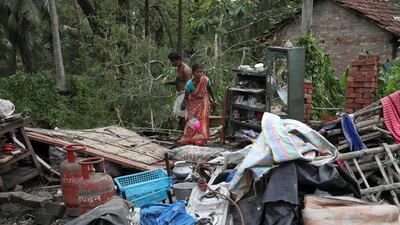
  • Residents salvage their belongings from the rubble of a damaged house in the aftermath of Cyclone Amphan, in South 24 Parganas district in the eastern state of West Bengal, India. REUTERS
    Residents salvage their belongings from the rubble of a damaged house in the aftermath of Cyclone Amphan, in South 24 Parganas district in the eastern state of West Bengal, India. REUTERS
  • Men cut branches of an uprooted tree in the aftermath of Cyclone Amphan, in South 24 Parganas district in the eastern state of West Bengal, India. REUTERS
    Men cut branches of an uprooted tree in the aftermath of Cyclone Amphan, in South 24 Parganas district in the eastern state of West Bengal, India. REUTERS
  • Residents salvage their belongings from the rubble of a damaged house in the aftermath of Cyclone Amphan, in South 24 Parganas district in the eastern state of West Bengal, India. REUTERS
    Residents salvage their belongings from the rubble of a damaged house in the aftermath of Cyclone Amphan, in South 24 Parganas district in the eastern state of West Bengal, India. REUTERS
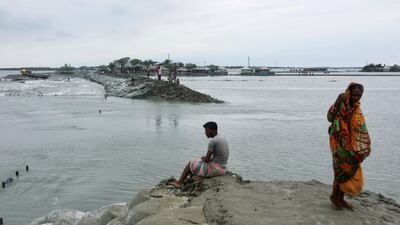
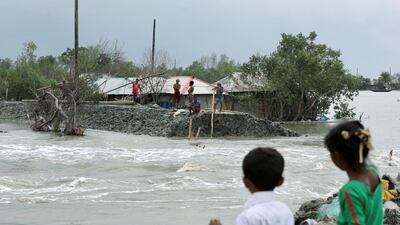
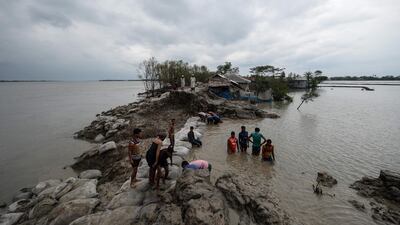
  • Coastal area is seen flooded after the embankment is destroyed as the cyclone Amphan makes its landfall in Satkhira, Bangladesh. REUTERS
    Coastal area is seen flooded after the embankment is destroyed as the cyclone Amphan makes its landfall in Satkhira, Bangladesh. REUTERS
  • Coastal area is seen flooded after the embankment is destroyed as the cyclone Amphan makes its landfall in Satkhira, Bangladesh. REUTERS
    Coastal area is seen flooded after the embankment is destroyed as the cyclone Amphan makes its landfall in Satkhira, Bangladesh. REUTERS
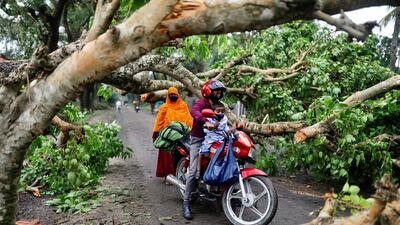
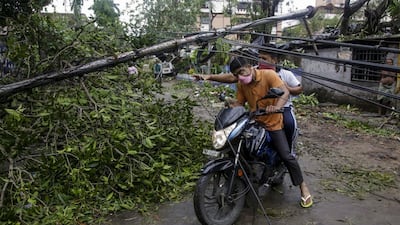
  • A man with a child ride on motorbike in the street blocked by trees that were uprooted by the cyclone Amphan, in Satkhira, Bangladesh. REUTERS
    A man with a child ride on motorbike in the street blocked by trees that were uprooted by the cyclone Amphan, in Satkhira, Bangladesh. REUTERS
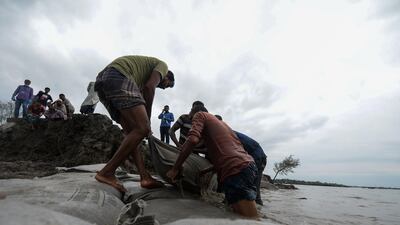
  • Volunteers and residents work to repair a damaged dam following the landfall of cyclone Amphan in Burigoalini. At least 84 people died as the fiercest cyclone to hit parts of Bangladesh and eastern India this century sent trees flying and flattened houses, with millions crammed into shelters despite the risk of coronavirus. AFP
    Volunteers and residents work to repair a damaged dam following the landfall of cyclone Amphan in Burigoalini. At least 84 people died as the fiercest cyclone to hit parts of Bangladesh and eastern India this century sent trees flying and flattened houses, with millions crammed into shelters despite the risk of coronavirus. AFP
  • Volunteers and residents place sack filled with soil to repair a damaged dam following the landfall of cyclone Amphan in Burigoalini. At least 84 people died as the fiercest cyclone to hit parts of Bangladesh and eastern India this century sent trees flying and flattened houses, with millions crammed into shelters despite the risk of coronavirus. AFP
    Volunteers and residents place sack filled with soil to repair a damaged dam following the landfall of cyclone Amphan in Burigoalini. At least 84 people died as the fiercest cyclone to hit parts of Bangladesh and eastern India this century sent trees flying and flattened houses, with millions crammed into shelters despite the risk of coronavirus. AFP
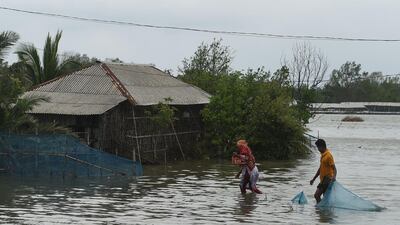
  • Residents wade through a flooded area after a dam broke following the landfall of cyclone Amphan in Shyamnagar. At least 84 people died as the fiercest cyclone to hit parts of Bangladesh and eastern India this century sent trees flying and flattened houses, with millions crammed into shelters despite the risk of coronavirus. AFP
    Residents wade through a flooded area after a dam broke following the landfall of cyclone Amphan in Shyamnagar. At least 84 people died as the fiercest cyclone to hit parts of Bangladesh and eastern India this century sent trees flying and flattened houses, with millions crammed into shelters despite the risk of coronavirus. AFP
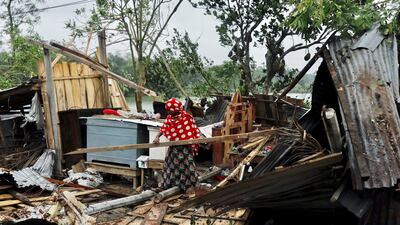
  • A woman clears her house that was demolished by the cyclone Amphan in Satkhira, Bangladesh. REUTERS
    A woman clears her house that was demolished by the cyclone Amphan in Satkhira, Bangladesh. REUTERS
  • An aerial view shows volunteers and residents working to fix a damaged dam following the landfall of cyclone Amphan in Burigoalini. At least 84 people died as the fiercest cyclone to hit parts of Bangladesh and eastern India this century sent trees flying and flattened houses, with millions crammed into shelters despite the risk of coronavirus. AFP
    An aerial view shows volunteers and residents working to fix a damaged dam following the landfall of cyclone Amphan in Burigoalini. At least 84 people died as the fiercest cyclone to hit parts of Bangladesh and eastern India this century sent trees flying and flattened houses, with millions crammed into shelters despite the risk of coronavirus. AFP
  • People make their way through damaged cables and a tree branch fallen in the middle of a road after Cyclone Amphan hit the region in Kolkata, India. A powerful cyclone ripped through densely populated coastal India and Bangladesh, blowing off roofs and whipping up waves that swallowed embankments and bridges and left entire villages without access to fresh water, electricity and communications. AP Photo
    People make their way through damaged cables and a tree branch fallen in the middle of a road after Cyclone Amphan hit the region in Kolkata, India. A powerful cyclone ripped through densely populated coastal India and Bangladesh, blowing off roofs and whipping up waves that swallowed embankments and bridges and left entire villages without access to fresh water, electricity and communications. AP Photo
  • Cyclone victims who were rescued form their destroyed home after Cyclone Amphan made landfall, in Bokkhali village near the Bay of Bengal, India. The Odisha government and Bengal government are considering a mass evacuation of the area. EPA
    Cyclone victims who were rescued form their destroyed home after Cyclone Amphan made landfall, in Bokkhali village near the Bay of Bengal, India. The Odisha government and Bengal government are considering a mass evacuation of the area. EPA