
Japanese Prime Minister Shinzo Abe said Monday the government plans to declare a state of emergency and proposed a stimulus package worth $1 trillion (Dh3.67tn) as new coronavirus infections spike in Tokyo and elsewhere.
"We hope to declare a state of emergency as early as tomorrow after listening to the opinions of the advisory panel," Mr Abe told reporters.
He said the government would roll out a stimulus package worth around 108 trillion yen to cushion the damage to the world's third-biggest economy.
The prime minister said experts on a government-commissioned task force urged him to get the state of emergency ready because the Covid-19 outbreak is rapidly expanding in major cities including Tokyo. He said the state of emergency will cover Tokyo, Osaka, Fukuoka and four other hard-hit prefectures.
-
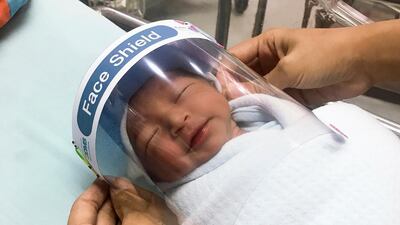
A nurse adjusts tiny face shield for a newborn baby to protect from new coronavirus at the newborn nursery of the hospital in Samutprakarn province, central Thailand. AP -
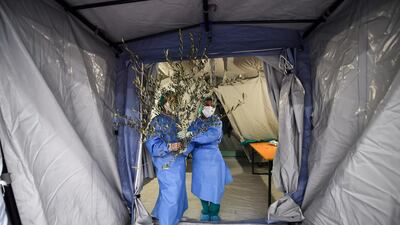
Members of the medical staff hold palm tree branches at the emergency unit of the Molinette Hospital on Palm Sunday, during the coronavirus disease (COVID-19) outbreak, in Turin, Italy. REUTERS -
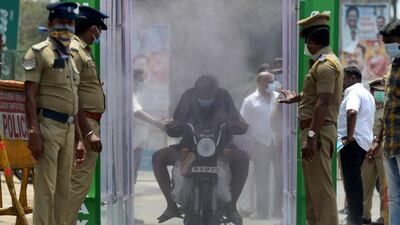
A motorist rides through a disinfection tunnel during a government-imposed nationwide lockdown as a preventive measure against the COVID-19 coronavirus in Chennai. AFP -
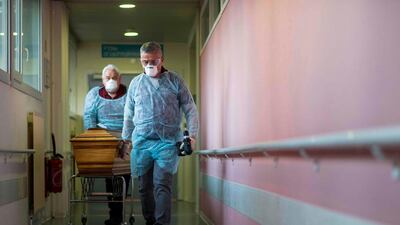
Employees of the Lantz funeral company, wearing face masks as protective measures, pull the coffin of a victim of the COVID-19 at an hospital in Mulhouse, eastern France. AFP -
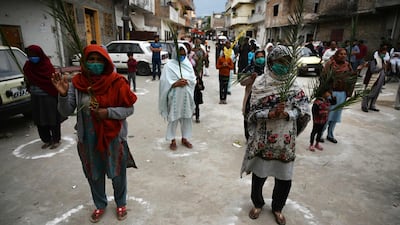
Christian devotees stand in circles marked on the ground to maintain social distancing as they hold palm branches to celebrate a Palm Sunday event at the Christian neighborhood during a government-imposed nationwide lockdown as a preventive measure against the COVID-19 coronavirus, in Islamabad. AFP -

Afghan four-year old Ahmad Yosuf plays with a Spiderman toy in the yard of his house as kindergartens continue to be closed due to the fear of coronavirus outbreak in Kabul, Afghanistan. EPA -
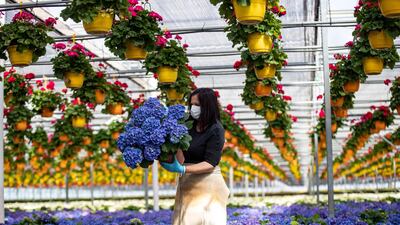
A woman wearing a protective mask holds a hydrangea at a greenhouse of the Saracino garden centre in Aprilia, Italy. EPA -
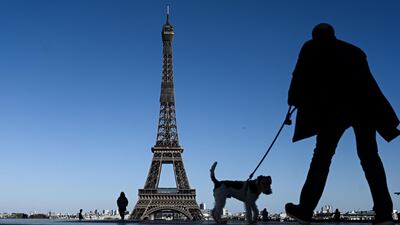
A man walks his dog in front of the Eiffel Tower in Paris on the twentieth day of a lockdown in France aimed at curbing the spread of COVID-19. AFP -
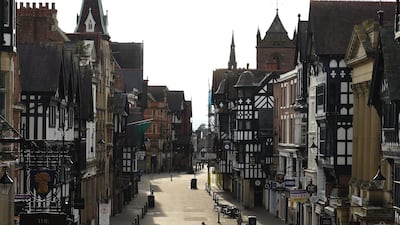
A man plays with a football on Eastgate Street in a near-deserted Chester city centre in north-West England as the warm weather tests the nationwide lockdown to combat the novel coronavirus pandemic. AFP -
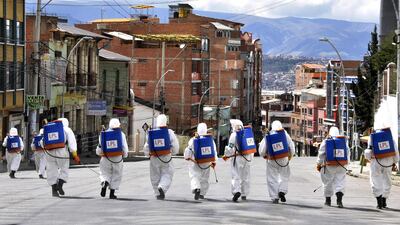
Municipal workers disinfect the streets of La Paz as a preventive measure to slow the spread of the novel coronavirus, COVID-19. AFP -
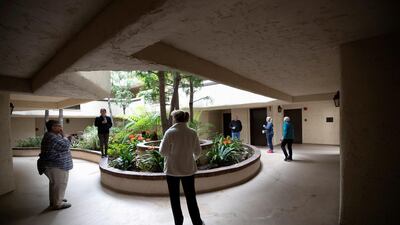
Residents take part in a socializing hour in the courtyard of their apartment complex while keeping a social distance during the global outbreak of the coronavirus disease (COVID-19), in Pasadena, California, U.S. REUTERS -
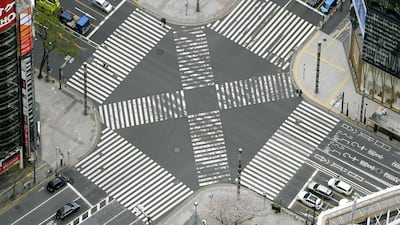
An aerial view shows less than usual passersby seen at a pedestrian crossing at Ginza shopping and amusement district after Tokyo Governor Yuriko Koike urged Tokyo residents to stay indoors in a bid to keep the coronavirus disease (COVID-19) from spreading, in Tokyo, Japan. REUTERS -
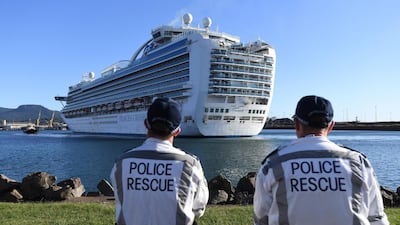
The Ruby Princess, with only crew onboard, docks at Port Kembla, Wollongong, Australia. A criminal investigation will be launched into how cruise line operator Carnival Australia was allowed to disembark Ruby Princess passengers in Sydney, resulting in several deaths and COVID-19 outbreaks throughout the country. EPA -
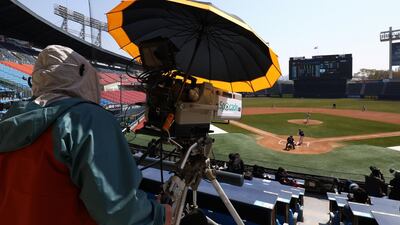
Employees of LG Twins broadcast their intra-team game played for fans at a empty Jamshil baseball stadium, as South Koreans take measures to protect themselves against the spread of coronavirus (COVID-19) in Seoul, South Korea. Getty Images


More than 3,500 people have tested positive for the coronavirus in Japan and 85 have died – not a huge outbreak compared with some hot spots, but the numbers keep rising. There is articular alarm over Tokyo, which has more than 1,000 cases, including 83 new ones on Monday.
A state of emergency, which Mr Abe said would last about a month, will give governors authority to call on people to stay at home and businesses to close, but not to order the kind of lockdowns seen in other countries. In most cases, there are no penalties for ignoring requests, and enforcement will rely more on peer pressure and respect for authority.
Pressure had been mounting on the government to take the step, although Mr Abe has voiced concern about being too hasty, given the restrictions on movement and businesses that would ensue.
The stimulus package is due to be rolled out this week.
An emergency would appear to have public support. In a poll published on Monday by JNN, run by broadcaster TBS, 80 per cent of those surveyed said Mr Abe should declare it while 12 per cent said it was not necessary. His approval rating fell by 5.7 points from last month to 43.2 per cent, the survey showed.
Kenji Shibuya, director of the Institute for Public Health at King's College, London, said the emergency was too late given the increase in cases in Tokyo.
"It should have been declared by April 1 at the latest," he said.

