
All nine million people in a major Chinese port city will be tested for Covid-19 after authorities reported a tiny cluster of coronavirus infections in Qingdao.
The outbreak snaps a streak of over two months without local transmission and underscores the risk of resurgence in countries that have achieved near-eradication of the pathogen.
The virus has been largely brought under control in China – where it first emerged last year – in stark contrast to many parts of the world still afflicted by rolling lockdowns and high case numbers.
The city in Shandong province said on Sunday that it found three asymptomatic cases linked to a hospital which treats Covid-19 patients coming from abroad. Expanded testing of hospital patients and staff then found another nine infections — of the total of 12 in the cluster so far, six are asymptomatic.
-

Residents wearing masks line up for a Covid-19 test outside the Worker's Stadium in Beijing on June 30. Test sites sprung up through the Chinese capital as frequent nasal swabs have become normal after the latest outbreak of the coronavirus. AP Photo -

An empty box office at the China Film Cinema in Beijing, which was closed due to the new coronavirus outbreak in Beijing. Reuters -

Security guards patrol outside the Dizhi Hall cinema, which was also closed. Reuters -
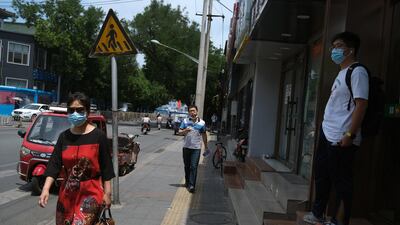
People wearing face masks are seen on a street, following a rise in cases in Beijing. Reuters -
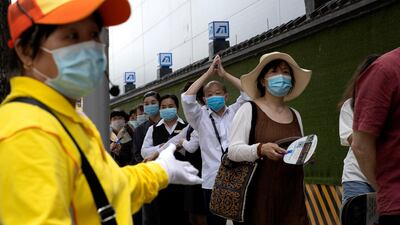
A resident makes a gesture as he lines up for a test outside the Worker's Stadium. AP Photo -

People wait in line for the nasal swab PCR test. China's capital partially lifted a weeks-long lockdown that was put in place to head off a feared second wave. AFP -
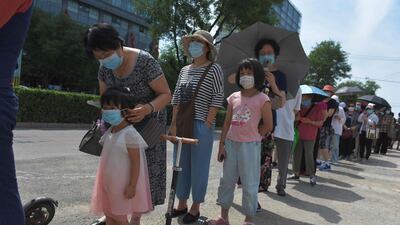
A woman adjusts a young girl's face mask as they wait in line. AFP -

An Air China plane sits on the tarmac at Beijing's Capital International Airport, which was nearly empty on June 30. AFP -
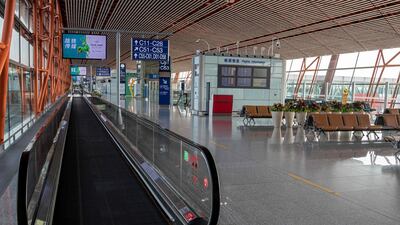
An almost empty terminal 3 at Capital International Airport. AFP -

Passengers in full protective suits make their way to their gate at terminal three. AFP -
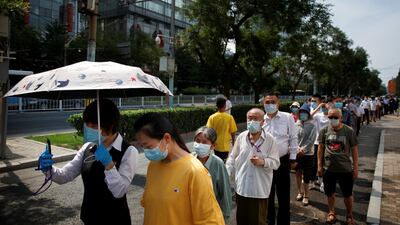
People line up in the heat for a test. Reuters -

A security guard is swabbed a testing station in Beijing. AFP -

Beijing has tested about 8 million people. Reuters -
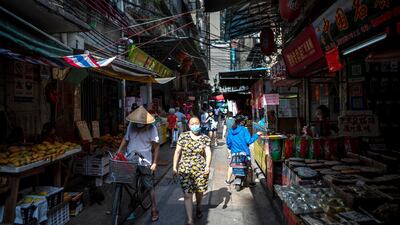
A woman walks through the wet market in Guangzhou, China. China races to contain a second wave of coronavirus cases mostly in Beijing. EPA -
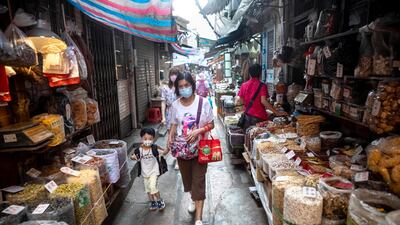
Wet markets have come under particular scrutiny following the coronavirus outbreak in late December, 2019. EPA


More testing is under way and aims to cover the entire city of more than nine million within five days, the local health commission said on Monday.
China has extensive, quick test capabilities and by noon on Monday the health commission said more than 277,000 people had already been tested in Qingdao, with nine positive results.
The cluster has now become China’s biggest in months, reflecting the difficulty of stamping out the coronavirus in any one country when outbreaks are still spreading rapidly in places like India and the US while rebounding in Europe.
Several nations in the Asia-Pacific region like Thailand and New Zealand have also maintained long stretches of virus-free periods, only to see the pathogen rear its head again.
Still, the new cluster is unlikely to interrupt China’s progress in moving past Covid-19 as its economy rebounds and life returns to normal for the vast majority of citizens. A national eight-day holiday period that just concluded saw 637 million trips made domestically, 80 per cent of the level from a year ago, reflecting the country’s confidence that mass travel with few restrictions will not result in uncontrollable new flare-ups.
The sources of these resurgences remain largely a mystery, as asymptomatic carriers prevent health experts from being able to map a chain of transmission. Last month, Qingdao also found two port workers — responsible for unloading frozen seafood — who tested positive in routine checks without showing symptoms.
China has suspended frozen food imports from plants in several countries after detecting the virus on the packaging or surface of imported meat and seafood.
Authorities in Qingdao are now sticking to the same playbook China has used in curbing resurgences after it contained the initial deadly outbreak in Wuhan. Amid mass testing and contact-tracing, all who test positive are isolated and quarantined, regardless of symptoms.

