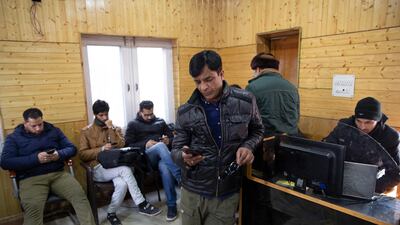
India ended an 18-month ban on high-speed internet for mobile devices in Kashmir.
But the order issued by the region’s home secretary, Shaleen Kabra, asked police officials to “closely monitor the impact of lifting restrictions" on 4G services.
A blanket internet ban, the longest in a democracy and described as “digital apartheid” by campaigners, took effect in August 2019, when India stripped Kashmir of its special status and statehood.
The region was divided into two federally governed territories.
The decision was accompanied by a security clampdown and communications blackout that made hundreds of thousands of people jobless, harmed the already feeble healthcare system and paused the education of millions.
Months later, India gradually eased some of the restrictions, and restored partial internet connectivity.
In January last year, authorities allowed the territory’s more than 12 million people to access government-approved websites over slow connections.
Two months later, authorities revoked a ban on social media and restored full internet connectivity, but not high-speed internet. In August, 4G services were allowed in two out of the region’s 20 districts.
Officials said the internet ban was aimed at heading off anti-India protests and attacks by rebels who have fought for decades for the region’s independence or unification with Pakistan, which administers another portion of Kashmir.
Many Kashmiris, however, view the move as part of the beginning of colonialism aimed at engineering a demographic change in India’s only Muslim-majority region.
The internet ban was criticised by politicians in Europe and the US, who called on the government to end the curbs.
Omar Abdullah, the region’s former most senior elected official who was jailed for several months in 2019, welcomed the internet restoration.
“Better late than never,” he tweeted.
Most of India’s internet shutdowns have been enforced in Kashmir but they have also been used elsewhere by the government of Prime Minister Narendra Modi.
Authorities have cut the internet at protest sites outside New Delhi, where tens of thousands of farmers have camped out against new agriculture laws for more than two months.
– Reporting by The Associated Press

Revival
Eminem
Interscope
Info
What: 11th edition of the Mubadala World Tennis Championship
When: December 27-29, 2018
Confirmed: men: Novak Djokovic, Rafael Nadal, Kevin Anderson, Dominic Thiem, Hyeon Chung, Karen Khachanov; women: Venus Williams
Tickets: www.ticketmaster.ae, Virgin megastores or call 800 86 823
Who's who in Yemen conflict
Houthis: Iran-backed rebels who occupy Sanaa and run unrecognised government
Yemeni government: Exiled government in Aden led by eight-member Presidential Leadership Council
Southern Transitional Council: Faction in Yemeni government that seeks autonomy for the south
Habrish 'rebels': Tribal-backed forces feuding with STC over control of oil in government territory
10 tips for entry-level job seekers
- Have an up-to-date, professional LinkedIn profile. If you don’t have a LinkedIn account, set one up today. Avoid poor-quality profile pictures with distracting backgrounds. Include a professional summary and begin to grow your network.
- Keep track of the job trends in your sector through the news. Apply for job alerts at your dream organisations and the types of jobs you want – LinkedIn uses AI to share similar relevant jobs based on your selections.
- Double check that you’ve highlighted relevant skills on your resume and LinkedIn profile.
- For most entry-level jobs, your resume will first be filtered by an applicant tracking system for keywords. Look closely at the description of the job you are applying for and mirror the language as much as possible (while being honest and accurate about your skills and experience).
- Keep your CV professional and in a simple format – make sure you tailor your cover letter and application to the company and role.
- Go online and look for details on job specifications for your target position. Make a list of skills required and set yourself some learning goals to tick off all the necessary skills one by one.
- Don’t be afraid to reach outside your immediate friends and family to other acquaintances and let them know you are looking for new opportunities.
- Make sure you’ve set your LinkedIn profile to signal that you are “open to opportunities”. Also be sure to use LinkedIn to search for people who are still actively hiring by searching for those that have the headline “I’m hiring” or “We’re hiring” in their profile.
- Prepare for online interviews using mock interview tools. Even before landing interviews, it can be useful to start practising.
- Be professional and patient. Always be professional with whoever you are interacting with throughout your search process, this will be remembered. You need to be patient, dedicated and not give up on your search. Candidates need to make sure they are following up appropriately for roles they have applied.
Arda Atalay, head of Mena private sector at LinkedIn Talent Solutions, Rudy Bier, managing partner of Kinetic Business Solutions and Ben Kinerman Daltrey, co-founder of KinFitz
UAE currency: the story behind the money in your pockets
The past winners
2009 - Sebastian Vettel (Red Bull)
2010 - Sebastian Vettel (Red Bull)
2011 - Lewis Hamilton (McLaren)
2012 - Kimi Raikkonen (Lotus)
2013 - Sebastian Vettel (Red Bull)
2014 - Lewis Hamilton (Mercedes)
2015 - Nico Rosberg (Mercedes)
2016 - Lewis Hamilton (Mercedes)
2017 - Valtteri Bottas (Mercedes)
Brief scores:
Toss: Sindhis, elected to field first
Kerala Knights 103-7 (10 ov)
Parnell 59 not out; Tambe 5-15
Sindhis 104-1 (7.4 ov)
Watson 50 not out, Devcich 49
