


India's ruling Bharatiya Janata Party has emerged as the biggest beneficiary of funds raised through a controversial electoral bonds programme, after the polling authority released the names of donors just weeks before national elections.
The BJP received 60 billion rupees ($723.8 million) of the total the scheme raised from donors, data released on Thursday by the Election Commission of India showed. The total funding amount was equal to $1.56 billion.
The biggest donors included Future Gaming and Hotel Services, a company under investigation by India's federal economic offences police over allegations of fraud and money laundering. Infrastructure company Megha Engineering and Qwik Supply Chain, a company having ties to billionaire Mukesh Ambani’s Reliance group, were also on the list of companies that funded political parties through the scheme.
The Election Commission released the donor data after the Supreme Court ruled the scheme was unconstitutional and breached the rights of voters.
Last month, the court struck down the scheme that allowed donors, including big companies, to buy electoral bonds from the State Bank of India to fund political parties without their names being made public.
The system introduced by Prime Minister Narendra Modi's government in 2017 allowed a person or company to buy bonds valued between 1,000 rupees and 10 million rupees from the bank. They can donate numerous bonds to a party registered with the Election Commission.
“It may be recalled that in the said matter, ECI [Election Commission of India] has consistently and categorically weighed in favour of disclosure and transparency, a position reflected in the proceedings of the Supreme Court and noted in the order also,” the commission said in a statement issued after publishing donor details on its website.
Top donor
Future Gaming and Hotel Services was the leading donor under the scheme. The company, owned by lottery magnate Santiago Martin, made political funding of 13.5 billion rupees through the scheme. Megha Engineering made the second-largest donation of 9.6 billion rupees, with Qwik Supply buying bonds worth 4.1 billion rupees.
It is still unclear which political party received the money, as the data released by the commission does not link donors to the recipients of their funding.
The Supreme Court on Friday asked the bank to disclose the unique alphanumeric numbers that will help to match donors with the parties they funded. The bank earlier told the court that it would take time to collate the necessary records and asked for three months to complete the process.
The data published by the commission comprised more than 40,000 entries and ran to about 800 pages. It showed 23 companies accounted for half the total value of electoral bonds purchased since April 2019.

Other donors included mining company Vedanta and the Serum Institute of India, the largest vaccine maker in the world. The institute was the main provider of shots for India during the Covid-19 pandemic.
Major groups such as telecom company Bharti Airtel, India’s largest private airline operator Indigo and real estate company DLF also made significant contributions to political parties, the data showed.
Steel magnate and billionaire Lakshmi Mittal made a personal contribution of 350 million rupees.
Critics of the programme said it lacked transparency and suggested donations could have been made in an attempt to influence policy decisions. The government has denied that claim and said the electoral bonds were meant to improve the political funding system and bring an end to cash donations.
Donor anonymity was meant to protect those who bought bonds, the government said.
-
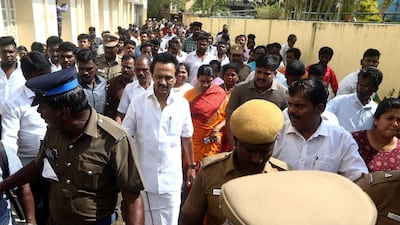
Dravida Munnetra Kazhagam (DMK) leader M.K. Stalin walks outside a polling station after casting his vote during the second phase of India's general elections in Chennai, India, Thursday, April 18, 2019. The Indian election is taking place in seven phases over six weeks in the country of 1.3 billion people. Some 900 million people are registered to vote for candidates to fill 543 seats in India's lower house of Parliament. (AP Photo/R. Parthibhan) -
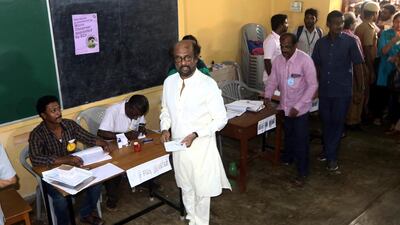
Indian superstar Rajnikanth arrives to cast his vote during the second phase of India's general elections in Chennai, India, Thursday, April 18, 2019. The Indian election is taking place in seven phases over six weeks in the country of 1.3 billion people. Some 900 million people are registered to vote for candidates to fill 543 seats in India's lower house of Parliament. (AP Photo/R. Parthibhan) -

Indian voters queue up to cast their vote at a polling station in Siliguri, West Bengal. AFP -
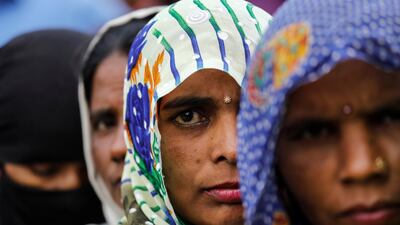
Voters line up to cast their votes in Amroha, in Uttar Pradesh. Reuters -
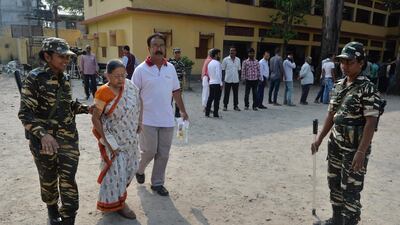
An Indian woman in Siliguri, West Bengal is helped at polling station. Reuters -
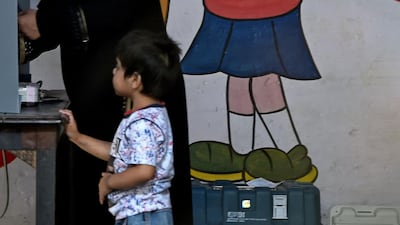
An Indian voter casts her vote at a polling station in Bulandshahr, in Uttar Pradesh. AFP -
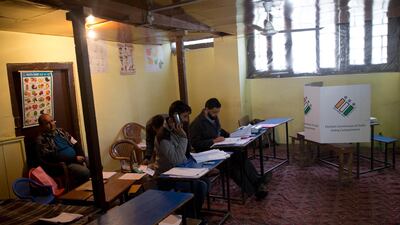
Election officers sit inside an empty polling station in Srinagar. AP Photo -
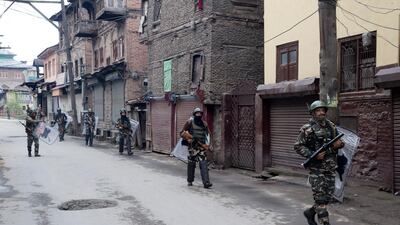
Indian paramilitary soldiers patrol a deserted street in Srinagar. AP Photo -
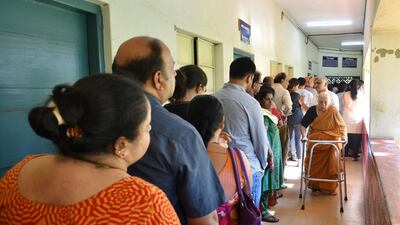
Indian voters line up to cast their ballot in Bengaluru. AFP -
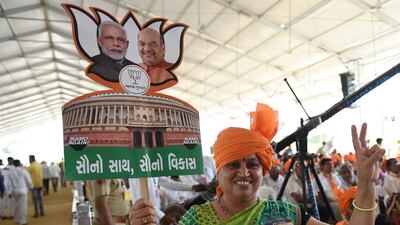
An Indian supporter of the Bhartiya Janta Party (BJP) carries a cut-out of the Indian Parliament with the images of Prime Minister Narendra Modi and BJP President Amit Shah during a rally in Amreli, some 250km from Ahmedabad, on April 18, 2019. More than 157 million of the 900 million electorate are eligible to cast ballots on the second of seven days of voting in the world's biggest election. / AFP / SAM PANTHAKY -
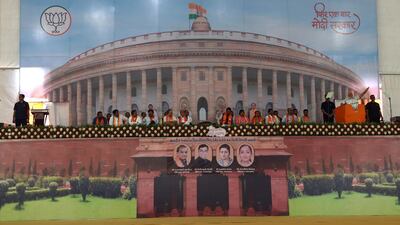
Indian Prime Minister Narendra Modi (2nd R) gives a speech on a stage with the backdrop of the Indian Parliament Building at a rally in Amreli, some 250km from Ahmedabad, on April 18, 2019. More than 157 million of the 900 million electorate are eligible to cast ballots on the second of seven days of voting in the world's biggest election. / AFP / SAM PANTHAKY


Spending for support
Political parties in India spend billions of rupees in elections in an effort to secure the support of hundreds of millions of voters in the world’s largest democracy. National elections are set to be held in the coming weeks.
In the last elections in 2019, political parties spent 550 billion rupees, a report by the Centre for Media Studies found.
The government defended the electoral bonds scheme before the court, but a five-judge bench ruled on February 15 that the initiative was unconstitutional and warned it could encourage “quid pro quo arrangements” between parties and donors.
The ruling came after a years-long hearing on a petition submitted by the Association for Democratic Reforms, an independent election watchdog, and the Communist Party of India (Marxist).
India’s opposition political parties, including the Congress Party, welcomed the decision to end the scheme. The main opposition party received 142 billion rupees in funding, less than the All India Trinamool Congress, a regional party that controls the eastern state of West Bengal. It received 160 billion rupees, the second-highest total from the scheme.

