

The operator of Japan's tsunami-damaged Fukushima Daiichi nuclear power plant began releasing treated radioactive water into the Pacific Ocean on Thursday.
Tokyo Electric Power Company (Tepco) broadcast live video showing an employee turning on a seawater pump, marking the beginning of a controversial project that is expected to last for decades.
Japanese fishermen have opposed the plan due to fears it may damage the reputation of their seafood. Concerns have also been raised in China and South Korea, making it a political and diplomatic issue.
The first discharge will involve the release of about 7,800 cubic metres of treated water and take about 17 days to complete, according to a document published on Tepco's website. The water will contain 1.1 trillion becquerels – a measure of radioactivity – of tritium, part of Tepco’s strategy to begin the process with relatively low concentrations of the radioactive material.
The company said its target is to discharge less than 22 trillion becquerels of tritium a year, and expects to release 5 trillion becquerels as it carries out a total of four releases of treated water by the end of March.
Japan's government and Tepco have said the water must be released to make room for the plant’s decommissioning and to prevent accidental leaks. They say the treatment and dilution will make the wastewater safer than required by international standards, and that its environmental impact will be negligible. But some scientists say the long-term impact of the low-dose radioactivity that remains in the water needs attention.
-
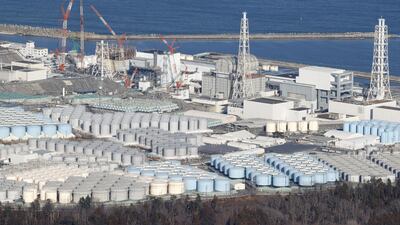
Storage tanks for treated water at the Fukushima nuclear power plant in Okuma, Japan. Reuters -
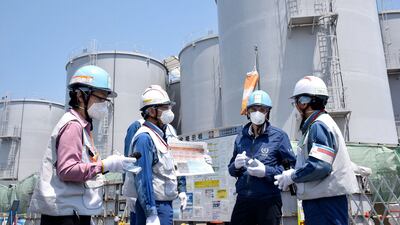
Authorities are set to begin pumping more than a million tonnes of treated radioactive water from the nuclear power plant into the sea. AFP -
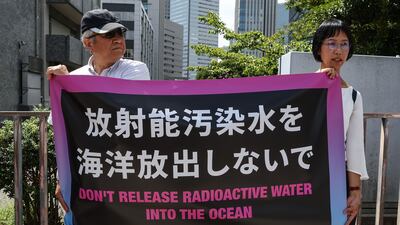
The move has drawn criticism, such as from these protesters outside the Japanese prime minister's official residence. Getty Images -
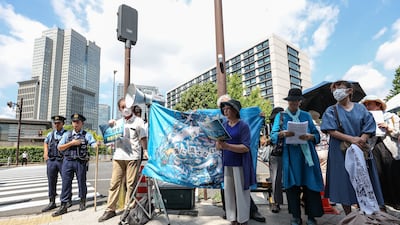
Japan's government plans to release water stored at Fukushima into the Pacific. Getty Images -
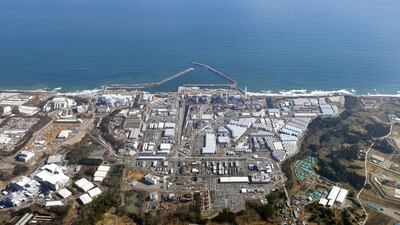
Neighbouring countries have objected, citing fears of radioactive contamination. Reuters -
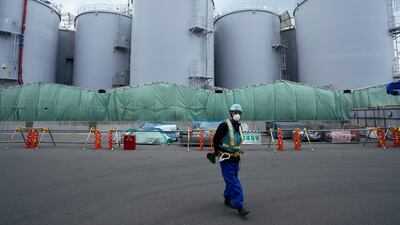
The accumulating water has been stored in tanks at Fukushima since 2011 and Japan says it needs to start releasing it as those containers are full. AP -
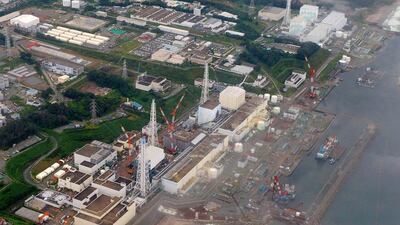
The nuclear meltdown at Fukushima in March 2011 was sparked by a tsunami that swept away towns and cities after a 9.0-magnitude earthquake, leaving more than 20,000 people dead or missing. AP


The water is being released more than 12 years after meltdowns of the plant's rectors caused by a massive earthquake and tsunami that struck on March 11, 2011. The plant has struggled with a growing stockpile of radioactive water that Tepco and the government say have hampered the task of removing the fatally toxic melted debris from the reactors.
The diluted, treated water is being sent from a mixing pool to a secondary pool, from where it will then be discharged into the ocean through an undersea tunnel. The plant has about 1,000 tanks of water that are already filled to 98 per cent of their 1.37-million-tonne capacity.
Safety concerns about the water release are unfounded, according to Nigel Marks, an expert on radioactive waste and an associate professor at Curtin University in Perth. Eating a lifetime’s worth of seafood from near the release site would have “the tritium radiation equivalent of one bite of a banana”, he said.
The International Atomic Energy Agency and Japan’s government have argued that similar releases of tritiated water are commonplace in the nuclear sector, and that Tepco’s proposal involves smaller discharges. A two-year IAEA review found Japan’s strategy would have a negligible impact on people and the environment.
With reporting from agencies.

