
Beijing has been hit by the heaviest rains since records began 140 years ago, its weather service said on Wednesday, as a series of typhoons struck eastern Asia.
Maximum precipitation was 744.8mm, from Saturday evening to Wednesday morning, the Beijing Meteorological Service said.
The highest levels of rain were recorded at the Wangjiayuan Reservoir in Changping district to the north-west of the Chinese capital.
At least 20 people were killed in floods that inundated the capital and other northern parts of China in the wake of Typhoon Doksuri, with more than 127,000 forced to leave their homes in Beijing alone.
At least 11 died in Beijing and 27 others are missing, while nine were killed in Hebei province, where 840,000 people have been evacuated.
China is bracing for its third typhoon in as many weeks as Typhoon Khanun approaches from Japan, where it has killed at least one person and left thousands without power in Okinawa.
Beijing usually has dry summers and had a period of record-breaking heat this year.
Danger from the rain had eased in the capital by Wednesday, but authorities warned that storms are heading north, towards provinces that are key centres for coal-mining and crops.
Also on Wednesday, the agriculture ministry announced $60 million in aid to eight affected provinces unable to export produce after the floods.
Beijing issued its first red flood alert in a decade ahead of Doksuri's arrival.
The city of Xingtai received two years' worth of rainfall in two days, China Meteorological Administration said on Tuesday.
Sixteen weather stations across northern China recorded a new high for daily precipitation, it added.
In Japan, Okinawa's power company said 220,580 households – nearly 35 per cent of the total in the region – were without electricity early on Wednesday.
An evacuation warning for Okinawa and the southern part of Kagoshima region was in place, urging more than 690,000 residents to move to safety, according to the Fire and Disaster Management authority.
Doksuri was one of the strongest typhoons to hit China this year and killed at least 26 people in the Philippines before bringing torrential rains to Taiwan and the Chinese mainland.
-
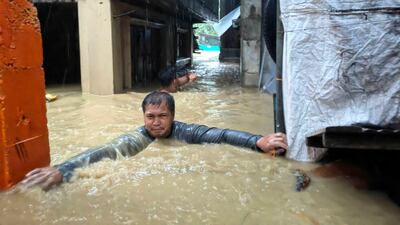
A man negotiates neck-deep floodwaters in Laoag City in the Philippines after Typhoon Doksuri. AP -
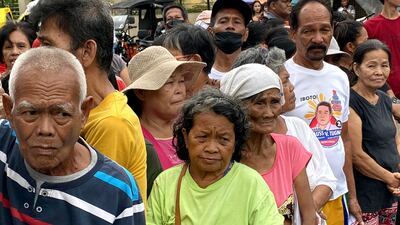
Filipino villagers queue during a relief distribution at a coastal village. EPA -

Enhanced rains brought about by Typhoon Doksuri saw significant flooding in Marikina City, Philippines. AP -
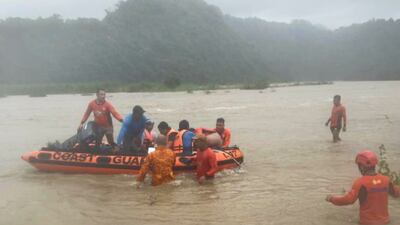
Rescuers use a rubber dinghy to evacuate quarry workers trapped in Naguilian, La Union province, Philippines. AP -
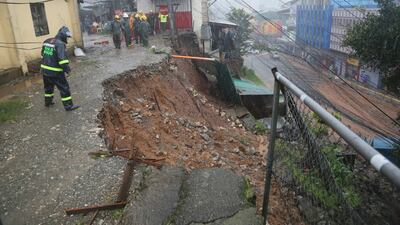
A police officer inspects an area damaged by a landslide caused by Typhoon Doksuri in Baguio City, the Philippines. AP -

The landslide destroyed homes and damaged vehicles in Baguio City. AP -
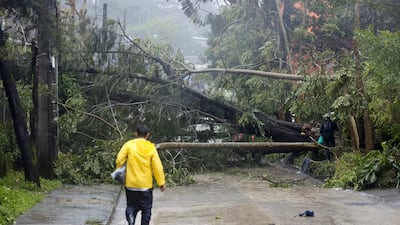
Toppled trees by the typhoon block a road in Baguio City. AP -
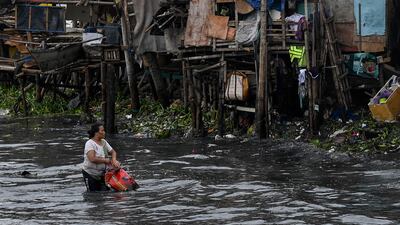
A woman wades through a flooded area in Manila. AFP -
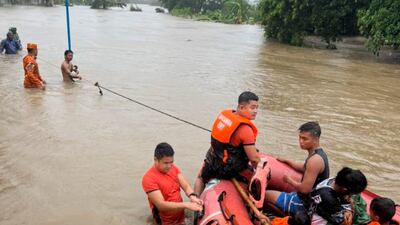
Rescuers evacuate residents to higher ground in Bacarra, in the northern Philippines. AP -
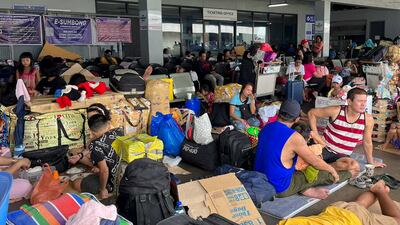
Stranded passengers fill a boarding terminal at a port in Manila after sea travel was suspended due to the typhoon. AP -

This satellite image shows Typhoon Doksuri near the northern Philippines. AP -
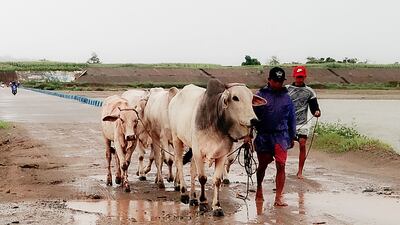
Farmers lead their cows to safety in Ilagan town as Typhoon Doksuri heads towards the northern Philippines. AFP -

Filipinos hold umbrellas as they watch a street performance in Quezon city, Metro Manila. EPA -
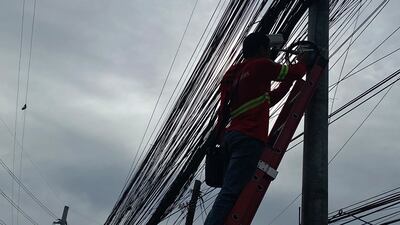
A lineman works on an electric post in Makati city, the Philippines. EPA -
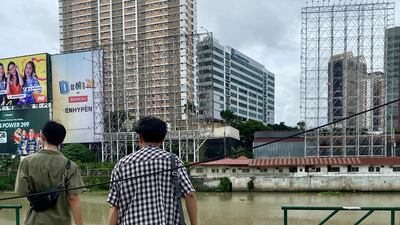
Doksuri is expected to exacerbate seasonal monsoon rains in the central and northern provinces. EPA


Typhoon Khanun has been classed as “very strong” and is expected to make landfall in eastern China later this week.
Other parts of East Asia have also been badly effected by seasonal rains that have worsened with climate change.
More than 40 people were killed in floods in South Korea last month, prompting President Yoon Suk Yeol to call for a complete overhaul of its weather response system.
The reality of climate change must be accepted, he said at the time.

