

Railway services have resumed nearly 50 hours after a deadly three-train crash in India left at least 275 people dead and about 1,100 passengers injured.
Work was completed on the stretch of track at Balasore in Odisha state after the two passenger trains and a freight train crashed into each other in one of the worst train disasters in the country in decades.
A freight train started its journey on the restored tracks near Bahanaga railway station late on Sunday, followed by a semi-high-speed Vande Bharat Express train on Monday.
The freight train was flagged off by Railway Minister Ashwini Vaishnaw.
The train – the first to run on the stretch of track since the accident – was carrying coal and headed to Rourkela Steel Plant in Odisha from a port in the southern city of Vizag. It started the journey at about 10.40pm.
Passenger train services have also resumed on the stretch.
“Down-line restoration complete. First train movement in section,” he wrote alongside a video on Twitter.
On Friday, 21 coaches from the Coromandel Express, which runs between the eastern cities of Kolkata and Chennai, and the Howrah Superfast Express, travelling north between the cities of Bengaluru and Howrah, derailed near Bahanaga station at about 7pm.
The Coromandel Express was travelling at 128kph while the other passenger train was travelling at 126kph, railway officials said.
A freight train standing on an adjoining track was also involved.
There were more than 3,400 passengers travelling in the two trains.
More than 1,000 workers were involved in restoration work at the site. Heavy machinery, including a 140-tonne railway crane and four road cranes, was used.
-

Rescue workers recover victims' bodies from the carriage wreckage of a three-train collision near Balasore, in India's eastern state of Odisha. AFP -
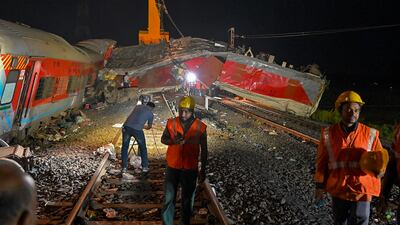
At least 288 people were killed and more than 850 injured in a horrific three-train collision in India, officials said. AFP -
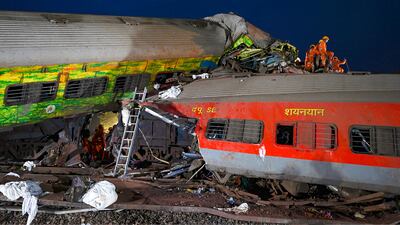
Rescue workers recover victims' bodies from the carriage wreckage of a three-train collision near Balasore, in India's eastern state of Odisha. AFP -
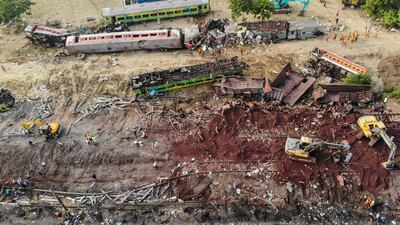
This aerial view shows damaged carriages at the accident site. AFP -
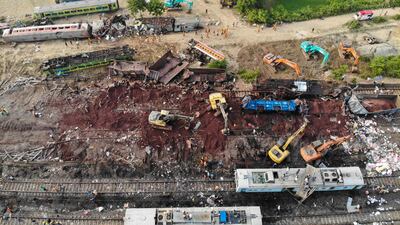
It is the deadliest rail accident in India in 20 years. AFP -

Indian authorities end rescue work and begin clearing mangled wreckage of two passenger trains that derailed in eastern India. AP -

Relatives look at the photographs of unidentified bodies of passengers displayed on laptop. AP -
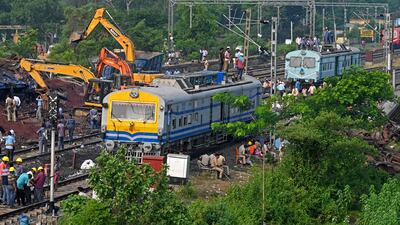
An investigation into the cause of the crash is also being launched. AFP -
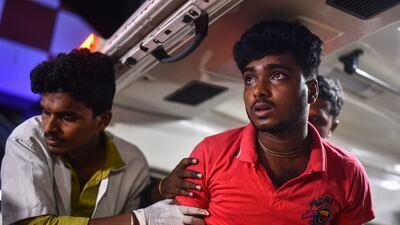
An injured passenger who was affected by the triple train accident in Odisha is transported to Rajiv Gandhi government hospital. EPA -

An injured passenger who was affected by the triple train accident in Odisha is transported to Rajiv Gandhi government hospital. EPA -
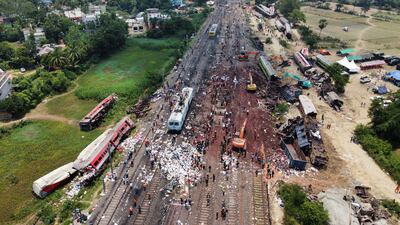
A drone view shows diggers removing damaged coaches following the train collision. Reuters -
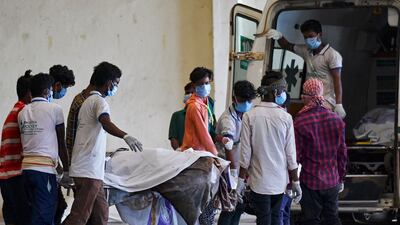
Rescue workers carry the body of a victim at a business park used as a temporary mortuary to identify the dead. AFP -
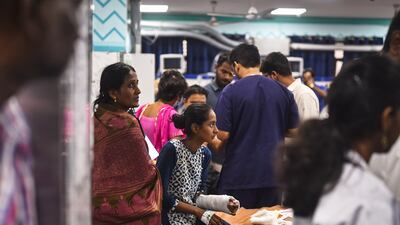
A special medical team with 36 doctors and 30 medical staff provided first aid to the injured passengers. EPA -

Victims' family members weep at a business park used as a temporary mortuary to identify the dead recovered from the carriage wreckage of a three-train collision. AFP -

Passengers with minor injuries have been shifted to the Rajiv Gandhi government hospital for treatment. EPA


The workers cleared the mangled heap of coaches that had either derailed or mounted one another due to the powerful force of the collision. They laid fresh tracks and repaired overhead wires.
On Sunday, officials said the crash was probably caused by human error.
Mr Vaishnaw said it happened due to “a change in electronic interlocking”.
An electronic interlocking system prevents the routes of different trains coming into conflict through the arrangement of the tracks. The aim of the system is to ensure no train is given the signal to proceed unless the route is proven safe.

