



China has called for a ceasefire between Ukraine and Moscow and the opening of peace talks in a 12-point proposal to end the fighting that started one year ago.
“Conflict and war benefit no one. All parties must stay rational and exercise restraint, avoid fanning the flames and aggravating tensions, and prevent the crisis from deteriorating further or even spiralling out of control,” the Chinese government said in a statement on Friday.
Beijing insists it remains neutral on the conflict despite saying it has a “no limits” relationship with Russia and having refused to criticise the invasion of Ukraine or even refer to it as such.
It has accused the West of provoking the conflict and “fanning the flames” by providing Ukraine with defensive arms. The US has also said China may be preparing to provide Russia with military aid, something Beijing says lacks evidence.
The move was cautiously welcomed by Ukraine’s President Volodymyr Zelenskyy.
“I think that, in general, the fact that China started talking about peace in Ukraine, I think that it is not bad. It is important for us that all states are on our side, on the side of justice,” he said at a news conference on Thursday with Spain's prime minister.
Ukraine’s charge d'affaires in Beijing Zhanna Leshchynska also called it a “good sign” and said they expect China to be more active in its support of Ukraine.
“We hope they also urge Russia to stop the war and withdraw its troops,” Ms Leshchynska said.
The 12-point plan issued on Friday morning by China’s Foreign Ministry urges an end of Western sanctions imposed on Russia and includes measures to keep nuclear facilities safe, establish humanitarian corridors for civilians and ensure the export of grain after disruptions inflated global food prices.
It mainly elaborated on long-held Chinese positions, including that all countries' “sovereignty, independence and territorial integrity” be guaranteed.
“Dialogue and negotiation are the only viable way out to resolve Ukraine crisis,” the proposal said.
It offered no details on what form talks should take, any preconditions or which countries should be involved, but said “China is willing to continue to play a constructive role in this regard”.
-
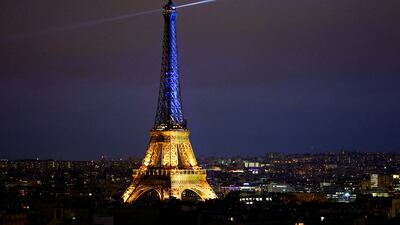
The Eiffel Tower in Paris is lit up in the blue-and-yellow colours of Ukraine. Reuters -
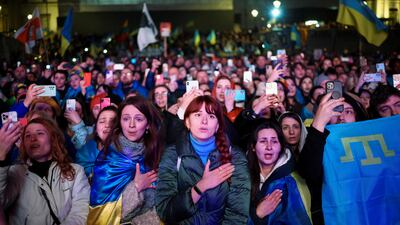
A vigil for Ukraine on the anniversary of the conflict with Russia, at Trafalgar Square in London on February 23. Reuters -

Ukrainians at the London vigil. EPA -
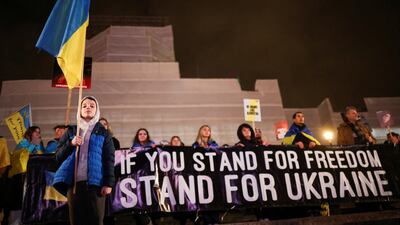
A child holds a Ukrainian flag during the Trafalgar Square vigil. Reuters -
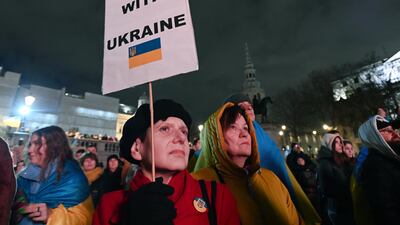
Ukrainians at Trafalgar Square. EPA -
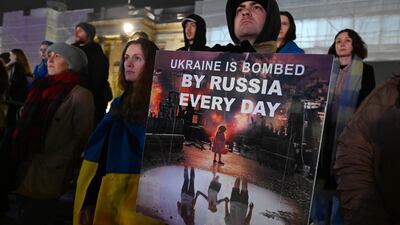
Ukrainians at Trafalgar Square. EPA -
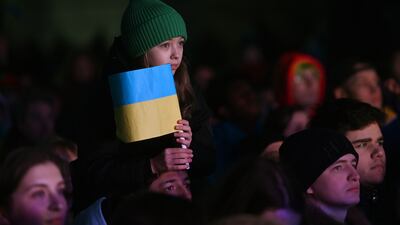
A young girl sits on her father's shoulders at the gathering. EPA -
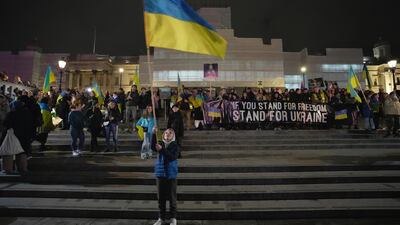
The Trafalgar Square vigil organised by the Ukrainian and US embassies in London for the one-year anniversary of the Russian invasion. AP -
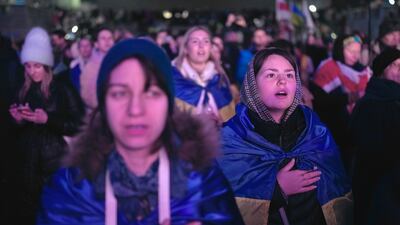
The Trafalgar Square vigil organised by the Ukrainian and US embassies in London for the one-year anniversary of the Russian invasion. AP -
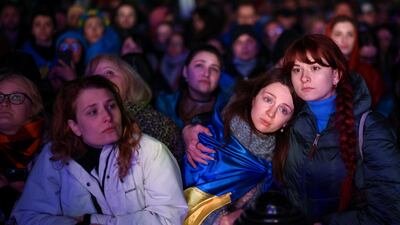
The Trafalgar Square vigil organised by the Ukrainian and US embassies in London for the one-year anniversary of the Russian invasion. Reuters -
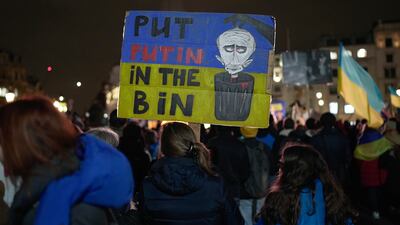
The Trafalgar Square vigil organised by the Ukrainian and US embassies in London for the one-year anniversary of the Russian invasion. AP -

A father carries a child on his shoulders at the vigil. AP -

The vigil at Trafalgar Square on Thursday. AP -
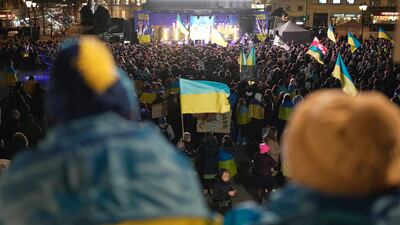
The vigil at Trafalgar Square on Thursday. AP -

The vigil at Trafalgar Square on Thursday. Reuters -
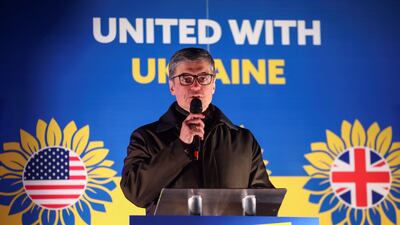
The Ukrainian ambassador to the UK, Vadym Prystaiko, addresses the London Vigil. Reuters -
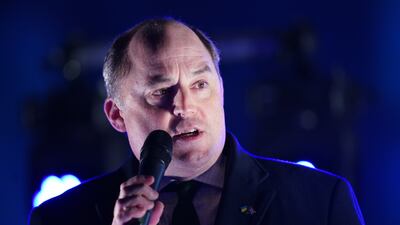
British Defence Secretary Ben Wallace, speaks at the vigil. PA -
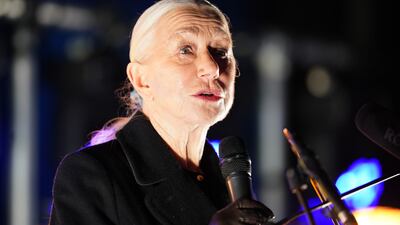
Actress and activist Helen Mirren addresses the London vigil. PA -

Tourists in Paris with balloons as the Eiffel Tower is lit in Ukraine's colours. AP -
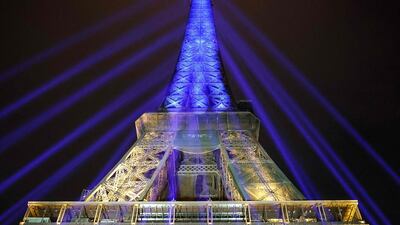
The Eiffel Tower light show in support of Ukraine. AFP -
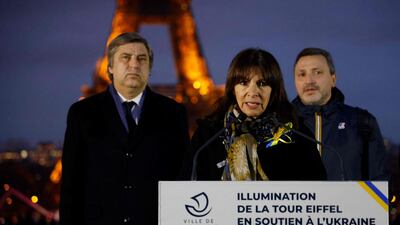
Paris Mayor Anne Hidalgo speaks alongside the Ukrainian ambassador to France, Vadym Omelchenko, during an event to light Eiffel Tower in the colours of the Ukrainian flag on Thursday. AFP -
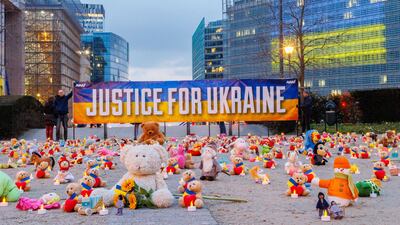
Avaaz activists and Ukrainian refugees on Thursday leave thousands of children's teddy bears and toys at Schuman Roundabout in front of the European Commission in Brussels to highlight the reported abduction 6,000 Ukrainian children by Russia. AP for Avaaz. org -
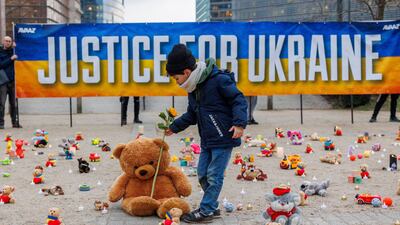
A Ukrainian refugee leaves a teddy bear in front of the European Commission building in Brussels. AP for Avaaz.org -
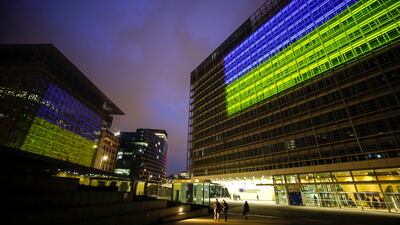
The EU Council and Commission buildings are lit in the colours of the Ukrainian flag on Thursday night. EPA


It also called an end to the “Cold War mentality” — China's standard term for what it regards as US hegemony, interference in other countries' affairs and maintenance of alliances such as Nato.
“A country’s security cannot be at the expense of other countries’ security, and regional security cannot be guaranteed by strengthening or even expanding military blocs,” the proposal said.
“The legitimate security interests and concerns of all countries should be taken seriously and properly addressed.”
China abstained on Thursday when the UN General Assembly approved a non-binding resolution that calls for Russia to end hostilities in Ukraine and withdraw its forces.
It is one of 16 countries that either voted against or abstained on almost all of five previous resolutions on Ukraine.
India, which has sought to balance relations with Russia and the West, also abstained.
State Department spokesman Ned Price said earlier on Thursday that the US would reserve judgment on China’s proposal but that Beijing’s allegiance with Russia meant it was not a neutral mediator.
However, he said China’s relationship with Russia put it in a good position for such proposals.
“[We hope that] all countries that have a relationship with Russia unlike the one that we have will use that leverage, will use that influence to push Russia meaningfully and usefully to end this brutal war of aggression. [China] is in a position to do that in ways that we just aren’t.”
The EU’s ambassador to China, Jorge Toledo, said they were studying the proposal.
“If the position paper is a positive sign for Ukraine then it's a positive sign for the EU, although we are studying the paper closely,” he said.
Russian President Vladimir Putin on Thursday hailed “new frontiers” in ties between Moscow and Beijing and signalled China's leader Xi Jinping would visit. Xi is expected to deliver a “peace speech” on Friday.
Foreign Minister Wang Yi reaffirmed the strength of their bilateral ties when he met with Russian President Vladimir Putin in Moscow this week.
However, China has said that Ukraine conflict is “not something it wishes to see”, and has repeatedly said any use of nuclear weapons would be completely unacceptable, in an implied repudiation of Putin’s statement that Russia would use “all available means” to protect its territory.
The line was reiterated in Beijing’s peace plan proposal.
“There are no winners in conflict wars,” it said.
“All parties should maintain rationality and restraint … support Russia and Ukraine to meet each other, resume direct dialogue as soon as possible, gradually promote the de-escalation and relaxation of the situation, and finally reach a comprehensive ceasefire,” it said.
Shi Yinhong, a professor of international relations at Beijing’s Renmin University, said China's proposal was necessary.
“China’s peace proposal does not change but combines its comprehensive positions on the crisis and war in Ukraine,” Mr Shi told AP.
China's position “always falls far short of Russia's preference but still meet criticism from the West and its allies”, Mr Shi said.
“China feels it necessary to repeat its self-perceived neutrality at this juncture, to save some international inference by not only criticising Nato but also distinguishing itself from Russia’s behaviour.”

