
Ten years after the Pakistan Taliban shot Malala Yousafzai for insisting on her right to education, schoolgirls in her home district of Swat in Khyber Pakhtunkhwa province say the assassination attempt only makes them more determined to pursue their studies and to speak up for their rights.
At the Khushal School and College (KSC) where Malala studied, Marjan, a 15-year-old student in Class 10 who goes by only her first name, pointed out the activist’s famous quotation; “One child, one teacher, one book and one pen can change the world”, inscribed on the school’s walls.
“One day someone will be quoting me like Malala,” she said.
Marjan and other girls at the school say they think about one day winning the Nobel Peace Prize like Malala, who became the youngest recipient of the honour in 2014, or even writing a book like her autobiography, I Am Malala.
-
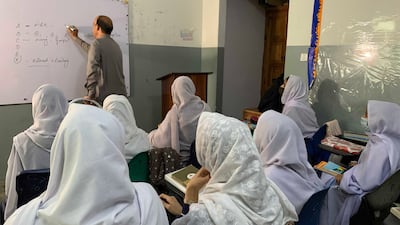
Iqbal Hussain, a member of the faculty at Khushal School and College in Pakistan's Swat region where Malala Youafzai was a pupil, teaches science to 10th grade pupils. All photos: Tariq Ullah for The National -

Iqbal Hussain, a staff member at Khushal School and College, says there has been a surge in enrolment of girl pupils after the Taliban attempt to kill on Malala on October 9, 2012, for speaking up for girls' right to education. -

Laila Khan shows a sketch to her psychology teacher in Khushal School and College, Mingora, a city in the Swat district of Pakistan's Khyber Pakhtunkhwa province. -
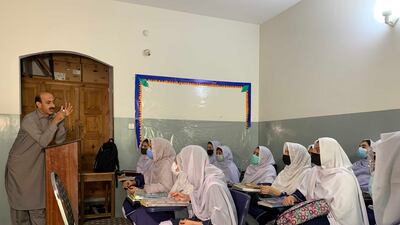
Iqbal Hussain teaches a class. -
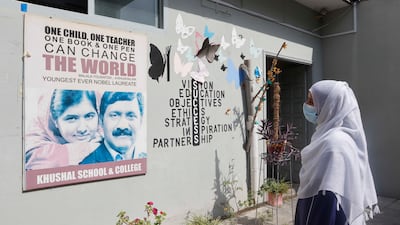
Marjan looks at a poster of Malala and her father, Ziauddin Yousafzai, on a wall at Khushal School and College. -

The classroom where Malala used to study at Khushal School and College. Malala, now 25, gained worldwide attention when she and two friends were shot on a school bus by Pakistani Taliban militants in 2012. -

Malala's picture, along with some of her quotes, on a school notice board. -

Marjan, a pupil, writes in her notebook. -

School director Huma Shakir at work in her office. -

Faiza Shah, a psychologist, takes a class. -
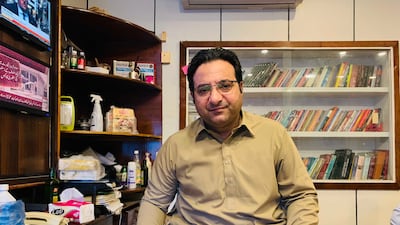
Fayaz Zafar, a journalist who has covered the Taliban insurgency in Swat, poses for a picture in his office in Mingora. -

Minahil, a pupil at Khushal School and College, finishes her class. -
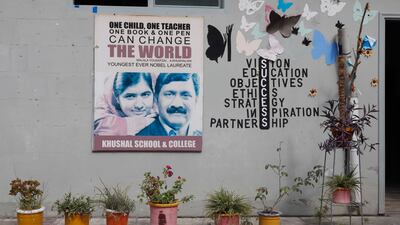
An image of Malala and her father. -
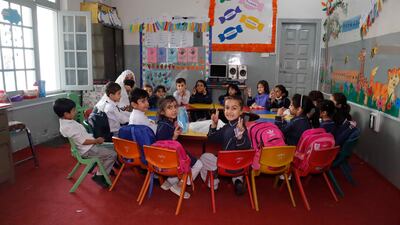
A nursery class poses for a photo at Khushal School and College. -

Tenth-grade pupils look at Malala's picture. -

Young children at play in Khushal School and College. -

The school's nursery class enjoying extracurricular activities. -
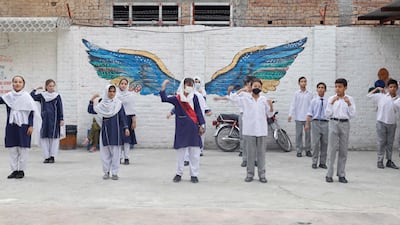
Pupils take part in a sports class.


Militants shot Malala, then aged 15, and two of her friends on a bus as they were returning from school on October 9, 2012. The attack was claimed by the outlawed Tehreek-i-Taliban Pakistan (TTP), commonly known as the Pakistani Taliban.
The hardline group, which was largely driven out of Swat in a military operation between 2007 and 2009, had issued a ban on girls attending school. However, Malala insisted on continuing her education.
Her teacher Iqbal Hussain recalled getting a phone call from Malala’s father Ziauddin Yousafzai to ask why she had not returned home. But news of the attack soon spread through the region and teachers rushed to the Swat Teaching Hospital in the Saidu Sharif area where Malala was taken, he said.
Surge in enrolment
Panicked parents tried to stop their daughters from attending school after the attack, Mr Iqbal told The National.
“I want to pay tribute to the brave girls of Swat because at that time their parents were not allowing them to go to school, but they protested and insisted on coming,” he said.
He said girls in Swat were inspired by Malala and there had been a surge in enrolment.
Marjan, whose ambition is to become a lawyer, said she chose to attend KSC because of Malala.
“I am still getting inspiration because Malala studied here,” she said, noting that the Taliban attack did not stop Malala from completing her education and becoming a voice for women’s rights.
Other students feel the same way, she said.
“There are girls in my school who are poor and orphans and have nothing but still they want to complete their studies.”
Huma Shakir, the school’s director, said the Taliban’s attack was not just on Malala but on education.
“If I just use the word terrorism, it wouldn’t be enough,” Ms Shakir told The National.
“The target was not Malala but education and women’s education.”
director, Khushal School and College
Instead, the incident changed children’s outlook and broadened their horizons.
“Everyone has come to know that a girl from Swat can win a Nobel Prize, and our dreams have grown,” Ms Shakir said.
“I've seen see two or three students in school saying that we should author a book.”
She said people in Swat respected women and valued their education, with parents comparing their daughters not in terms of dowry, fashion, beauty or money, but by their academic achievements.
Taliban threat looms again
But people fear the Taliban are making a comeback in Swat, despite government assurances to the contrary, after several attacks in the past month.
A bomb blast on September 13, which killed a former member of the civilian resistance to the Taliban's rule and seven other people, was followed a few weeks later by the abduction of a policeman and two military officers. The Taliban have released video of their captives.
Fayaz Zafar, a local journalist who has covered militancy in the area, said the Taliban were taking a different approach from their early days.
Before launching their insurgency and seizing control of Swat, the Taliban had first infiltrated local communities, slowly gaining people's confidence through religious sermons and charity work, Zafar said.
“In this new resurrection, the Taliban have directly taken up weapons,” he said.
However, this time people have been quick to show their opposition to the militants, with thousands staging demonstrations against their return and calling for peace in Swat.
Such protests were rare when the Taliban previously had a presence in the area, Zafar said.
High-profile target
Irfan Ashraf, a professor at Peshawar University’s journalism department and author of the book The Dark Side of News Fixing, says the media, including himself, were partly responsible for the Taliban targeting Malala.
Before the attack that made her an international household name, Malala was known in Pakistan for her active and outspoken support for girls' education in the face of opposition from hardliners. Besides addressing public meetings, she also appeared on local television, including an interview with celebrity TV anchor Hamid Mir on the widely watched Geo channel.
Mr Ashraf said he sought out Malala after the Taliban announced they were closing girls’ schools in January 2009, months before they were driven out of Swat by the military.
“I wanted to have a report on girls' education in Swat and Malala’s father agreed that his daughter could talk to me,” he said.
That same year, Mr Ashraf was offered the role of co-producer for a New York Times documentary on girls' education in Swat in which it was decided that Malala would be the key character.
“Initially, Malala’s narrative wasn’t against the Taliban but for the right to education,” he said, “but the media turned the narrative and it became ‘Malala against the Taliban’ and led to the attempt on her life.”

