India's 100-metre-high Noida 'Twin Towers' demolished


Taniya Dutta
  • English
  • Arabic

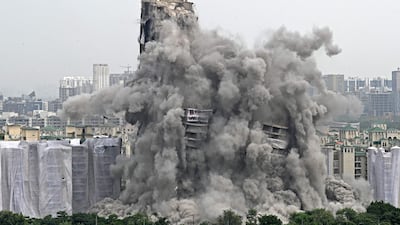
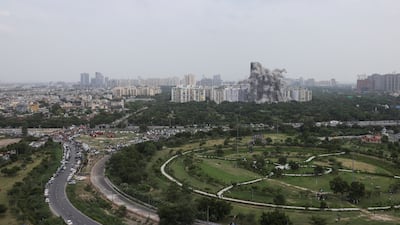
Two 100-metre-high residential towers collapsed with a loud thud into a huge cloud of dust in Delhi’s satellite city Noida on Sunday, marking a rare legal victory against illegal construction by India's big developers.

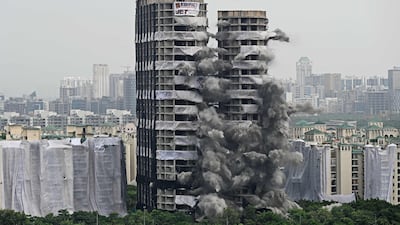
The Apex and Ceyane buildings, commonly called the "Twin Towers", crumbled in less than 10 seconds as 3,700 kilograms of explosives were detonated to carry out the Supreme Court's demolition order.

The developer Supertech began constructing the towers inside an existing housing complex more than a decade ago. However, it was forced to stop work in 2011 when residents of the area filed a lawsuit claiming the buildings breached municipal laws.

Hundreds of people had gathered to witness the demolition in Noida, about 25 kilometres south-east of New Delhi, as police struggled to keep onlookers outside a 500-metre, cordoned-off safety zone.

The crowd cheered and booed as a massive explosion shook the ground and the towers came down crashing at 2.30pm local time.

Ram Bir, 36, said he came from nearby Greater Noida city to witness the “historic” demolition, but also questioned how they were built in the first place.

We are here to see how these huge buildings will crash down but I am curious how these towers could be erected if they were illegal
Ram Bir,
resident of Greater Noida

"We are here to see how these huge buildings will crash down, but I am curious how these towers could be erected if they were illegal. What was the government doing?” he told The National.

People also watched from the balconies and terraces of buildings and other vantage points.

"This is the first time I have seen something like this. I was both scared and excited," said Siraj Ansari, who witnessed the demolition from a nearby bridge.

The demolition was carried out after authorities evacuated nearly 7,000 residents from nearby buildings and posted hundreds of police and emergency workers in the area.

Stray animals were also removed, and the area was declared a no-fly zone for 30 minutes during the demolition.

Buildings around the Twin Towers were covered with geotextile fabric to protect them from damage.

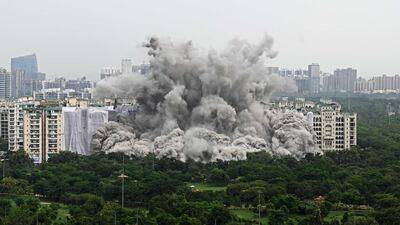
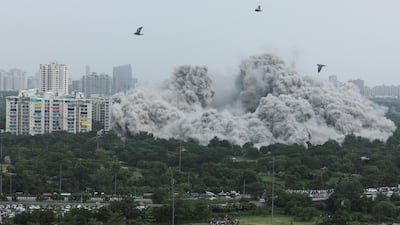
Officials said the demolition left nearly 60,000 tonnes of concrete debris and a cloud of dust 60 storeys high.

More than 100 water tankers and smog guns were used to control the dust and air pollution.

Some of the debris will be used to fill in the basements of the towers.

The demolition was carried out with about 3,700kg of explosives packed into about 10,000 holes drilled into the buildings.

The final checks began at noon on Sunday, before the explosives were charged for detonation.

Utkarsh Mehta, chief executive of Edifice Engineering, the company that carried out the demolition, said it would be "like a waterfall, so that it will slowly and steadily will come down to the ground and the impact and vibration would be reduced”.

Some media reports said the demolition had partially failed as parts of the towers did not fall as planned and landed next to a residential complex.

Officials said residents were to be allowed back into their homes later on Sunday after engineers assessed the situation and defused any leftover explosives.

The demolition is one of the biggest carried out so far in a country that has a chronic problem of illegal construction.

Four luxury high-rise apartments were demolished with explosives in the southern Kerala state in 2020 after they were found to be built in an environmentally sensitive zone.

  • On Sunday, the crack of thousands of kilograms of explosives that rang across Noida, a satellite city of New Delhi, brought an end to one of India’s most notorious property scandals and reduced two illegal 100-metre-high residential towers to rubble. Photo: AFP
    On Sunday, the crack of thousands of kilograms of explosives that rang across Noida, a satellite city of New Delhi, brought an end to one of India’s most notorious property scandals and reduced two illegal 100-metre-high residential towers to rubble. Photo: AFP
  • Construction on Apex and Ceyanne buildings, popularly known as the Twin Towers, stopped after residents brought a lawsuit against developer Supertech that claimed they violated the site plan and blocked air and sunlight to hundreds of nearby homes. Photo: AFP
    Construction on Apex and Ceyanne buildings, popularly known as the Twin Towers, stopped after residents brought a lawsuit against developer Supertech that claimed they violated the site plan and blocked air and sunlight to hundreds of nearby homes. Photo: AFP
  • A controlled implosion brought the towers down after the Supreme Court ruled in favour of the residents. Photo: AFP
    A controlled implosion brought the towers down after the Supreme Court ruled in favour of the residents. Photo: AFP
  • A homebuyers’ group said the Supreme Court ruling was not enough to reform the planning system. Reuters
    A homebuyers’ group said the Supreme Court ruling was not enough to reform the planning system. Reuters
  • Some experts say the demolition of the Supertech Twin Towers will send a stern message to the property sector to follow the law. Reuters
    Some experts say the demolition of the Supertech Twin Towers will send a stern message to the property sector to follow the law. Reuters
  • Campaigners who fought against the Twin Towers say corruption and greed in India's property sector have left thousands of homebuyers in jeopardy. Reuters
    Campaigners who fought against the Twin Towers say corruption and greed in India's property sector have left thousands of homebuyers in jeopardy. Reuters
  • Police barricades went up in Noida as time for the Twin Towers to come down grew closer. AFP
    Police barricades went up in Noida as time for the Twin Towers to come down grew closer. AFP
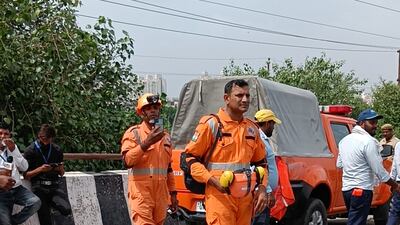
  • About 500 police officers and teams of National Defence Rescue Forces personnel were on duty at the site. Taniya Dutta for The National
    About 500 police officers and teams of National Defence Rescue Forces personnel were on duty at the site. Taniya Dutta for The National
  • Hundreds of people gathered to watch the demolition outside the cordon and police had to keep some onlookers from trying to get too close. Taniya Dutta for The National
    Hundreds of people gathered to watch the demolition outside the cordon and police had to keep some onlookers from trying to get too close. Taniya Dutta for The National
  • Nearby buildings were covered with geotextile fabric to protect them from damage as the Twin Towers collapsed. Taniya Dutta for The National
    Nearby buildings were covered with geotextile fabric to protect them from damage as the Twin Towers collapsed. Taniya Dutta for The National

Illegal structures

Construction on the Twin Towers was halted in 2011 after a legal challenge by residents of the housing complex where they were being built.

The residents said the buildings breached the site plan because the land had been earmarked for a garden, and complained that they also blocked air and sunlight to hundreds of existing dwellings.

The Allahabad High Court in Uttar Pradesh ordered their demolition in 2014, a ruling that was upheld by the Supreme Court in 2021.

Court documents showed that Supertech, which also built the existing residential complex, had colluded with authorities to construct the towers.

In a statement released shortly before the demolition, Supertech said the towers had received proper permissions but were ordered demolished on technical grounds.

"The building plans of the project including the two towers were approved by the Noida Authority in 2009, which was strictly in accordance with the-then prevailing Building Bye-laws announced by the State Government," the company said.

"However, the Hon'ble Supreme Court has not found the construction satisfactory on technical grounds and accordingly issued orders to demolish the two towers. We respect the orders of the Apex Court and are committed to implementing the same."

The Supreme Court has ordered the developer to refund payments from buyers of homes in the towers, together with 12 per cent interest. The developer must also pay 20 million rupees (about $250,000) to the residents’ welfare association of the housing complex.


The biog

Favourite Emirati dish: Fish machboos

Favourite spice: Cumin

Family: mother, three sisters, three brothers and a two-year-old daughter

World record transfers

1. Kylian Mbappe - to Real Madrid in 2017/18 - €180 million (Dh770.4m - if a deal goes through)
2. Paul Pogba - to Manchester United in 2016/17 - €105m
3. Gareth Bale - to Real Madrid in 2013/14 - €101m
4. Cristiano Ronaldo - to Real Madrid in 2009/10 - €94m
5. Gonzalo Higuain - to Juventus in 2016/17 - €90m
6. Neymar - to Barcelona in 2013/14 - €88.2m
7. Romelu Lukaku - to Manchester United in 2017/18 - €84.7m
8. Luis Suarez - to Barcelona in 2014/15 - €81.72m
9. Angel di Maria - to Manchester United in 2014/15 - €75m
10. James Rodriguez - to Real Madrid in 2014/15 - €75m

The%20specs%3A%202024%20Mercedes%20E200
%3Cp%3E%3Cstrong%3EEngine%3A%20%3C%2Fstrong%3E2.0-litre%20four-cyl%20turbo%20%2B%20mild%20hybrid%0D%3Cbr%3E%3Cstrong%3EPower%3A%20%3C%2Fstrong%3E204hp%20at%205%2C800rpm%20%2B23hp%20hybrid%20boost%0D%3Cbr%3E%3Cstrong%3ETorque%3A%20%3C%2Fstrong%3E320Nm%20at%201%2C800rpm%20%2B205Nm%20hybrid%20boost%0D%3Cbr%3E%3Cstrong%3ETransmission%3A%20%3C%2Fstrong%3E9-speed%20auto%0D%3Cbr%3E%3Cstrong%3EFuel%20consumption%3A%20%3C%2Fstrong%3E7.3L%2F100km%0D%3Cbr%3E%3Cstrong%3EOn%20sale%3A%20%3C%2Fstrong%3ENovember%2FDecember%0D%3Cbr%3E%3Cstrong%3EPrice%3A%20%3C%2Fstrong%3EFrom%20Dh205%2C000%20(estimate)%3C%2Fp%3E%0A
The burning issue

The internal combustion engine is facing a watershed moment – major manufacturer Volvo is to stop producing petroleum-powered vehicles by 2021 and countries in Europe, including the UK, have vowed to ban their sale before 2040. The National takes a look at the story of one of the most successful technologies of the last 100 years and how it has impacted life in the UAE.

Part three: an affection for classic cars lives on

Read part two: how climate change drove the race for an alternative 

Read part one: how cars came to the UAE

Traces%20of%20Enayat
%3Cp%3E%3Cstrong%3EAuthor%3A%3C%2Fstrong%3E%20Iman%20Mersal%3Cbr%3E%3Cstrong%3EPublisher%3A%3C%2Fstrong%3E%20And%20Other%20Stories%3Cbr%3E%3Cstrong%3EPages%3A%3C%2Fstrong%3E%20240%3C%2Fp%3E%0A
Ten tax points to be aware of in 2026

1. Domestic VAT refund amendments: request your refund within five years

If a business does not apply for the refund on time, they lose their credit.

2. E-invoicing in the UAE

Businesses should continue preparing for the implementation of e-invoicing in the UAE, with 2026 a preparation and transition period ahead of phased mandatory adoption. 

3. More tax audits

Tax authorities are increasingly using data already available across multiple filings to identify audit risks. 

4. More beneficial VAT and excise tax penalty regime

Tax disputes are expected to become more frequent and more structured, with clearer administrative objection and appeal processes. The UAE has adopted a new penalty regime for VAT and excise disputes, which now mirrors the penalty regime for corporate tax.

5. Greater emphasis on statutory audit

There is a greater need for the accuracy of financial statements. The International Financial Reporting Standards standards need to be strictly adhered to and, as a result, the quality of the audits will need to increase.

6. Further transfer pricing enforcement

Transfer pricing enforcement, which refers to the practice of establishing prices for internal transactions between related entities, is expected to broaden in scope. The UAE will shortly open the possibility to negotiate advance pricing agreements, or essentially rulings for transfer pricing purposes. 

7. Limited time periods for audits

Recent amendments also introduce a default five-year limitation period for tax audits and assessments, subject to specific statutory exceptions. While the standard audit and assessment period is five years, this may be extended to up to 15 years in cases involving fraud or tax evasion. 

8. Pillar 2 implementation 

Many multinational groups will begin to feel the practical effect of the Domestic Minimum Top-Up Tax (DMTT), the UAE's implementation of the OECD’s global minimum tax under Pillar 2. While the rules apply for financial years starting on or after January 1, 2025, it is 2026 that marks the transition to an operational phase.

9. Reduced compliance obligations for imported goods and services

Businesses that apply the reverse-charge mechanism for VAT purposes in the UAE may benefit from reduced compliance obligations. 

10. Substance and CbC reporting focus

Tax authorities are expected to continue strengthening the enforcement of economic substance and Country-by-Country (CbC) reporting frameworks. In the UAE, these regimes are increasingly being used as risk-assessment tools, providing tax authorities with a comprehensive view of multinational groups’ global footprints and enabling them to assess whether profits are aligned with real economic activity. 

Contributed by Thomas Vanhee and Hend Rashwan, Aurifer

Updated: August 29, 2022, 6:04 AM