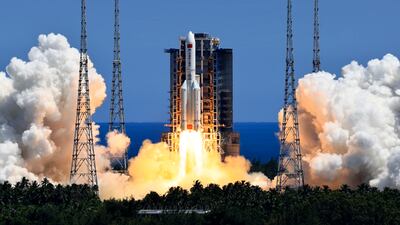
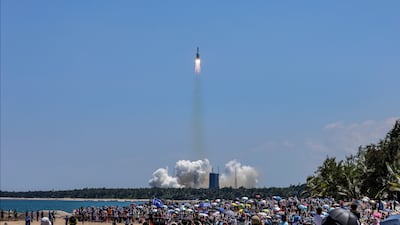
Large pieces of metal found in Indonesian and Malaysian villages are thought to be debris from a Chinese rocket that made an uncontrolled re-entry into Earth earlier this week.
One huge piece was discovered at a village on the Indonesian side of the Malaysian-Indonesian border on Monday, local media reported.
On July 30, remnants of the Long March 5B, China’s largest rocket, fell back to Earth after a fiery re-entry over the Indian Ocean.
Videos of what is believed to be the debris entering the atmosphere was captured by people in Malaysia and Indonesia, which quickly went viral.
We strongly advise everyone to not approach the location due to suspected presence of radioactive substance in the object
Indonesian police statement
Villagers and police at the border investigated a 5-metre long and 2-metre wide charred metal piece that was found.
“We have cordoned off the site to prevent intruders from coming in,” an Indonesian police officer told local media.
“We strongly advise everyone to not approach the location due to suspected presence of radioactive substance in the object,” he said, adding that his team would co-ordinate with the West Kalimantan police in handling the situation.
“For now, the origin of the object is not known for sure, but on Saturday night at 23.09pm (12.09am Malaysian time), some residents in Pengadang did hear a ‘loud roar from the sky’,” he said.
A resident in the area reported the sighting of the debris to the village chief, after suspecting that it could be remnants from the rocket.
Similar unidentified objects have also been discovered in parts of Malaysia.
Jonathan McDowell, an astrophysicist at the Harvard-Smithsonian Centre for Astrophysics, told The Guardian that the metal appeared to be the same size as the Chinese rocket’s core stage.
“It looks like the end cap of a rocket stage propellant tank,” he said.
“There’s no doubt in my mind that it’s from the rocket … it’s in the right place at the right time and looks like it is from the right kind of rocket.”
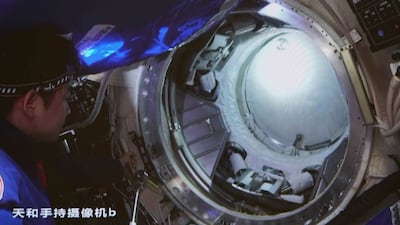
The rocket was launched on July 24 and carried the Wentian space station module into orbit.
During the core stage’s re-entry, most of the debris reportedly burnt up in the atmosphere, but up to 40 per cent could have survived.
China had said that the pieces fell into the Sulu Sea, in the south-western area of the Philippines.
Nasa administrator Bill Nelson criticised China for not sharing a trajectory of the rocket debris.
“The People’s Republic of China did not share specific trajectory information as their Long March 5B rocket fell back to Earth,” he said.
“All spacefaring nations should follow established best practices, and do their part to share this type of information in advance to allow reliable predictions of potential debris impact risk, especially for heavy-lift vehicles, like the Long March 5B, which carry a significant risk of loss of life and property.”
Last year in May, remnants of another Long March 5B made an uncontrolled re-entry into Earth’s atmosphere and fell into the Indian Ocean.
The event caused anxiety and a sharp rebuke from the US space agency.
Another uncontrolled re-entry is expected in October when China launches its Mengtian module into orbit.
These modules will help complete China’s Tiangong space station in low-Earth orbit.
.

Living in...
This article is part of a guide on where to live in the UAE. Our reporters will profile some of the country’s most desirable districts, provide an estimate of rental prices and introduce you to some of the residents who call each area home.
Mercer, the investment consulting arm of US services company Marsh & McLennan, expects its wealth division to at least double its assets under management (AUM) in the Middle East as wealth in the region continues to grow despite economic headwinds, a company official said.
Mercer Wealth, which globally has $160 billion in AUM, plans to boost its AUM in the region to $2-$3bn in the next 2-3 years from the present $1bn, said Yasir AbuShaban, a Dubai-based principal with Mercer Wealth.
“Within the next two to three years, we are looking at reaching $2 to $3 billion as a conservative estimate and we do see an opportunity to do so,” said Mr AbuShaban.
Mercer does not directly make investments, but allocates clients’ money they have discretion to, to professional asset managers. They also provide advice to clients.
“We have buying power. We can negotiate on their (client’s) behalf with asset managers to provide them lower fees than they otherwise would have to get on their own,” he added.
Mercer Wealth’s clients include sovereign wealth funds, family offices, and insurance companies among others.
From its office in Dubai, Mercer also looks after Africa, India and Turkey, where they also see opportunity for growth.
Wealth creation in Middle East and Africa (MEA) grew 8.5 per cent to $8.1 trillion last year from $7.5tn in 2015, higher than last year’s global average of 6 per cent and the second-highest growth in a region after Asia-Pacific which grew 9.9 per cent, according to consultancy Boston Consulting Group (BCG). In the region, where wealth grew just 1.9 per cent in 2015 compared with 2014, a pickup in oil prices has helped in wealth generation.
BCG is forecasting MEA wealth will rise to $12tn by 2021, growing at an annual average of 8 per cent.
Drivers of wealth generation in the region will be split evenly between new wealth creation and growth of performance of existing assets, according to BCG.
Another general trend in the region is clients’ looking for a comprehensive approach to investing, according to Mr AbuShaban.
“Institutional investors or some of the families are seeing a slowdown in the available capital they have to invest and in that sense they are looking at optimizing the way they manage their portfolios and making sure they are not investing haphazardly and different parts of their investment are working together,” said Mr AbuShaban.
Some clients also have a higher appetite for risk, given the low interest-rate environment that does not provide enough yield for some institutional investors. These clients are keen to invest in illiquid assets, such as private equity and infrastructure.
“What we have seen is a desire for higher returns in what has been a low-return environment specifically in various fixed income or bonds,” he said.
“In this environment, we have seen a de facto increase in the risk that clients are taking in things like illiquid investments, private equity investments, infrastructure and private debt, those kind of investments were higher illiquidity results in incrementally higher returns.”
The Abu Dhabi Investment Authority, one of the largest sovereign wealth funds, said in its 2016 report that has gradually increased its exposure in direct private equity and private credit transactions, mainly in Asian markets and especially in China and India. The authority’s private equity department focused on structured equities owing to “their defensive characteristics.”
The specs: 2017 Ford F-150 Raptor
Price, base / as tested Dh220,000 / Dh320,000
Engine 3.5L V6
Transmission 10-speed automatic
Power 421hp @ 6,000rpm
Torque 678Nm @ 3,750rpm
Fuel economy, combined 14.1L / 100km
The biog
Title: General Practitioner with a speciality in cardiology
Previous jobs: Worked in well-known hospitals Jaslok and Breach Candy in Mumbai, India
Education: Medical degree from the Government Medical College in Nagpur
How it all began: opened his first clinic in Ajman in 1993
Family: a 90-year-old mother, wife and two daughters
Remembers a time when medicines from India were purchased per kilo
UAE currency: the story behind the money in your pockets
FIXTURES
Thursday
Dibba v Al Dhafra, Fujairah Stadium (5pm)
Al Wahda v Hatta, Al Nahyan Stadium (8pm)
Friday
Al Nasr v Ajman, Zabeel Stadium (5pm)
Al Jazria v Al Wasl, Mohammed Bin Zayed Stadium (8pm)
Saturday
Emirates v Al Ain, Emirates Club Stadium (5pm)
Sharjah v Shabab Al Ahli Dubai, Sharjah Stadium (8pm)
The biog
Name: Timothy Husband
Nationality: New Zealand
Education: Degree in zoology at The University of Sydney
Favourite book: Lemurs of Madagascar by Russell A Mittermeier
Favourite music: Billy Joel
Weekends and holidays: Talking about animals or visiting his farm in Australia
The National's picks
4.35pm: Tilal Al Khalediah
5.10pm: Continous
5.45pm: Raging Torrent
6.20pm: West Acre
7pm: Flood Zone
7.40pm: Straight No Chaser
8.15pm: Romantic Warrior
8.50pm: Calandogan
9.30pm: Forever Young
How the bonus system works
The two riders are among several riders in the UAE to receive the top payment of £10,000 under the Thank You Fund of £16 million (Dh80m), which was announced in conjunction with Deliveroo's £8 billion (Dh40bn) stock market listing earlier this year.
The £10,000 (Dh50,000) payment is made to those riders who have completed the highest number of orders in each market.
There are also riders who will receive payments of £1,000 (Dh5,000) and £500 (Dh2,500).
All riders who have worked with Deliveroo for at least one year and completed 2,000 orders will receive £200 (Dh1,000), the company said when it announced the scheme.
UAE currency: the story behind the money in your pockets
Who's who in Yemen conflict
Houthis: Iran-backed rebels who occupy Sanaa and run unrecognised government
Yemeni government: Exiled government in Aden led by eight-member Presidential Leadership Council
Southern Transitional Council: Faction in Yemeni government that seeks autonomy for the south
Habrish 'rebels': Tribal-backed forces feuding with STC over control of oil in government territory