
Sri Lanka's Parliament will vote on a new president on Wednesday, after the resignation of Gotabaya Rajapaksa who has fled the country.
Nominations for the post will be received on Tuesday and MPs will vote the following day, a statement from Speaker Mahinda Yapa Abeywardana's office said.
Prime Minister Ranil Wickremesinghe was sworn in as Sri Lanka’s interim president on Friday.
Mr Rajapaksa resigned after mass protests over the country’s economic collapse had forced him out of office.
Sri Lanka has run short of money to pay for imports of basic necessities such as food, fertiliser and fuel, to the despair of its 22 million people.
Its rapid economic decline has been all the more shocking because, before this crisis, the economy had been expanding, with a growing, comfortable middle class.
The nation is seeking help from the International Monetary Fund and other creditors but its finances are so poor that even obtaining a bailout has proven difficult, Mr Wickremesinghe recently said.
The country remains a powder keg and the military warned the public on Thursday that it had powers to respond in case of chaos — a message some found concerning.
-
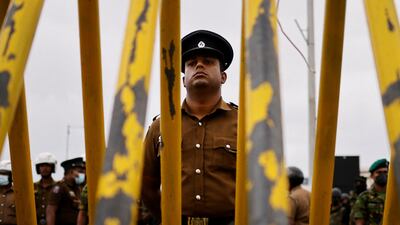
Security personnel stand guard after a raid on an anti-government protest camp in Colombo early on Friday, amid Sri Lanka's economic crisis. Reuters -
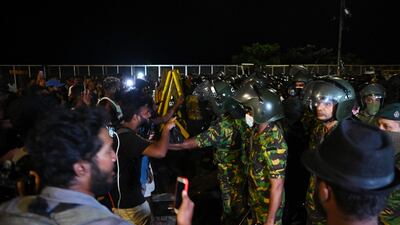
Anti-government protesters speak with members of Sri Lankan security forces. AFP -
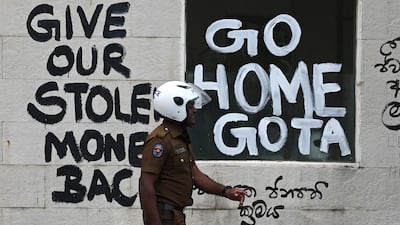
A policeman walks past slogans against the newly elected Sri Lankan President Ranil Wickramasinghe in Colombo. AFP -
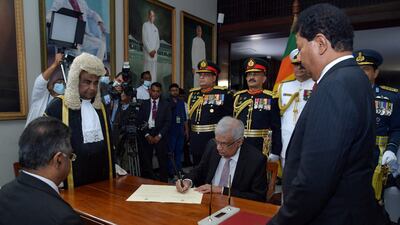
Ranil Wickremesinghe is sworn in as the new president of Sri Lanka by Chief Justice Jayantha Jayasuriya. Reuters -
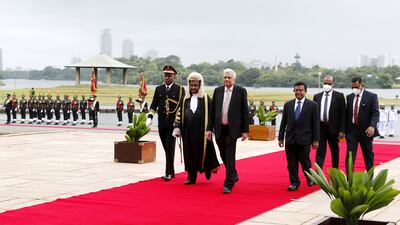
Mr Wickremesinghe, centre, arrives at his swearing-in ceremony in Colombo. EPA -

Ranil Wickremesinghe leaves a Buddhist temple in Colombo after he was named as Sri Lanka's eighth executive president. Reuters -
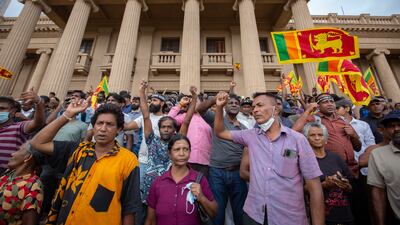
Sri Lankans protest after Mr Wickremesinghe defeated Dullas Alahapperuma, a member of the breakaway faction of the ruling Sri Lanka Podujana Peramuna party, by 134 votes to 82 in a parliamentary vote to pick the next president. Getty -
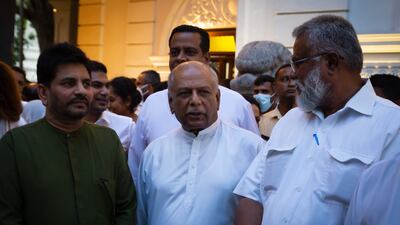
Dinesh Gunawardena, centre, leader of the House of Parliament, arrives at Gangaramaya Temple in Colombo. Getty -
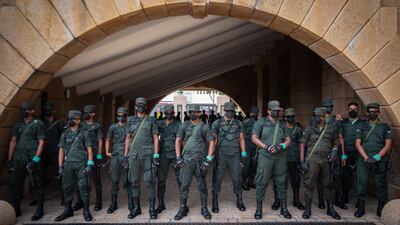
Soldiers stand guard at the Presidential Secretariat after Mr Wickremesinghe was announced as Sri Lanka's new president. Getty -
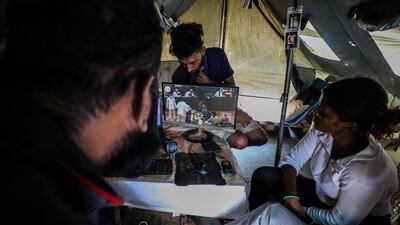
Protesters watch a live broadcast of the parliamentary vote to pick Sri Lanka's new president. EPA -
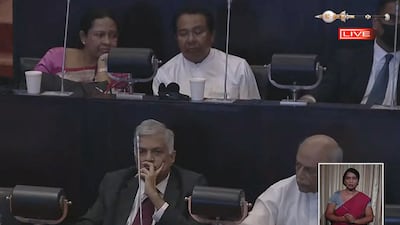
A screen grab of Mr Wickremesinghe, bottom left, during the vote count announcement in Sri Lanka's Parliament. AFP -
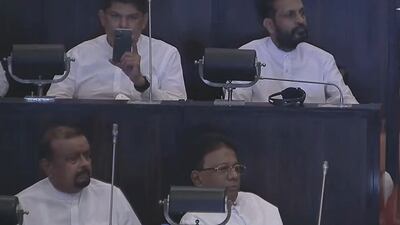
Mr Alahapperuma, bottom right, during the parliamentary vote in Colombo. AFP -
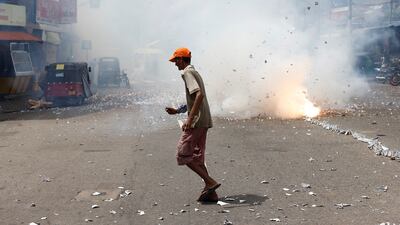
A supporter celebrates in Colombo after Mr Wickremesinghe was elected as president. Reuters -

Mr Wickremesinghe's supporters celebrate in the capital after his election as Sri Lankan president. Getty -
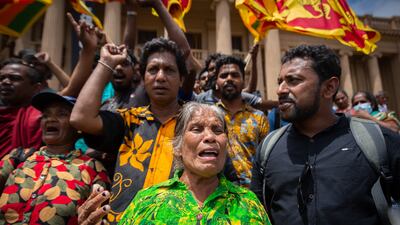
Sri Lankans protest after the announcement of Mr Wickremesinghe as president. Getty -
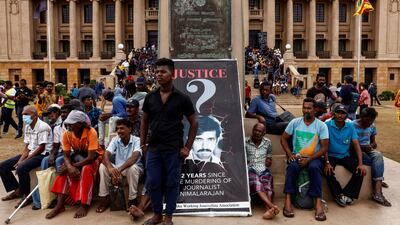
Demonstrators watch a public screen as voting begins in Sri Lanka's Parliament. Reuters -
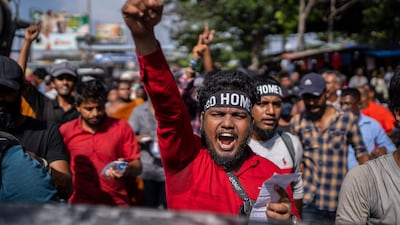
Protesters in Colombo demand Mr Wickremesinghe's resignation as prime minister and acting president before the parliamentary vote. AP -
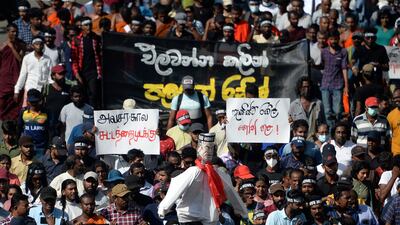
Demonstrators carry an effigy of Mr Wickremesinghe. AFP -
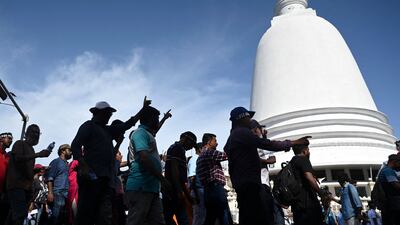
Demonstrators take part in a procession against Mr Wickremesinghe. AFP -
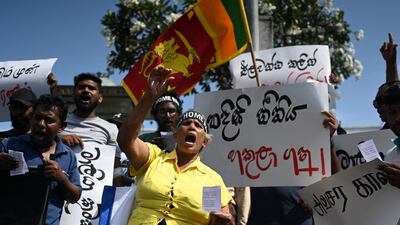
Demonstrators shout slogans. AFP -
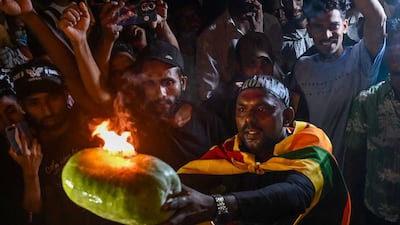
Sri Lankan demonstrators take part in a celebration in Colombo to mark the 100th day of protests. AFP -
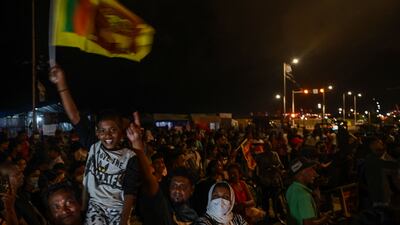
After months of street protests, Sri Lanka’s parliament will elect a new president to replace Gotabaya Rajapaksa on Wednesday. AFP -
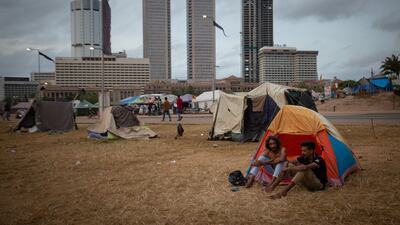
The country faces its worst economic crisis in decades due to the lack of foreign reserves, resulting in severe shortages of food, fuel, medicines and imported goods. Getty -
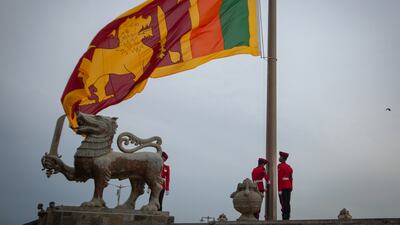
Soldiers lower the national flag at Galle Face Green in Colombo. Getty -

A demonstrator writes a slogan against acting president Ranil Wickremesinghe. AFP -
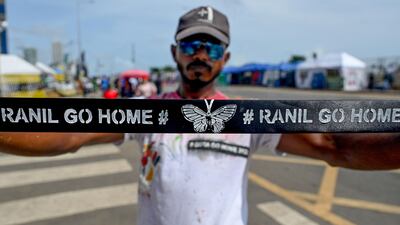
Mr Wickremesinghe is a top contender in the race to succeed Mr Rajapaksa. AFP -
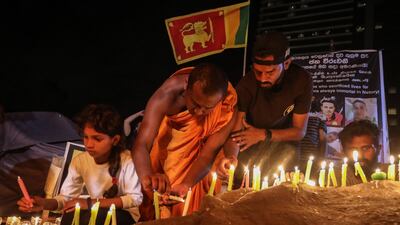
People light candles in the capital in memory of protesters killed or wounded since the demonstrations began. EPA -
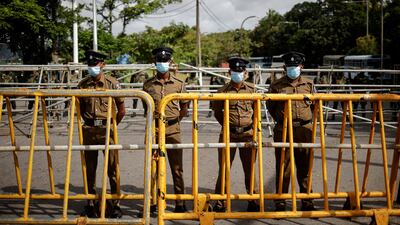
Police officers stand guard outside Parliament in Colombo. Reuters -
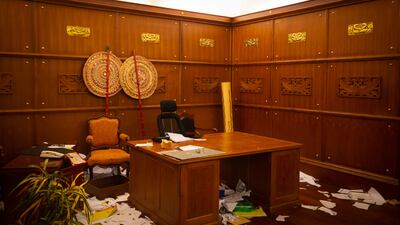
The vandalised office of the Sri Lankan president inside his official residence in the capital. Getty -
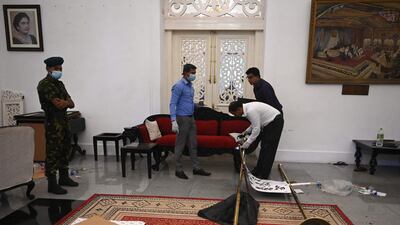
Police officials gather evidence at the president’s official residence after it was overrun by anti-government protesters on July 9. AFP -
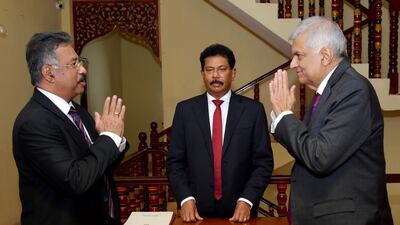
Sri Lankan Prime Minister Ranil Wickremesinghe, right, is sworn in as acting president by Chief Justice Jayantha Jayasuriya in Colombo. EPA -

Parliamentary Speaker Mahinda Yapa Abeywardena addresses the media in Colombo. AFP -
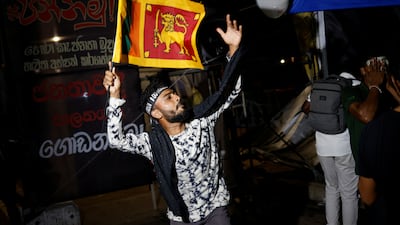
People dance in Colombo as they celebrate the resignation of Mr Rajapaksa amid the country’s economic crisis. Reuters -
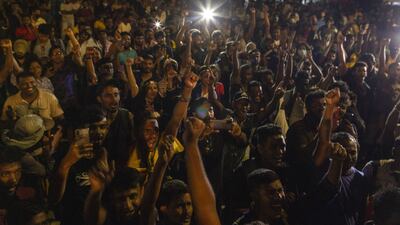
Demonstrators cheer after hearing news that Mr Rajapaksa had emailed his letter of resignation after fleeing months of anti-government protests. Bloomberg -
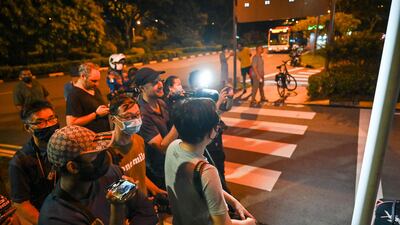
Members of the media wait outside the VIP complex of Changi International Airport in Singapore for the arrival of Mr Rajapaksa, his wife and two bodyguards. Sri Lanka's president left the Maldives on July 14 aboard a Saudia Airlines plane bound for Singapore. AFP -
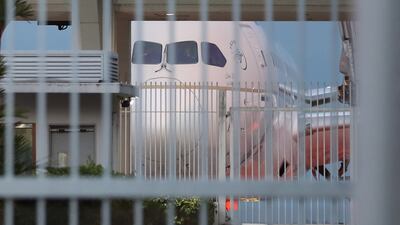
A Saudia Airlines plane believed to be carrying Mr Rajapaksa arrives on the tarmac at Changi Airport in Singapore. EPA -
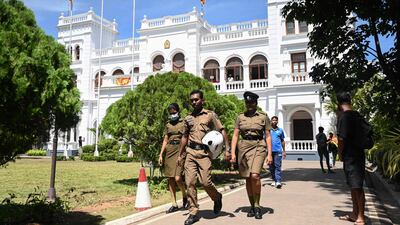
Police officers walk outside Sri Lankan Prime Minister Ranil Wickremesinghe's office, a day after thousands of anti-government protesters stormed the building, when he was named acting president. AFP -
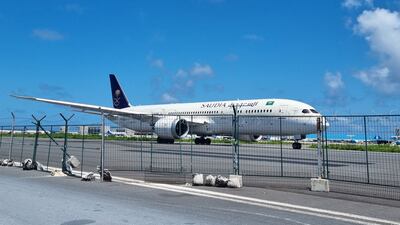
A Saudia airline Boeing 787 Dreamliner bound for Singapore and carrying Sri Lanka's fleeing president Gotabaya Rajapaksa, his wife and bodyguards prepares to take off at the Velana International airport, in the Maldives. AFP -
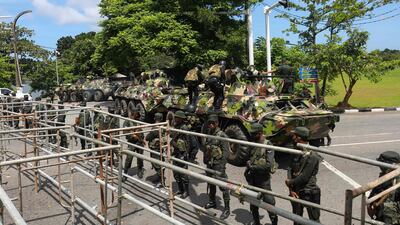
Sri Lankan soldiers stand guard near the parliament building in Colombo, a day after thousands of anti-government protesters stormed the prime minister's office. AFP -
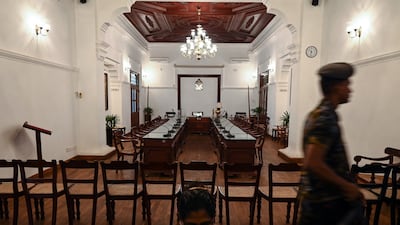
A soldier walks past a demonstrator sitting in a meeting room, at the prime minister's offices. AFP -

Soldiers patrol the buildings of the prime minister's office. AFP -

Troops make their way to an anti-government protest at the prime minister's office in Colombo, Sri Lanka. Bloomberg -

Demonstrators takes pictures inside the complex housing the Sri Lankan prime minister's offices. AFP -
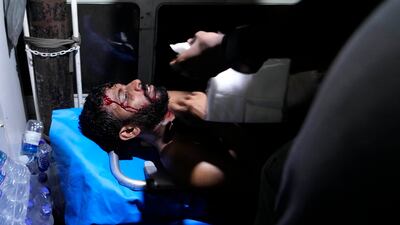
An injured protester lies in an ambulance after clashes with police near parliament in Colombo. AP -
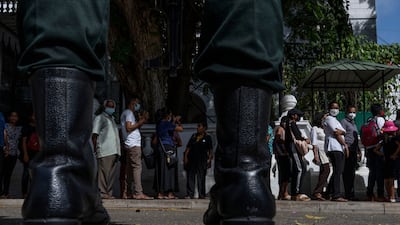
People wait to enter the presidential palace in Colombo, Sri Lanka. AP -
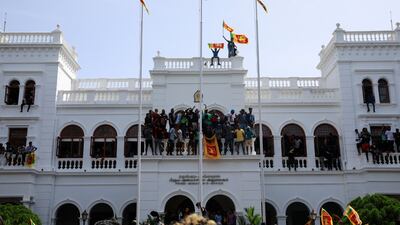
Protesters in Colombo hold Sri Lankan flags as they stand on top of the office of acting Prime Minister Ranil Wickremesinghe, amid the country's economic crisis. Reuters -
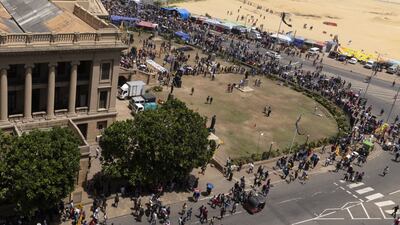
Protesters demand the resignation of Mr Wickremasinghe. Bloomberg -
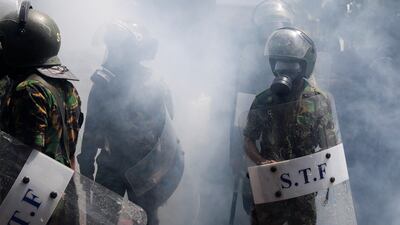
Police officers stand guard in Colombo. Reuters -
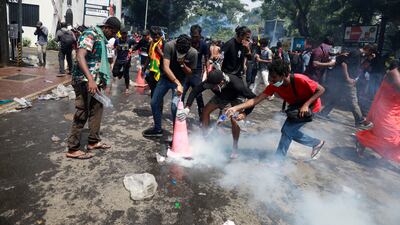
Police fire tear gas to control the crowds. Reuters -
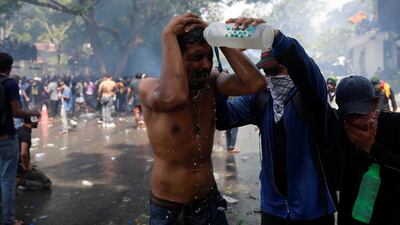
A protester pours water on a man as tensions soar. Reuters -
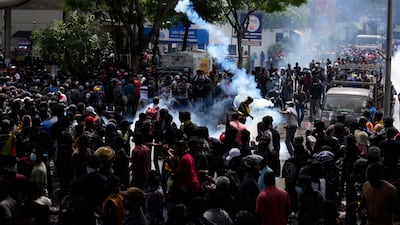
Protesters throw teargas shells. AP Photo -

Protesters storm Prime Minister Ranil Wickremesinghe's office in Colombo, Sri Lanka and demand his resignation, after President Gotabaya Rajapaksa fled the economic and political crisis for the Maldives. AP -
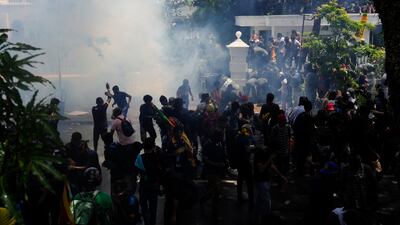
Police use tear gas to disperse Sri Lankan protesters outside the prime minister's office. AP -
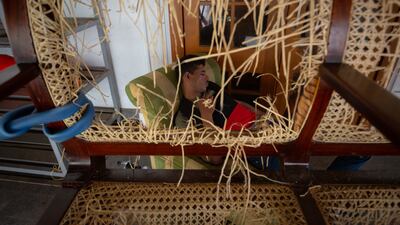
A protester sleeps on vandalised furniture inside the presidential palace in Colombo, which has been occupied by demonstrators for days. Getty Images -

A satellite image shows people gathered outside Sri Lanka's Parliament building in Colombo amid the country's economic and political crisis. AFP -

Youths play carrom inside the Sri Lankan prime minister's official residence, which was stormed by protesters at the weekend. Reuters -
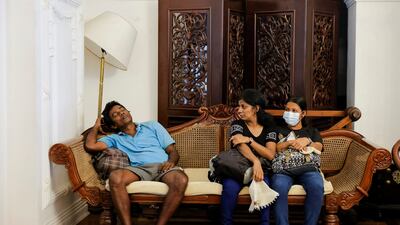
People sit on a couch inside the prime minister's official residence. The protests against the government have simmered since May, but erupted again last Saturday. Reuters -
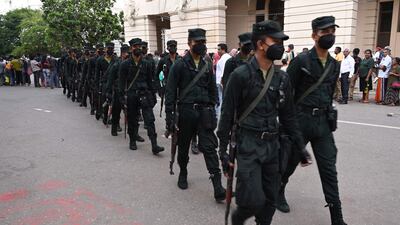
Army cadets march past people queuing to get inside Sri Lankan President Gotabaya Rajapaksa's official residence in Colombo. AFP -
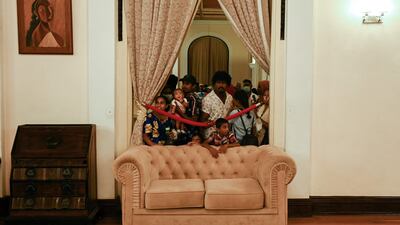
People visit Mr Rajapaksa's official residence in Colombo. It was reported on Wednesday that he had fled the country for the Maldives. AFP -
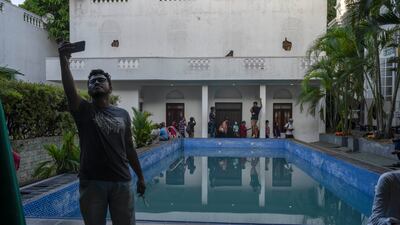
A man takes a selfie at the presidential palace. AP -
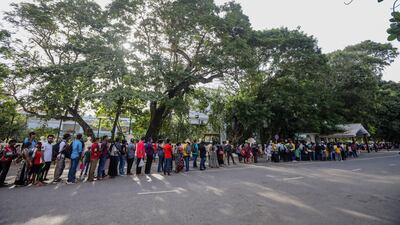
Sri Lankans line up to take a look inside the presidential palace in Colombo. EPA -
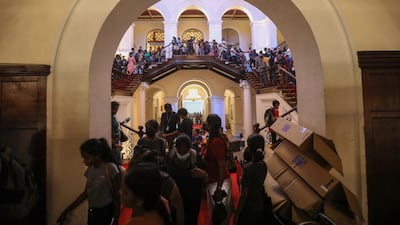
Crowds flock to take in the presidential palace. EPA -
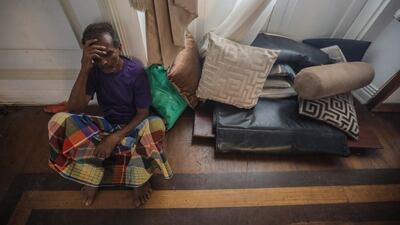
A man takes a rest inside the prime minister's official residence in Colombo. EPA -
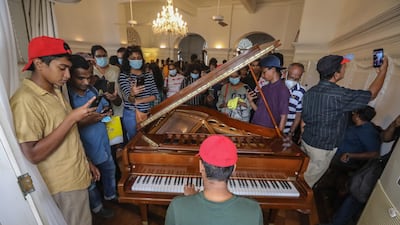
People sing songs inside the prime minister's official residence. EPA -
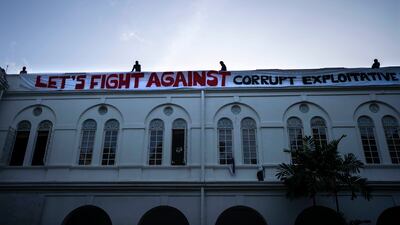
Protesters erect a banner on the presidential palace three days after it was stormed by anti-government demonstrators in Colombo. AP -

People wait in a queue to collect gas at a distribution point in Colombo. AFP -
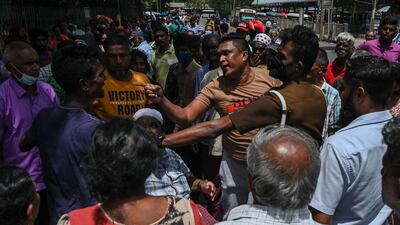
Sri Lankans quarrel as they wait for gas at a distribution point. AFP -

A driver of an autorickshaw sleeps inside his vehicle while waiting in a queue to buy petrol at a fuel station in Colombo. AP
Mr Abeywardana promised a swift and transparent process for electing a new president.
“I request the honourable and loving citizens of this country to create a peaceful atmosphere in order to implement the proper Parliamentary democratic process and enable all members of Parliament to participate in the meetings and function freely and conscientiously,” he said on Friday.
At least 45 people were taken for medical treatment after a standoff between riot police and protesters on Wednesday night near Parliament, as Sri Lankans demanded the removal of both Mr Rajapaksa and Mr Wickremesinghe, hospital sources told Reuters.
The specs
Engine: 2.0-litre four-cylinder turbo
Power: 268hp at 5,600rpm
Torque: 380Nm at 4,800rpm
Transmission: CVT auto
Fuel consumption: 9.5L/100km
On sale: now
Price: from Dh195,000
Hidden killer
Sepsis arises when the body tries to fight an infection but damages its own tissue and organs in the process.
The World Health Organisation estimates it affects about 30 million people each year and that about six million die.
Of those about three million are newborns and 1.2 are young children.
Patients with septic shock must often have limbs amputated if clots in their limbs prevent blood flow, causing the limbs to die.
Campaigners say the condition is often diagnosed far too late by medical professionals and that many patients wait too long to seek treatment, confusing the symptoms with flu.
The specs
Engine: 2.0-litre 4cyl turbo
Power: 261hp at 5,500rpm
Torque: 405Nm at 1,750-3,500rpm
Transmission: 9-speed auto
Fuel consumption: 6.9L/100km
On sale: Now
Price: From Dh117,059
The%20specs
How to turn your property into a holiday home
- Ensure decoration and styling – and portal photography – quality is high to achieve maximum rates.
- Research equivalent Airbnb homes in your location to ensure competitiveness.
- Post on all relevant platforms to reach the widest audience; whether you let personally or via an agency know your potential guest profile – aiming for the wrong demographic may leave your property empty.
- Factor in costs when working out if holiday letting is beneficial. The annual DCTM fee runs from Dh370 for a one-bedroom flat to Dh1,200. Tourism tax is Dh10-15 per bedroom, per night.
- Check your management company has a physical office, a valid DTCM licence and is licencing your property and paying tourism taxes. For transparency, regularly view your booking calendar.
Mercer, the investment consulting arm of US services company Marsh & McLennan, expects its wealth division to at least double its assets under management (AUM) in the Middle East as wealth in the region continues to grow despite economic headwinds, a company official said.
Mercer Wealth, which globally has $160 billion in AUM, plans to boost its AUM in the region to $2-$3bn in the next 2-3 years from the present $1bn, said Yasir AbuShaban, a Dubai-based principal with Mercer Wealth.
“Within the next two to three years, we are looking at reaching $2 to $3 billion as a conservative estimate and we do see an opportunity to do so,” said Mr AbuShaban.
Mercer does not directly make investments, but allocates clients’ money they have discretion to, to professional asset managers. They also provide advice to clients.
“We have buying power. We can negotiate on their (client’s) behalf with asset managers to provide them lower fees than they otherwise would have to get on their own,” he added.
Mercer Wealth’s clients include sovereign wealth funds, family offices, and insurance companies among others.
From its office in Dubai, Mercer also looks after Africa, India and Turkey, where they also see opportunity for growth.
Wealth creation in Middle East and Africa (MEA) grew 8.5 per cent to $8.1 trillion last year from $7.5tn in 2015, higher than last year’s global average of 6 per cent and the second-highest growth in a region after Asia-Pacific which grew 9.9 per cent, according to consultancy Boston Consulting Group (BCG). In the region, where wealth grew just 1.9 per cent in 2015 compared with 2014, a pickup in oil prices has helped in wealth generation.
BCG is forecasting MEA wealth will rise to $12tn by 2021, growing at an annual average of 8 per cent.
Drivers of wealth generation in the region will be split evenly between new wealth creation and growth of performance of existing assets, according to BCG.
Another general trend in the region is clients’ looking for a comprehensive approach to investing, according to Mr AbuShaban.
“Institutional investors or some of the families are seeing a slowdown in the available capital they have to invest and in that sense they are looking at optimizing the way they manage their portfolios and making sure they are not investing haphazardly and different parts of their investment are working together,” said Mr AbuShaban.
Some clients also have a higher appetite for risk, given the low interest-rate environment that does not provide enough yield for some institutional investors. These clients are keen to invest in illiquid assets, such as private equity and infrastructure.
“What we have seen is a desire for higher returns in what has been a low-return environment specifically in various fixed income or bonds,” he said.
“In this environment, we have seen a de facto increase in the risk that clients are taking in things like illiquid investments, private equity investments, infrastructure and private debt, those kind of investments were higher illiquidity results in incrementally higher returns.”
The Abu Dhabi Investment Authority, one of the largest sovereign wealth funds, said in its 2016 report that has gradually increased its exposure in direct private equity and private credit transactions, mainly in Asian markets and especially in China and India. The authority’s private equity department focused on structured equities owing to “their defensive characteristics.”
On Women's Day
Dr Nawal Al-Hosany: Why more women should be on the frontlines of climate action
Shelina Janmohamed: Why shouldn't a spouse be compensated fairly for housework?
Samar Elmnhrawy: How companies in the Middle East can catch up on gender equality
The National Editorial: Is there much to celebrate on International Women's Day 2021?
Ten tax points to be aware of in 2026
1. Domestic VAT refund amendments: request your refund within five years
If a business does not apply for the refund on time, they lose their credit.
2. E-invoicing in the UAE
Businesses should continue preparing for the implementation of e-invoicing in the UAE, with 2026 a preparation and transition period ahead of phased mandatory adoption.
3. More tax audits
Tax authorities are increasingly using data already available across multiple filings to identify audit risks.
4. More beneficial VAT and excise tax penalty regime
Tax disputes are expected to become more frequent and more structured, with clearer administrative objection and appeal processes. The UAE has adopted a new penalty regime for VAT and excise disputes, which now mirrors the penalty regime for corporate tax.
5. Greater emphasis on statutory audit
There is a greater need for the accuracy of financial statements. The International Financial Reporting Standards standards need to be strictly adhered to and, as a result, the quality of the audits will need to increase.
6. Further transfer pricing enforcement
Transfer pricing enforcement, which refers to the practice of establishing prices for internal transactions between related entities, is expected to broaden in scope. The UAE will shortly open the possibility to negotiate advance pricing agreements, or essentially rulings for transfer pricing purposes.
7. Limited time periods for audits
Recent amendments also introduce a default five-year limitation period for tax audits and assessments, subject to specific statutory exceptions. While the standard audit and assessment period is five years, this may be extended to up to 15 years in cases involving fraud or tax evasion.
8. Pillar 2 implementation
Many multinational groups will begin to feel the practical effect of the Domestic Minimum Top-Up Tax (DMTT), the UAE's implementation of the OECD’s global minimum tax under Pillar 2. While the rules apply for financial years starting on or after January 1, 2025, it is 2026 that marks the transition to an operational phase.
9. Reduced compliance obligations for imported goods and services
Businesses that apply the reverse-charge mechanism for VAT purposes in the UAE may benefit from reduced compliance obligations.
10. Substance and CbC reporting focus
Tax authorities are expected to continue strengthening the enforcement of economic substance and Country-by-Country (CbC) reporting frameworks. In the UAE, these regimes are increasingly being used as risk-assessment tools, providing tax authorities with a comprehensive view of multinational groups’ global footprints and enabling them to assess whether profits are aligned with real economic activity.
Contributed by Thomas Vanhee and Hend Rashwan, Aurifer
Women & Power: A Manifesto
Mary Beard
Profile Books and London Review of Books
SPECS
FFP EXPLAINED
What is Financial Fair Play?
Introduced in 2011 by Uefa, European football’s governing body, it demands that clubs live within their means. Chiefly, spend within their income and not make substantial losses.
What the rules dictate?
The second phase of its implementation limits losses to €30 million (Dh136m) over three seasons. Extra expenditure is permitted for investment in sustainable areas (youth academies, stadium development, etc). Money provided by owners is not viewed as income. Revenue from “related parties” to those owners is assessed by Uefa's “financial control body” to be sure it is a fair value, or in line with market prices.
What are the penalties?
There are a number of punishments, including fines, a loss of prize money or having to reduce squad size for European competition – as happened to PSG in 2014. There is even the threat of a competition ban, which could in theory lead to PSG’s suspension from the Uefa Champions League.
Result
Arsenal 4
Monreal (51'), Ramsey (82'), Lacazette 85', 89')
West Ham United 1
Arnautovic (64')
While you're here
Cheryl Thompson: Stop the practice of blackface that's as Canadian as hockey
Kareem Shaheen: Alghabra outshines the racists who malign him
Kareem Shaheen: In Canada, I have finally found a home
MATCH INFO
Uefa Champioons League semi-final:
First leg: Liverpool 5 Roma 2
Second leg: Wednesday, May 2, Stadio Olimpico, Rome
TV: BeIN Sports, 10.45pm (UAE)


