



British Prime Minister Boris Johnson agreed to a new defence and security co-operation deal with India at a meeting with his “special friend” Narendra Modi in New Delhi on Friday.
Western countries, led by the US, have been attempting to lure India away from its long-time ally Russia, its main arms supplier, since the invasion of Ukraine that New Delhi has refused to condemn.
“We've agreed to a new and expanded Defence and Security Partnership, a decades-long commitment that will … forge tighter bonds between us,” Mr Johnson said in a joint press statement in which he also called Mr Modi his “special friend".
Mr Johnson, who is on a two-day visit to India, arrived in New Delhi late on Thursday after making a day-long trip to western Gujarat state where he announced new investment worth £1 billion ($1.3bn).
-
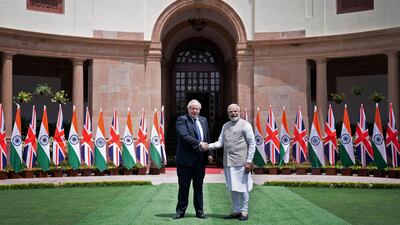
The two leaders shake hands before meeting to discuss free trade deals and enhanced security co-operation. AFP -
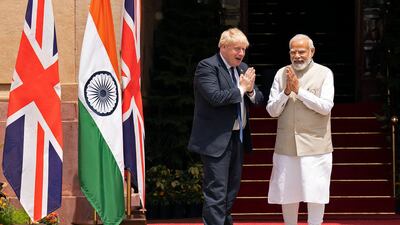
Britain's Prime Minister Boris Johnson (L) and his Indian counterpart Narendra Modi bond before their meeting at Hyderabad House in New Delhi. AFP -
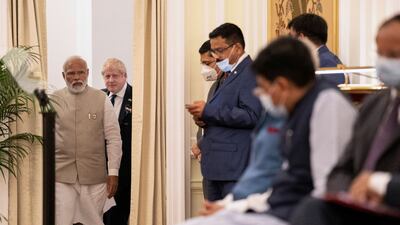
Narendra Modi arrives to address a joint press briefing with his Boris Johnson at Hyderabad House. Reuters -
Boris Johnson is on a two-day visit to India. Getty Images -
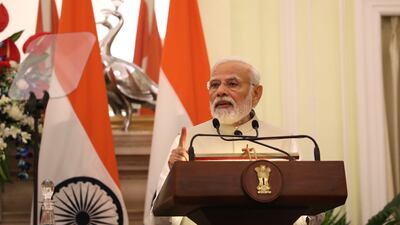
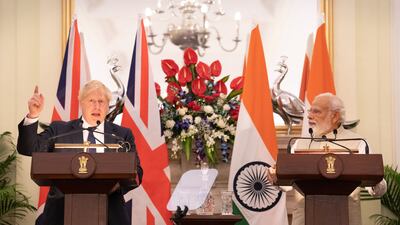
Indian Prime Minister Narendra Modi speaks during a joint statement with Britain's Prime Minister Boris Johnson after an exchange of agreements in New Delhi. EPA -
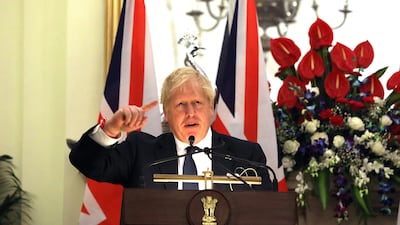
Boris Johnson makes his point after talks with Narendra Modi focused on economic and political ties between Britain and India. EPA -
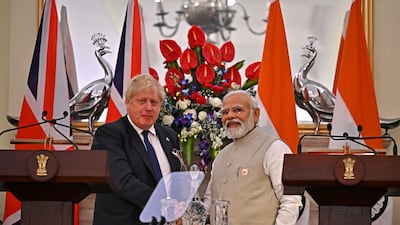
Boris Johnson and Narendra Modi agreed on a new security deal in India. EPA -
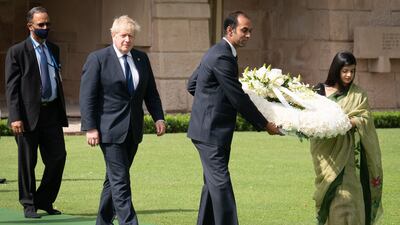
Boris Johnson visits Mahatma Gandhi's memorial at Raj Ghat in New Delhi. Getty Images -
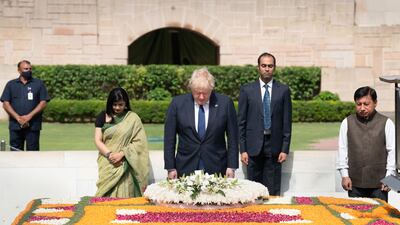
Boris Johnson pays his respects at Mahatma Gandhi's memorial. Getty Images -
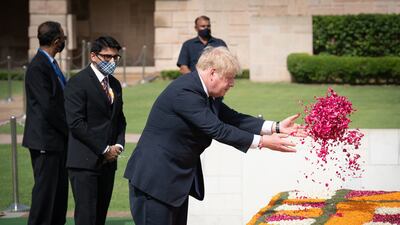
The British prime minister lays a wreath at the memorial in Raj Ghat. Getty Images -
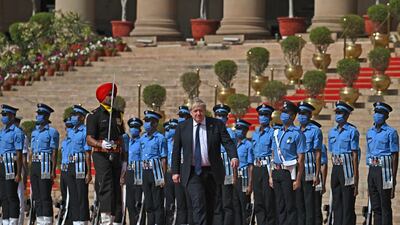
Boris Johnson inspects a guard of honour during a ceremonial reception at presidential palace Rashtrapati Bhavan in New Delhi. Getty Images -
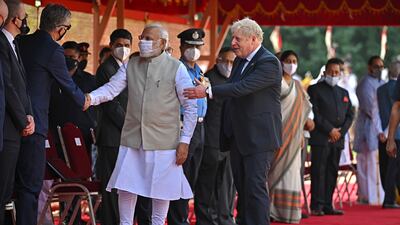
Boris Johnson introduces his dignitaries to Narendra Modi. Getty Images -
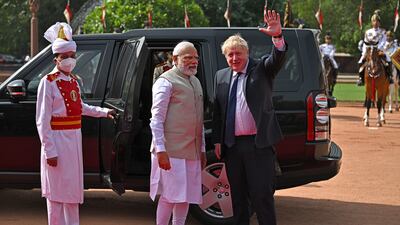
Boris Johnson and Narendra Modi discussed new collaborations on defence and green energy, with the UK leader seeking to reduce India's dependence on Russian fossil fuels and military equipment. Getty Images -
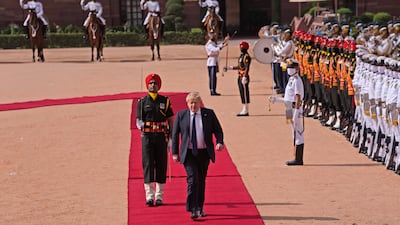
British Prime Minister Boris Johnson inspects a joint military guard of honour at the Indian presidential palace in New Delhi. AP Photo -
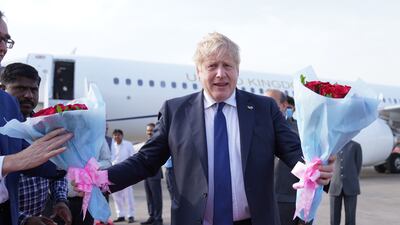
British Prime Minister Boris Johnson arrives at Sarda Vallabhbhai Patel International Airport in Ahmedabad, India. Getty Images -
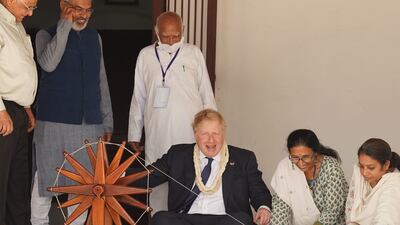
Boris Johnson is shown how to operate a spinning wheel at the Sabarmati Ashram, also known as Gandhi Ashram, in Ahmedabad. Getty Images -
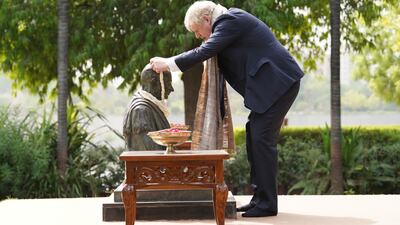
Boris Johnson garlands a bust of Mahatma Gandhi on the first day of his official trip to India. Getty Images -
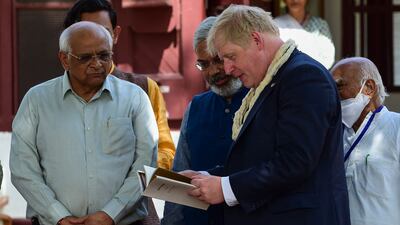
The British prime minister browses a book during his visit to the Sabarmati Ashram in Ahmedabad. AFP -
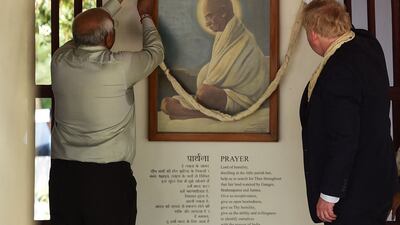
Boris Johnson is shown a painting of Mahatma Gandhi in Ahmedabad. AFP -
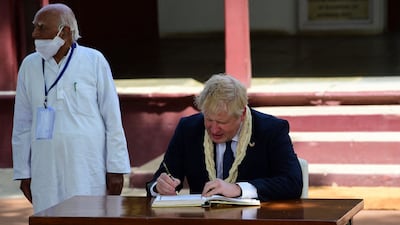
Boris Johnson signs a visitors' book at the Sabarmati Ashram, Ahmedabad. AFP -
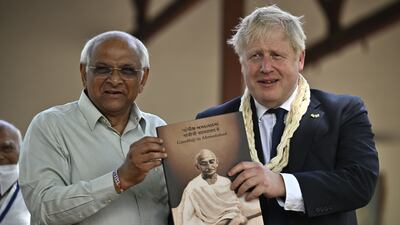
Boris Johnson receives a book from the chief minister of India's Gujarat state Bhupendra Patel. PA -
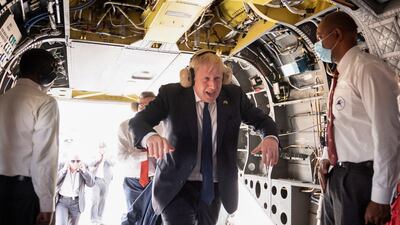
Boris Johnson boards an Indian military Chinook helicopter for a flight to the new JCB factory at Vadodara in India's Gujarat state. Reuters -

Boris Johnson waves from a digger at JCB's new factory in Vadodara, Gujarat, during his two-day trip to India. PA -

Boris Johnson meets workers at the JCB factory in Vadodara. AP
The two leaders on Friday agreed to deepen bilateral ties in the defence, security and trade sectors, particularly in the Asia-Pacific region where China is expanding its influence.
Mr Johnson said the two countries discussed next-generation defence and security collaboration across sea, land, air, space and cyber in the Indo-Pacific region.
“The threats of autocratic coercion have grown even further and it's therefore vital that we deepen our co-operation including our shared interest in keeping the Indo-Pacific open and free,” he said.
“For defence procurement, we have agreed to work together to meet threats across land, sea and air, space and cyber, including partnering on new fighter jet technology, maritime technology to detect and respond to threats in the oceans,” he said.
Early on Friday, Mr Johnson laid flowers at the tomb of Mahatma Gandhi before Mr Modi received the UK prime minister at a ceremonial reception at the Presidential Palace.
The British leader thanked Mr Modi for the “fantastic welcome” and said his India visit was a “very auspicious moment” for both countries.
Mr Johnson’s India trip has been twice postponed because of Covid-19 flare-ups in each country and comes as a respite from the “partygate” controversy that has sparked calls for him to step down.
British MPs on Thursday agreed to launch an investigation by a parliamentary committee into Mr Johnson's previous denials to the House of Commons that gatherings at Downing Street during the pandemic lockdowns constituted a breach of the government’s own laws, sparking widespread public anger.
But he rejected the demands and insisted he would remain in office, although admitting that he understood “people's feelings”.
Mr Johnson's India visit comes after hectic diplomatic efforts by western countries to lure the South Asian nation away from its long-time ally Russia following its invasion of Ukraine.
Post-Brexit, London has been seeking new markets and free-trade agreements, especially with countries in the Asia-Pacific region that are some of the fastest-growing economies.
It is also negotiating a free-trade agreement with India under the “road map 2030" that outlines plans to boost bilateral trade to more than $100bn over the next 10 years.
India is the second-largest foreign direct investor in the UK. Its exports to the UK stood at $8.15bn in 2020-21, while imports totalled $4.95bn.
But New Delhi has been insisting on visa relaxations for students and professionals in exchange for a deal, with Mr Johnson hinting that his government will accommodate concerns that could have stalled the talks.
“UK is creating an India-specific, open general export licence, reducing bureaucracy and slashing delivery times. We aim to have a new free trade agreement by Diwali [in October] … this could double our trade and investments by the end of the decade,” Mr Johnson said.
The British prime minister also emphasised that the two countries are taking forward the Green Grid Solar Power initiative set up to provide surplus renewable energy to create an integrated global electricity network.
The two countries have signed new partnerships on defence, artificial intelligence and green energy, along with investment deals in areas including robotics, electric vehicles and satellite launches.

