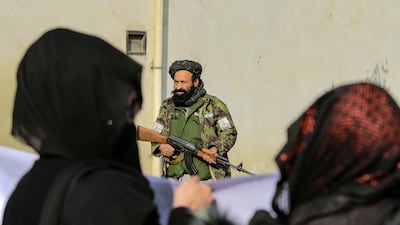
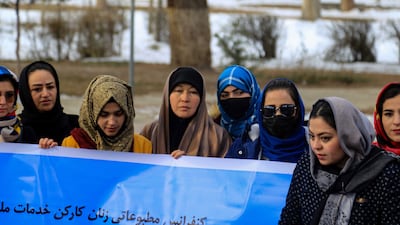
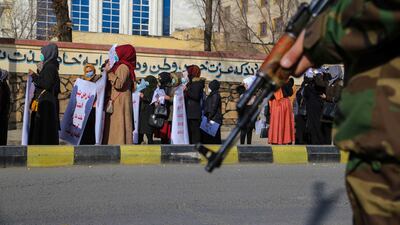
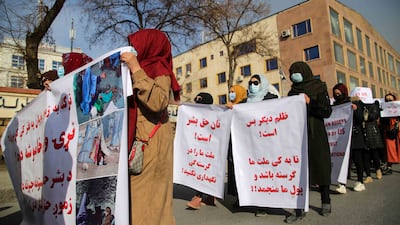
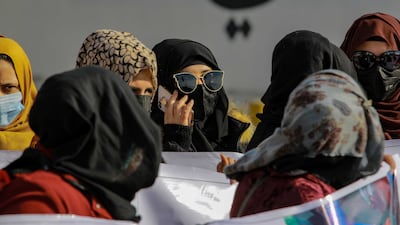
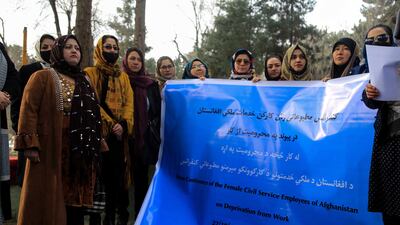
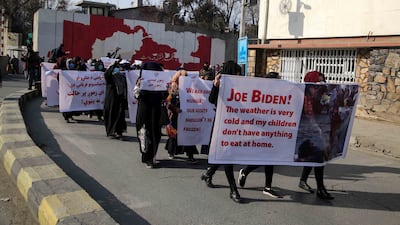
Women in Kabul dress as men earlier this month to protest against restrictive rules imposed by the Taliban

Afghan women driven to risk Taliban’s wrath by dressing as men


  • English
  • Arabic

Dressed in a loose-fitting shirt and trousers, the traditional attire of men in Afghanistan, Rabia Balkhi navigated the streets of Kabul discreetly, her face covered with a mask at all times and her head down to avoid eye contact.

Divorced and raising a child alone, the 29-year-old was forced to dress as a man to escape attention from the Taliban, the hardline Islamist group who imposed severe restrictions on women after they seized power in August.

“Being a woman in Afghanistan is difficult, but it is worse for a single mother. And since the Taliban takeover, it has become harder,” Rabia said.

Now in hiding with her daughter, she spoke to The National on condition of anonymity, asking to use the name of a renowned female poet from Afghan history instead.

Rabia Balkhi walks down a street in Kabul dressed in traditional Afghan men's clothing.

“When the Taliban took over my city, my ex-husband asked them to hand over my child to him. They began to threaten me and wanted to forcefully marry me off again, so I came to Kabul,” she said.

Rabia used to work in the offices of NGOs until the Taliban takeover. In Kabul, she survived on her savings and financial and food assistance collected from aid organisations.

Life became even more difficult in late December when the Taliban barred women from leaving home without a mahram – a male guardian.

“I lived alone, taking care of myself and my child. I was scared when I saw the Taliban were telling taxi drivers to not accept women travelling alone,” she said, referring to videos circulated online this month showing the extremists stopping motorists in Kabul to enforce their new rules, including mandatory beards for men.

Pushed to the limit, Rabia decided to protest. On New Year’s Day she asked a friend to take photos of her dressed in her men’s clothes and holding up a sign that read, “I am a woman. I don’t have a mahram”, and posted them online.

“At first, I could only think how I was responsible for my kid, and if something happened to me it would hurt my child. But then I thought of the many women like me who did not have a mahram and could not speak up,” she said.

“I could no longer remain silent. So I decided to join the revolution,” she said, referring to the many other women who have staged protests against the Taliban regime since last year.

Rabia’s photos went viral within hours and other women joined her online protest by posting similar photos of themselves in male attire.

Afghan women pose for a photo in men's clothing in a form of protest started by Rabia Balkhi to oppose restrictions imposed on women by Afghanistan's Taliban rulers.

“We want to show the Taliban that they can not prevent us from doing what is our right by imposing restrictions,” one of the protesters, who asked to be identified by the pseudonym Lily Hamidi, told The National.

“These rules are very difficult for all women, but especially women who do not have a mahram. What are they supposed to do?

“Even women who have mahrams cannot accept this and depend on a man who might not be available 24 hours a day to do her work,” she said.

“We don’t want to be limited this way, and I don’t want the Taliban to govern my clothes. I do not accept the obligatory burqa."

Rabia was identified by the Taliban and was arrested at her home days after her photos went viral. Some of the other women who joined her protest, including Lily, are no longer contactable.

“They held me for two hours, questioning me about other protesters, and even slapped me several times. They eventually let me go, and I picked up my daughter and went into hiding,” Rabia said.

“I’ve lost everything – my job, my home and my country. But when faced with such ludicrous rules, I had no option,” she said.

“I held the poster so the world would know the situation Afghan women are in, forced to give up their very identity. I did it knowing full well the risks it would put me in, because I had to speak up.”


Anghami
Started: December 2011
Co-founders: Elie Habib, Eddy Maroun
Based: Beirut and Dubai
Sector: Entertainment
Size: 85 employees
Stage: Series C
Investors: MEVP, du, Mobily, MBC, Samena Capital

Mercer, the investment consulting arm of US services company Marsh & McLennan, expects its wealth division to at least double its assets under management (AUM) in the Middle East as wealth in the region continues to grow despite economic headwinds, a company official said.

Mercer Wealth, which globally has $160 billion in AUM, plans to boost its AUM in the region to $2-$3bn in the next 2-3 years from the present $1bn, said Yasir AbuShaban, a Dubai-based principal with Mercer Wealth.

Within the next two to three years, we are looking at reaching $2 to $3 billion as a conservative estimate and we do see an opportunity to do so,” said Mr AbuShaban.

Mercer does not directly make investments, but allocates clients’ money they have discretion to, to professional asset managers. They also provide advice to clients.

“We have buying power. We can negotiate on their (client’s) behalf with asset managers to provide them lower fees than they otherwise would have to get on their own,” he added.

Mercer Wealth’s clients include sovereign wealth funds, family offices, and insurance companies among others.

From its office in Dubai, Mercer also looks after Africa, India and Turkey, where they also see opportunity for growth.

Wealth creation in Middle East and Africa (MEA) grew 8.5 per cent to $8.1 trillion last year from $7.5tn in 2015, higher than last year’s global average of 6 per cent and the second-highest growth in a region after Asia-Pacific which grew 9.9 per cent, according to consultancy Boston Consulting Group (BCG). In the region, where wealth grew just 1.9 per cent in 2015 compared with 2014, a pickup in oil prices has helped in wealth generation.

BCG is forecasting MEA wealth will rise to $12tn by 2021, growing at an annual average of 8 per cent.

Drivers of wealth generation in the region will be split evenly between new wealth creation and growth of performance of existing assets, according to BCG.

Another general trend in the region is clients’ looking for a comprehensive approach to investing, according to Mr AbuShaban.

“Institutional investors or some of the families are seeing a slowdown in the available capital they have to invest and in that sense they are looking at optimizing the way they manage their portfolios and making sure they are not investing haphazardly and different parts of their investment are working together,” said Mr AbuShaban.

Some clients also have a higher appetite for risk, given the low interest-rate environment that does not provide enough yield for some institutional investors. These clients are keen to invest in illiquid assets, such as private equity and infrastructure.

“What we have seen is a desire for higher returns in what has been a low-return environment specifically in various fixed income or bonds,” he said.

“In this environment, we have seen a de facto increase in the risk that clients are taking in things like illiquid investments, private equity investments, infrastructure and private debt, those kind of investments were higher illiquidity results in incrementally higher returns.”

The Abu Dhabi Investment Authority, one of the largest sovereign wealth funds, said in its 2016 report that has gradually increased its exposure in direct private equity and private credit transactions, mainly in Asian markets and especially in China and India. The authority’s private equity department focused on structured equities owing to “their defensive characteristics.”

Who's who in Yemen conflict

Houthis: Iran-backed rebels who occupy Sanaa and run unrecognised government

Yemeni government: Exiled government in Aden led by eight-member Presidential Leadership Council

Southern Transitional Council: Faction in Yemeni government that seeks autonomy for the south

Habrish 'rebels': Tribal-backed forces feuding with STC over control of oil in government territory

COMPANY%20PROFILE
%3Cp%3E%3Cstrong%3ECompany%20name%3C%2Fstrong%3E%3A%20ASI%20(formerly%20DigestAI)%3C%2Fp%3E%0A%3Cp%3E%3Cstrong%3EStarted%3A%3C%2Fstrong%3E%202017%3C%2Fp%3E%0A%3Cp%3E%3Cstrong%3EFounders%3A%3C%2Fstrong%3E%20Quddus%20Pativada%3C%2Fp%3E%0A%3Cp%3E%3Cstrong%3EBased%3A%3C%2Fstrong%3E%20Dubai%2C%20UAE%3C%2Fp%3E%0A%3Cp%3E%3Cstrong%3EIndustry%3A%3C%2Fstrong%3E%20Artificial%20intelligence%2C%20education%20technology%3C%2Fp%3E%0A%3Cp%3E%3Cstrong%3EFunding%3A%3C%2Fstrong%3E%20%243%20million-plus%3C%2Fp%3E%0A%3Cp%3E%3Cstrong%3EInvestors%3A%3C%2Fstrong%3E%20GSV%20Ventures%2C%20Character%2C%20Mark%20Cuban%3C%2Fp%3E%0A
COMPANY%20PROFILE
%3Cp%3E%3Cstrong%3ECompany%20name%3A%3C%2Fstrong%3E%20Revibe%20%0D%3Cbr%3E%3Cstrong%3EStarted%3A%3C%2Fstrong%3E%202022%0D%3Cbr%3E%3Cstrong%3EFounders%3A%3C%2Fstrong%3E%20Hamza%20Iraqui%20and%20Abdessamad%20Ben%20Zakour%20%0D%3Cbr%3E%3Cstrong%3EBased%3A%3C%2Fstrong%3E%20UAE%20%0D%3Cbr%3E%3Cstrong%3EIndustry%3A%3C%2Fstrong%3E%20Refurbished%20electronics%20%0D%3Cbr%3E%3Cstrong%3EFunds%20raised%20so%20far%3A%3C%2Fstrong%3E%20%2410m%20%0D%3Cbr%3E%3Cstrong%3EInvestors%3A%20%3C%2Fstrong%3EFlat6Labs%2C%20Resonance%20and%20various%20others%0D%3C%2Fp%3E%0A
Updated: January 25, 2022, 6:40 AM