

The governor of a central Philippine province pleaded on the radio on Tuesday for the government to quickly send food and other aid following Typhoon Rai.
He warned that without outside help, troops and police would have to be sent in to prevent looting amid growing hunger.
Governor Arthur Yap of Bohol province said he could no longer secure rice and other food aid after his contingency fund ran out. He added that many of the 1.2 million people in his island province, which remained without power and mobile phone services five days after the typhoon struck, have become increasingly desperate.
Rai struck last Thursday, killing nearly 400 people and affecting 1.8 million, displacing 630,000 of them, according to the UN Office for the coordination of Humanitarian Affairs. But the toll may still increase as emergency crews restore communications and power to more towns and villages.
In an interview on DZBB radio network, Mr Yap thanked President Rodrigo Duterte for visiting his province but said: “If you would not send money for food, you should send soldiers and police, because if not lootings will break out here.”
Mr Duterte visited Bohol at the weekend and witnessed the extensive devastation. Mr Yap said the government’s social welfare department promised to send 35,000 food packs, an inadequate amount for the province’s 375,000 families, but even those have not yet arrived.
Some looting, mostly of small merchandise stores, has occurred, Yap said. He added that the situation remained under control. But he warned that the looting could worsen if people, especially in hard-hit island municipalities, grow more desperate. People cannot withdraw money from banks without hone connections and power, and fuel and water shortages have also sparked long queues, he said.
The national police said widespread looting was not a problem in the typhoon-ravaged regions and they were ready to deal with any lawlessness.
“Our food supply is running low. Maybe, in a few days, we will totally run out,” said Fely Pedrablanca mayor of Tubajon town on Dinagat Island.
“The government pre-positioned food and non-food items but they are not enough because many are in need,” Danilo Atienza, Southern Leyte's disaster chief, told Reuters.
Typhoon Rai caused sustained winds of 195 kilometres per hour, with gusts of up to 270 kph at its most lethal, before blowing out into the South China Sea on Friday.
Nearly a million people were lashed by the typhoon, including more than 400,000 who had to be moved to emergency shelters as it approached. Some have begun to return home but others either lost their houses entirely or need to do major repairs.
Emergency crews were working to restore electricity in 227 cities and towns, officials said on Monday, adding that power had been restored in only 21 areas so far. Phone connections have been restored in at least 106 of more than 130 cities and towns.
Two local airports remained closed on Monday except for emergency flights, but most others have reopened, the civil aviation agency said.
Mr Duterte said government emergency funds have been mostly used for the coronavirus pandemic but promised to raise 2 billion pesos ($40 million) from government agency savings to provide additional funds to typhoon-hit provinces.
-

President Rodrigo Duterte, right, and Senator Bong Go, centre, with villagers during an inspection of the typhoon-hit island of Bohol, the Philippines. EPA -

Villagers work on removing a toppled tree from the top of a house in Bohol, the Philippines. EPA -
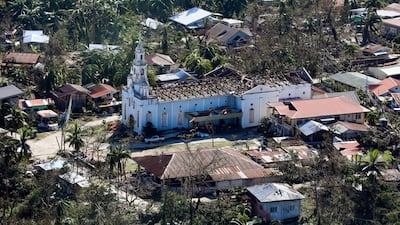
An aerial shot of the destruction on the island of Bohol, the Philippines. EPA -
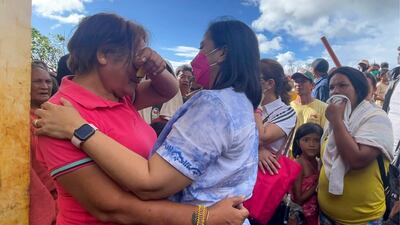
Vice President Leni Robredo, foreground right, comforts a woman after inspecting damage caused by Typhoon Rai on the Dinagat Islands, the Philippines. AP -

A damaged building on the Dinagat Islands, southern Philippines. AP -

Vice President Leni Robredo, centre, inspects damage caused by Typhoon Rai on the Dinagat Islands, southern Philippines. AP -

A man checks his damaged home on the Dinagat Islands in the Philippines. AP -

Cars pass a toppled electricity post in Surigao city. AP -

A resident looks at toppled trees and wreckage left by Typhoon Rai on Siargao Island. AP -
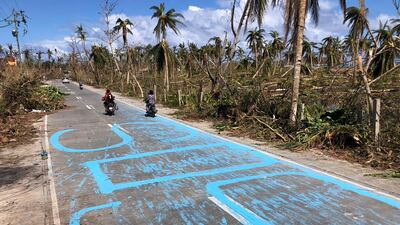
Motorists drive past signs asking for help painted on a road in General Luna town. AFP -
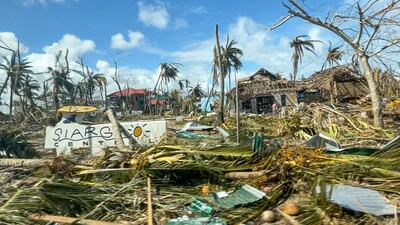
Wreckage left by Typhoon Rai in Siargao Island, the Philippines. AP


The Philippines has not appealed for international help but Japan said it was sending power generators, camping tents, sleeping pads, water containers and tarpaulin roofing sheets to hard-hit regions while China announced it was providing 20,000 food packs and rice.
About 20 tropical storms and typhoons annually batter the Philippines, which also lies along the seismically active Pacific “Ring of Fire” region, where earthquakes and volcanic eruptions frequently occur, making the Southeast Asian nation of more than 100 million people one of the world’s most disaster-prone countries.

