

Pakistan has its best chance ever to stamp out polio, officials say, after a surprise drop in cases possibly caused by Covid lockdowns over the past year.
The world's fifth-most populous country has seen cases drop to almost nothing only a year after international monitors warned its eradication programme was performing badly and heading for disaster.
The reduction of movement caused by lockdowns in response to the Covid-19 pandemic may have helped curb cases of the crippling virus, officials said.
An announcement that the Afghan Taliban would allow door-to-door vaccinations to begin across Afghanistan for the first time in more than three years may also boost immunisations by encouraging hardline vaccine sceptics in Pakistan to allow the distribution of oral drops.
Dr Shahzad Baig, who co-ordinates Pakistan's national operations centre for polio eradication, said the signs were “very, very positive”.
“The stars are aligning,” he told The National.
-
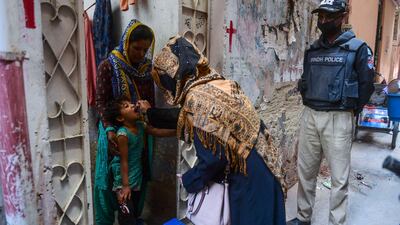
A health worker administers polio vaccine drops to a child during a door-to-door campaign in Karachi, Pakistan. AFP -
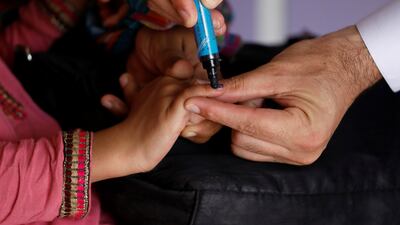
A girl gets her finger marked after she is administered polio vaccine drops at a civil dispensary in Peshawar. Reuters -
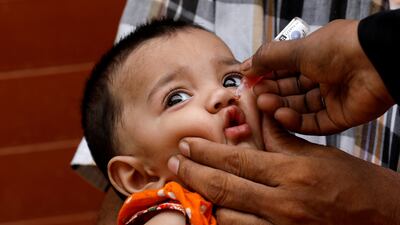
A girl receives vaccine drops during an anti-polio campaign in a low-income neighbourhood in Karachi. Reuters -
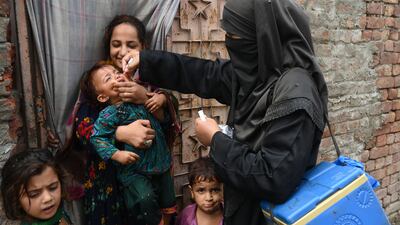
A health worker administers polio vaccine drops to a child during a polio vaccination campaign at a slum area in Lahore. AFP -
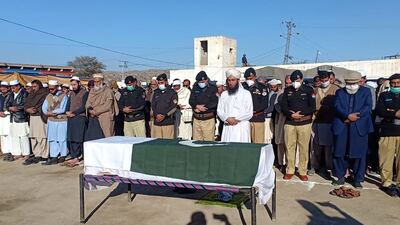
Security officials offer funeral prayers for a slain policeman killed in an attack on polio vaccination workers in Karak, a town in Khyber Pakhtunkhwa province. AFP -
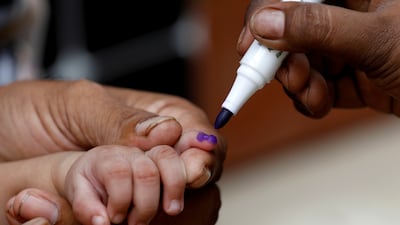
A boy gets his finger marked after he is administered polio vaccine drops in Karachi. Reuters -

A health worker administers polio vaccine drops in Lahore. AFP -
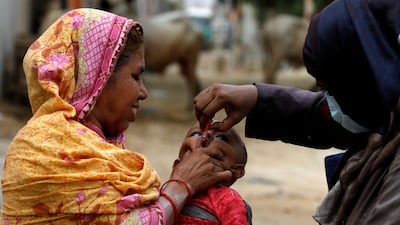
A boy receives polio vaccine drops in Karachi. Reuters -
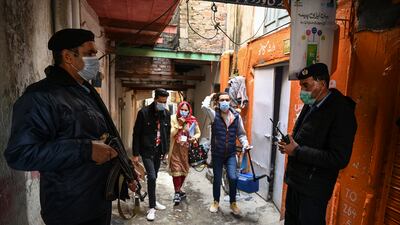
Policemen escort health workers during a polio vaccination door-to-door campaign in a slum area in Islamabad. AFP


This new mood of cautious optimism contrasts with two years of gloom in which the goal of stamping out the childhood scourge had appeared to slip further away.
The three-decade-long worldwide campaign had come tantalisingly close to ending a disease that caused 350,000 cases a year in the late 1980s, only to apparently stall and lose ground.
In Pakistan – which along with Afghanistan is the last haunt of the wild virus – cases had fallen to only 12 in 2018.
Yet mismanagement and vaccine hesitancy saw the number leap back to 145 in 2019 and 84 cases in 2020.
Meanwhile, cases arising from the mutation of weakened virus strains used in vaccine drops also rose – from 22 in 2019 to 135 in 2020.
The UAE, which supports the polio campaign in both countries, has delivered more the 580 million vaccine doses to children in Pakistan alone since 2014, the UAE Pakistan Assistance Programme said ahead of World Polio Day on Sunday.
-
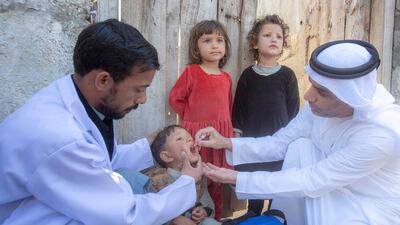
The UAE is closely involved in efforts to eradicate polio in Pakistan. -
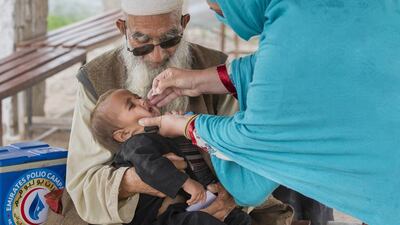
Healthcare workers gave 28 million vaccine doses to more than 16 million children in Pakistan between July and September 2020. -
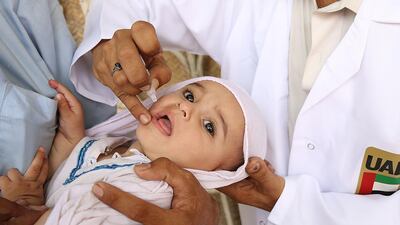
Since 2014, the UAE has contributed more than $200m towards the eradication of polio in Pakistan. It has delivered 483 million doses of polio vaccine and immunised more than 86 million children. -
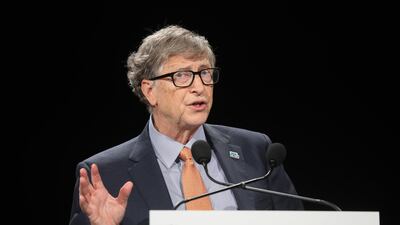
Microsoft founder Bill Gates has praised the work of the UAE in fighting polio in Pakistan. -
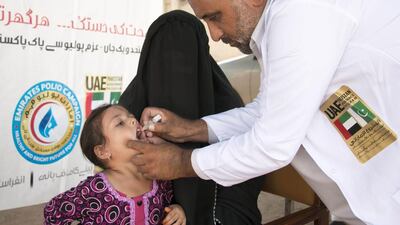
In the first six months of 2021, Pakistan reported only one case of wild polio. In 2020, it reported 77 cases of polio and 147 in 2019, according to the Global Polio Eradication Initiative. -
To be certified a polio-free nation, Pakistan must report no affected children over a three-year period.


A panel of international observers who monitor the campaign warned 12 months ago that the vision of a polio-free world seemed “a distant pinpoint of light”.
The polio programme was in “dire straits,” the board's five members warned, blaming complacency and a “jaw-dropping” slump in performance.
However, figures in Pakistan so far in 2021 show a surprise reversal. There has been only one case of wild virus recorded and eight cases of vaccine-derived virus. Dr Baig said he does not believe the fall is due to cases going unrecorded.
co-ordinator for Pakistan's polio eradication drive
“As far as the vaccination campaign goes, maybe Covid was a blessing in disguise,” he said.
“It made our campaign circulations difficult, but I think that because of Covid, there was less population movement.”
Dr Baig said lockdowns had reduced the number of children who were out of the house when teams knocked on doors.
Pakistan's campaign has struggled for years against hardline suspicion and conspiracy theories, with a stubborn minority believing the drops are harmful, or even a western-backed plot to sterilise Muslims.
Militants have regularly killed polio workers and their police guards.
Dr Baig said he believed the October 18 announcement that the Afghan Taliban had agreed to resume door-to-door vaccinations would persuade holdouts on the Pakistan side of the border.
Widespread movement of people across the porous border between the neighbours has long complicated the eradication campaign and meant epidemiologists treat the two countries as a single outbreak.
“I think it is an incredible development,” he said.
“Pakistan and Afghanistan are considered one epidemiological bloc. The virus does not differentiate between Pakistan's borders and Afghanistan.”
“The majority of the refusals we are experiencing on the Pakistan side of the border, they are based on religious refusals.
"They have some kind of sentimental attachment to the Taliban and since the Taliban were not promoting, favouring or allowing the vaccination, or even the involvement of females, that was a big challenge on this side.
“Now the Taliban have accepted that they will allow house-to-house vaccination in Afghanistan. I think it will have a significant effect on the Pakistan side," Dr Baig said.
"It will significantly reduce the refusals and increase the vaccine acceptance.”
Environmental tests on sewage samples were also promising, he said.
In 2020, the virus was found at 68 per cent of sites, but so far in 2021, that had fallen to one in 10.
WHO regional director for polio eradication
Dr Hamid Jafari, the director of polio eradication for the World Health Organisation in the region, agreed that Covid lockdowns may have played a role in slowing the spread on both sides of the border.
“Probably some of the outcomes of the Covid pandemic have had an influence. There was more restriction of movement of populations, and the virus moves with people and that's what propagates the virus,” Dr Jafari said.
He said that after the Taliban's announcement, there was a sense of urgency to start administering drops again.
“It's very important that we prevent a resurgence of polio given the current unprecedented opportunity epidemiologically.”

