

As soon as the first warning came about intense rainfall in Kerala, Rijo Rajan knew instantly it could again turn into a nightmare.
Mr Rajan, 28, and his family immediately began preparing for the impending deluge amid fears of devastating floods similar to those that struck the coastal Indian state in recent years.
By Sunday evening, their worst fears had been realised as incessant rain caused landslides and flash floods in a disaster some experts have blamed on climate change.
Mr Rajan’s two-storey house in Thiruvalla in Pathanamthitta district was half-marooned in brown water gushing from the overflowing Pamba and Manimala rivers.
With no electricity and fears of more rain, the family of five, including grandparents, are helplessly hoping for mercy.
Mr Rajan said his family was reliving the harrowing experience of floods in his home town last year and in 2018.
“We are just praying for the rains to stop. We are very worried for our lives,” Mr Rajan, a chef, told The National from his flooded home.
“There is no power supply and we are going through a difficult time.”
Experts say flooding is an environmental calamity, which can be blamed on climate change and “man-made disaster”.
-
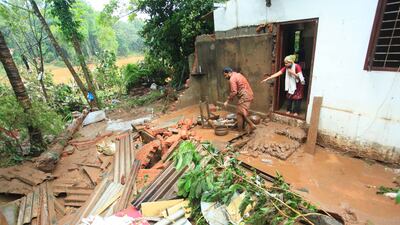
An Indian man clears mud from his home after heavy rain hits Kottayam in Kerala, causing a landslide. EPA -
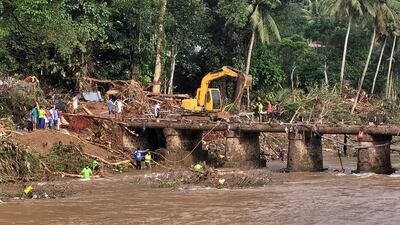
Rescue work gets under way. EPA -
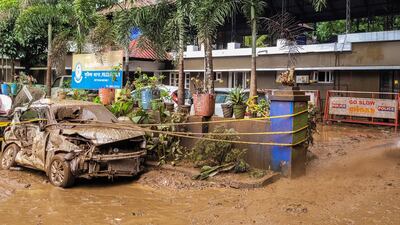
A car was completely destroyed by the landslide in the town of Manimala. EPA -

Rescuers search for bodies in Koottickal, southern Kerala. AP -
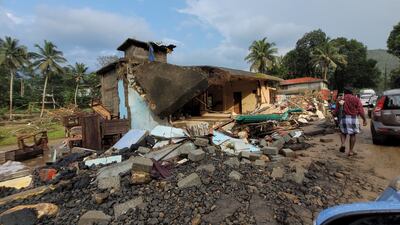
Many homes were destroyed in the area. EPA -
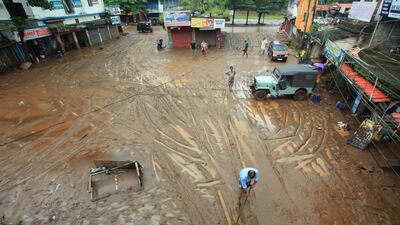
A man clears the sludge in Manimala. EPA -
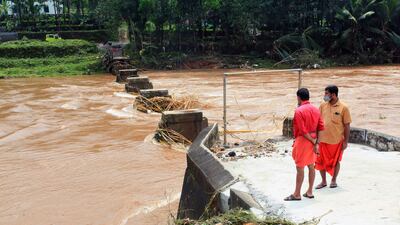
Men stand near the flooded river in Manimala. EPA -
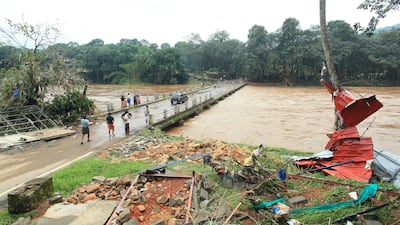
Destruction can be seen all around Kerala. EPA -
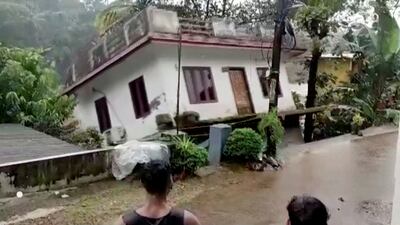
A house is swept away in Kottayam. Reuters -
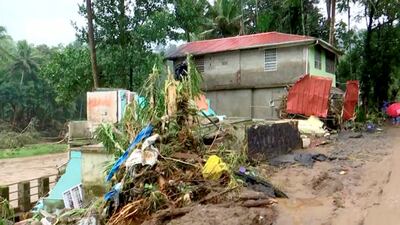
A house damaged by heavy rains in Kottayam. Reuters -

Trees and debris strewn outside a damaged house in Kottayam. Reuters -
Rescue workers carry the body of a victim, recovered from a house swept by a landslide at Kokkayar village, in Idukki district. Reuters -
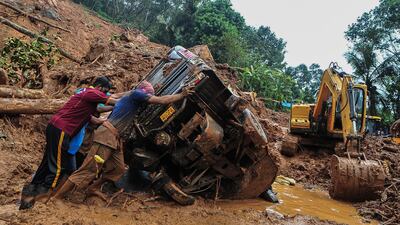
Rescue workers push an overturned vehicle stuck in the debris at the site of a landslide caused by heavy rains in Kokkayar. AFP -
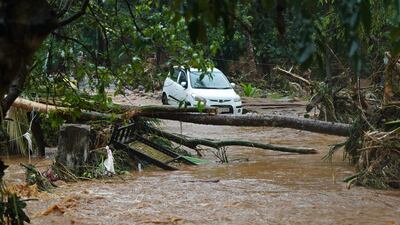
A car is stuck after flash floods caused by heavy rains in Thodupuzha. AFP -
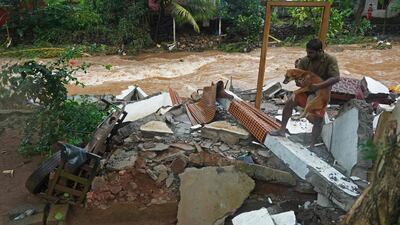
A resident carries a dog from the debris after his house was destroyed by flash floods in Thodupuzha. AFP -
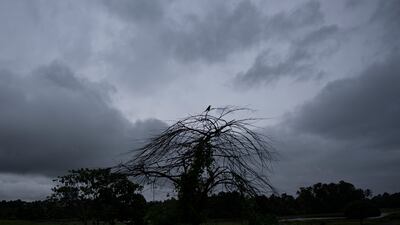
A bird perches on a tree as rain clouds cover the sky in Kochi. AP -
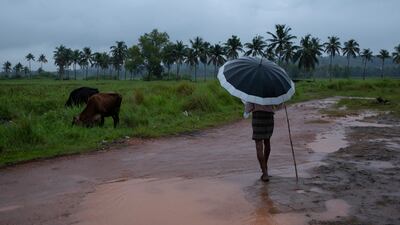
A man holds an umbrella and watches his grazing cows in Kochi. AP -
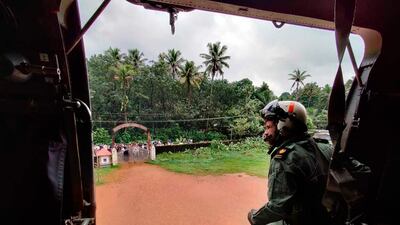
An Indian navy helicopter on the way to distribute relief material to flood-affected people in Kottayam district. AP -
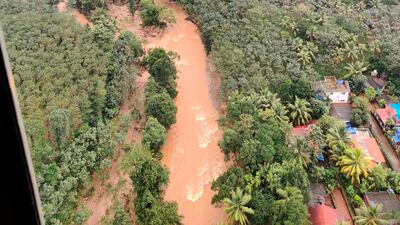
Scenes after a landslide triggered by heavy rains in the Western Ghats mountains in Koottickal, Kottayam district. AP


Kerala, a state of 34 million people, witnessed the worst floods in a century in 2018 when severe rains caused flashfloods and landslides, killing nearly 500 people and leaving a million homeless.
The following year, more than 125 people were killed in flashfloods and landslides across the state. More than 50 were killed in August last year after landslides struck the hilly Munnar region.
The latest spell of torrential rains was caused by mini-cloudbursts triggered by an unusual transformation of the cloud system over the Western Ghats, Dr S Abhilash, an atmospheric scientist at the Cochin University of Science and Technology in Kerala, told The National.
“Kerala never experienced this type of classical cloudburst exceeding 100 millimetre in one hour, but considering the vulnerable landscapes, the mountain region, a rainfall of 50mm can trigger a lot of damage,” said Dr Abhilash.
“We expect mini-cloudburst events as the change in climate is supporting that because global warming is adding more water vapour to the atmosphere and it will produce a lot of heavy rain.”
Heavy rains have hit the state since Friday and India’s weather office on Monday said the inclement weather would continue. It warned of more rains lashing the region until Thursday, further increasing Mr Rajan’s worries as authorities opened shutters at Kakki dam to release excess water.
Bodies recovered
Teams of emergency workers and the army recovered 27 bodies. The majority were from Kottayam and Idukki, the two worst-affected districts that received 164.5mm and 305.5mm rain, respectively, on Saturday.
Officials said dozens were still missing as about 9,000 people had been transferred to temporary shelters across the state.
Scores of houses and roads were swept in the floods and landslides, with military helicopters being pressed to reach areas disconnected by the floods.
atmospheric scientist at the Cochin University of Science and Technology
Most parts of Kerala fall under the highly ecologically sensitive region in the Western Ghats, a mountain range extending through India’s west coast, and one the world's largest biodiversity hotspots.
In 2011, a government committee headed by ecologist Madhav Gadgil had recommended that all of the Western Ghats be declared a sensitive region and “almost all developmental activities such as mining, thermal and power plants halted in it”.
But development such as roads, buildings and rock quarries in sensitive areas of the state have helped cause natural disasters, said Dr Abhilash.
Any infrastructural activity on the hill slopes can adversely impact the region’s environment, with regular downpours causing soil erosion and landslides, he said.

“The event is a combination of man-made disaster and climate change. Though rainfall is triggering this, the man-made activities in Western Ghats are aggravating the disaster potential,” Dr Abhilash said.
The coastal state is also facing severe challenges because of rising sea levels, with a recent visualisation tool released by Nasa projecting sea levels in the state’s largest city Kochi to rise by 300mm in the next four decades.
A 2018 report by India’s National Centre for Coastal Research said several coastal regions in the state had witnessed up to a 45 per cent reduction in the shoreline because of soil erosion.
Dr Abhilash said the state could continue to be in the grip of similar natural disasters if swift corrective measures including reduced human footprints were not taken.
“The policymakers know the solution but we have to reduce the human-footprint on highly ecologically sensitive regions."

