
A hard-up fisherman in Thailand is in line for a windfall of more than $1 million after finding a rare piece of expensive “whale vomit” on a beach.
Narong Phetcharaj was returning to shore when he saw a strange object in the surf at Niyom beach in southern Thailand’s Surat Thani province.
He found a large lump of a waxy mass called ambergris, which is French for grey amber.
The substance, which is regurgitated by sperm whales, can be sold for up to $40,000 a kilogram.
Mr Phetcharaj found a piece weighing about 30kg, which could be worth up to $1.2 million
The fisherman took the mass to experts at the Prince of Songkla University, who identified it as ambergris.
The substance is produced by sperm whales, which eat large quantities of cephalopods such as squid and cuttlefish and usually vomit out indigestible elements such as the beaks and pens.
Sometimes, these parts move into the whale's intestines and bind together, slowly becoming a solid mass which grows inside the huge mammal over many years.
The whale then vomits out the mass, which solidifies and floats on the surface of the ocean. It has a foul smell at first but after drying out, it develops a sweet and long-lasting fragrance, making it a sought-after ingredient in the perfume industry.
"None of the villagers has ever seen or touched a real whale ambergris before and that’s why everybody was happy," Mr Phetcharaj said.
"I'm so excited; I don’t know what to do. I plan to sell the ambergris as I’ve already received a certificate to prove that it's real.
"If I can get a good price, I'll retire from working as a fisherman and throw a party for my friends."
-

Winner of Ocean Photographer of the Year, Aimee Jan: A green turtle, surrounded by glass fish in Ningaloo Reef, Western Australia. 'I was out snorkelling when one of my colleagues told me there was a turtle under a ledge in a school of glass fish, about 10 metres down,' says Jan. 'When I dived down to look, the fish separated around the turtle perfectly. I said to her: ‘I think I just took the best photo I have ever taken’.' -

Second place in Ocean Photographer of the Year, Henley Spiers: 'Diving amidst the barrage of gannets, I witness the violent synchronicity of these impressive seabirds as they embark on fishing dives,' says Spiers of this photo taken in the UK's Isle of Noss. 'They hit the water at 60 miles per hour (96kmh), an impact they can only withstand thanks to specially evolved air sacs in the head and chest. The bird’s agility transfers from air to sea where it also swims with incredible speed.' -
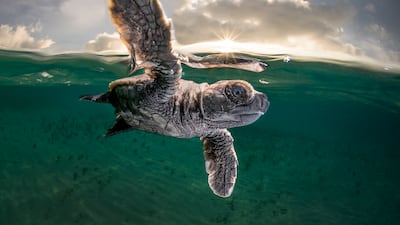
Third place in Ocean Photographer of the Year, Matty Smith: 'A hawksbill turtle hatchling just 3.5cm long and a few minutes old takes its first swim,' says Smith of his photo taken in Lissenung Island, Papua New Guinea. 'It had emerged from an egg just minutes earlier with approximately 100 of its siblings. They quickly made their way into the ocean to disperse as rapidly as they could and avoid predation from birds and fish. I had to work quickly for this shot.' -
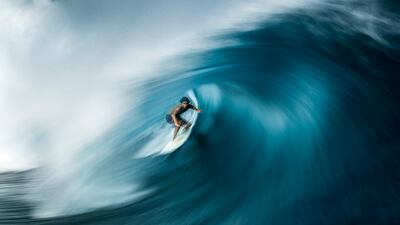
Winner of Ocean Adventure Photographer of the Year, Ben Thouard: Surfer Matahi Drollet catches a wave known as Teahupo’o in Tahiti, French Polynesia -

Second place in Adventure Photographer of the Year, Ben Thouard: A wave known as Teahupo’o, as seen from below, in Tahiti, French Polynesia -
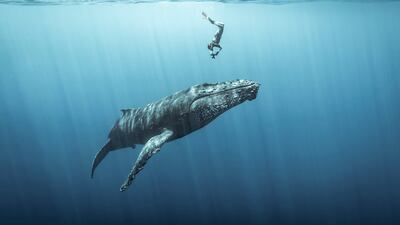
Third place in Ocean Adventure Photographer of the Year, Sebastien Pontoizeau: A freediver duck dives to capture a photograph of a humpback whale off the coast of Reunion Island -
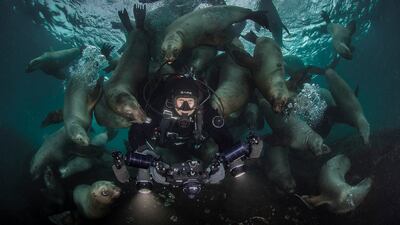
Nominee in Adventure Photographer of the Year, Steve Woods: Sea lions swarm a diver off Vancouver Island, Canada -
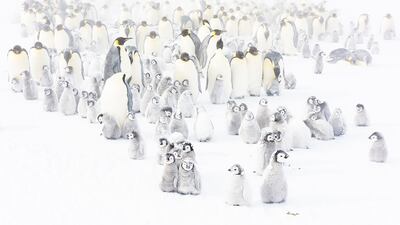
Winner of Collective Portfolio Award, Stefan Christmann: In late spring, the emperor penguin colony almost mainly consists of chicks in Antarctica -
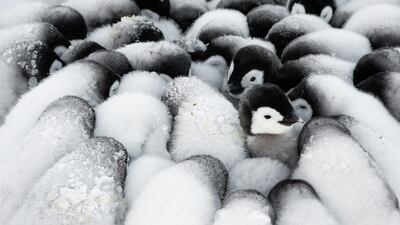
Winner of Collective Portfolio Award, Stefan Christmann: When both parents are foraging, their chicks gather in creches, or mini huddles -
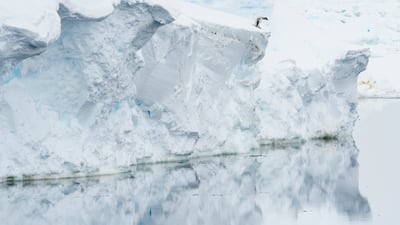
Winner of Collective Portfolio Award, Stefan Christmann: A lone chick standing on the ice shelf, as the sea ice broke up too early, in Antarctica -
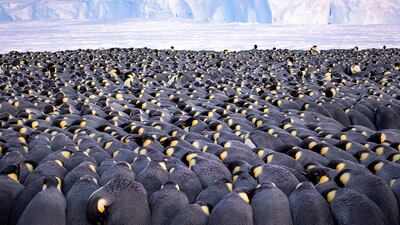
Winner of Collective Portfolio Award, Stefan Christmann: Male emperor penguins huddling during polar night in Antarctica, to stay warm as a group -
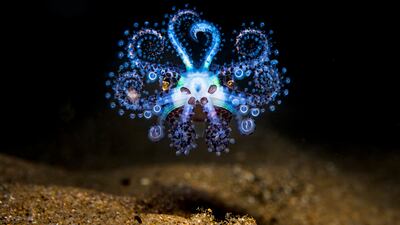
Second place in Collective Portfolio Award, Matty Smith: A southern bobtail squid performs a spectacular display on the seabed at night -
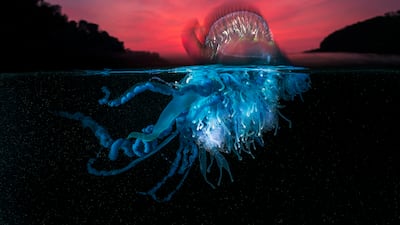
Second place in Collective Portfolio Award, Matty Smith: Pacific Man o’ War, a colourful marine invader, under an apocalyptic red sky -

Second place in Collective Portfolio Award, Matty Smith: The Porpita porpita siphonophore appears like a miniature spinning galaxy on the ocean surface -

Third place in Collective Portfolio Award, Alex Kydd: A rare encounter with a fever of cownose rays on the Ningaloo Reef, Western Australia -
Third place in Collective Portfolio Award, Alex Kydd: A freediver falls through an ocean full of moon jellyfish in Raja Ampat, West Papua -
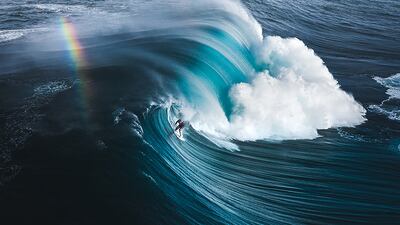
Winner of Community Choice Award, Phil de Glanville: Surfer Jack Robinson rides the famous break known as ‘The Right’, home to some of the heaviest waves in the world in Denmark, Western Australia -
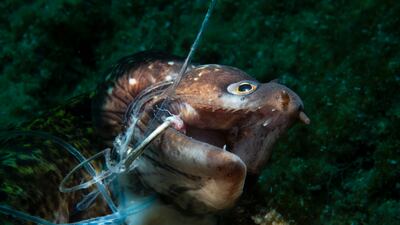
Winner of Conservation Photographer of the Year, Kerim Sabuncuoglu: A dead moray eel on an abandoned fishing line in Bodrum, Turkey -
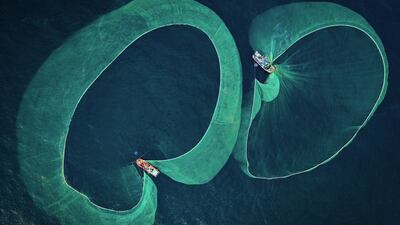
Highly Commended in Conservation Photographer of the Year, Thien Nguyen: Anchovy fishing boats photographed from above along the coastline of Phu Yen province, Vietnam -

Winner of Exploration Photographer of the Year, Martin Broen: Speleothems cast long shadows at cenote Dos Pisos in Quintana Roo, Mexico -
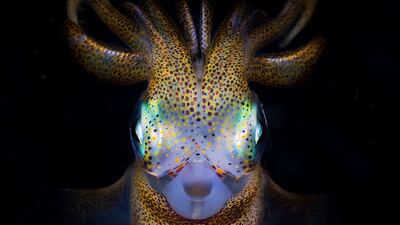
Third place in Exploration Photographer of the Year, Matty Smith: A portrait of a squid, taken in Bushrangers Bay, Australia
The mystery of ambergris
The substance has been called the treasure of the sea and referred to as floating gold.
Its origin remained a mystery for years, with theories suggested it was hardened sea foam or the droppings of large birds.
However, it was not until large-scale whaling began in the 1800s that the discovered was made that the sperm whale was the material’s only producer.
Conflicting opinions still exist as to how ambergris emerges from the whale. Many believe that the whale regurgitates the mass – which is where the substance gets its nickname “whale vomit”. Some believe the whale pass the mass along with faecal matter, whereas others say the obstruction grows so large it eventually fatally ruptures the animal.

The Buckingham Murders
Starring: Kareena Kapoor Khan, Ash Tandon, Prabhleen Sandhu
Director: Hansal Mehta
Rating: 4 / 5
Monster Hunter: World
Capcom
PlayStation 4, Xbox One
Infiniti QX80 specs
Engine: twin-turbocharged 3.5-liter V6
Power: 450hp
Torque: 700Nm
Price: From Dh450,000, Autograph model from Dh510,000
Available: Now
Afro%20salons
Game Changer
Director: Shankar
Stars: Ram Charan, Kiara Advani, Anjali, S J Suryah, Jayaram
Rating: 2/5
Heavily-sugared soft drinks slip through the tax net
Some popular drinks with high levels of sugar and caffeine have slipped through the fizz drink tax loophole, as they are not carbonated or classed as an energy drink.
Arizona Iced Tea with lemon is one of those beverages, with one 240 millilitre serving offering up 23 grams of sugar - about six teaspoons.
A 680ml can of Arizona Iced Tea costs just Dh6.
Most sports drinks sold in supermarkets were found to contain, on average, five teaspoons of sugar in a 500ml bottle.
While you're here
Hussein Ibish: Kamala Harris's views on the Middle East
Janine di Giovanni: America a dystopian city on a hill
Sulaiman Hakemy: Make America lose again
While you're here:
Daham Alasaad: 'Where are our beautiful camels?' Syria's Bedouin wonder
Charlie Mitchell: Warships seize terror financing narcotics in Indian Ocean
Nick Webster: Wildlife trade 'funnelled back to organised crime in region'
Benefits of first-time home buyers' scheme
- Priority access to new homes from participating developers
- Discounts on sales price of off-plan units
- Flexible payment plans from developers
- Mortgages with better interest rates, faster approval times and reduced fees
- DLD registration fee can be paid through banks or credit cards at zero interest rates
Our legal consultant
Name: Dr Hassan Mohsen Elhais
Position: legal consultant with Al Rowaad Advocates and Legal Consultants.
While you're here
Kareem Shaheen: Even a pandemic could not unite today's America
Michele Wucker: The difference between a black swan and a grey rhino
Robert Matthews: Has flawed science and rushed research failed us?
How green is the expo nursery?
Some 400,000 shrubs and 13,000 trees in the on-site nursery
An additional 450,000 shrubs and 4,000 trees to be delivered in the months leading up to the expo
Ghaf, date palm, acacia arabica, acacia tortilis, vitex or sage, techoma and the salvadora are just some heat tolerant native plants in the nursery
Approximately 340 species of shrubs and trees selected for diverse landscape
The nursery team works exclusively with organic fertilisers and pesticides
All shrubs and trees supplied by Dubai Municipality
Most sourced from farms, nurseries across the country
Plants and trees are re-potted when they arrive at nursery to give them room to grow
Some mature trees are in open areas or planted within the expo site
Green waste is recycled as compost
Treated sewage effluent supplied by Dubai Municipality is used to meet the majority of the nursery’s irrigation needs
Construction workforce peaked at 40,000 workers
About 65,000 people have signed up to volunteer
Main themes of expo is ‘Connecting Minds, Creating the Future’ and three subthemes of opportunity, mobility and sustainability.
Expo 2020 Dubai to open in October 2020 and run for six months
Some of Darwish's last words
"They see their tomorrows slipping out of their reach. And though it seems to them that everything outside this reality is heaven, yet they do not want to go to that heaven. They stay, because they are afflicted with hope." - Mahmoud Darwish, to attendees of the Palestine Festival of Literature, 2008
His life in brief: Born in a village near Galilee, he lived in exile for most of his life and started writing poetry after high school. He was arrested several times by Israel for what were deemed to be inciteful poems. Most of his work focused on the love and yearning for his homeland, and he was regarded the Palestinian poet of resistance. Over the course of his life, he published more than 30 poetry collections and books of prose, with his work translated into more than 20 languages. Many of his poems were set to music by Arab composers, most significantly Marcel Khalife. Darwish died on August 9, 2008 after undergoing heart surgery in the United States. He was later buried in Ramallah where a shrine was erected in his honour.
TICKETS
Tickets start at Dh100 for adults, while children can enter free on the opening day. For more information, visit www.mubadalawtc.com.
It's up to you to go green
Nils El Accad, chief executive and owner of Organic Foods and Café, says going green is about “lifestyle and attitude” rather than a “money change”; people need to plan ahead to fill water bottles in advance and take their own bags to the supermarket, he says.
“People always want someone else to do the work; it doesn’t work like that,” he adds. “The first step: you have to consciously make that decision and change.”
When he gets a takeaway, says Mr El Accad, he takes his own glass jars instead of accepting disposable aluminium containers, paper napkins and plastic tubs, cutlery and bags from restaurants.
He also plants his own crops and herbs at home and at the Sheikh Zayed store, from basil and rosemary to beans, squashes and papayas. “If you’re going to water anything, better it be tomatoes and cucumbers, something edible, than grass,” he says.
“All this throwaway plastic - cups, bottles, forks - has to go first,” says Mr El Accad, who has banned all disposable straws, whether plastic or even paper, from the café chain.
One of the latest changes he has implemented at his stores is to offer refills of liquid laundry detergent, to save plastic. The two brands Organic Foods stocks, Organic Larder and Sonnett, are both “triple-certified - you could eat the product”.
The Organic Larder detergent will soon be delivered in 200-litre metal oil drums before being decanted into 20-litre containers in-store.
Customers can refill their bottles at least 30 times before they start to degrade, he says. Organic Larder costs Dh35.75 for one litre and Dh62 for 2.75 litres and refills will cost 15 to 20 per cent less, Mr El Accad says.
But while there are savings to be had, going green tends to come with upfront costs and extra work and planning. Are we ready to refill bottles rather than throw them away? “You have to change,” says Mr El Accad. “I can only make it available.”
KILLING OF QASSEM SULEIMANI
National Editorial: Suleimani has been killed, now we must de-escalate
Mina Al Oraibi: Air strike casts a long shadow over the decade ahead
Jack Moore: Why the assassination is such a monumental gamble
Matthew Levitt: Iran retains its ability to launch terror attacks
Damien McElroy: A CEO tasked with spreading Iran's influence
Hussein Ibish: Trump's order on solid constitutional ground
Simon Waldman: Cautious Israel keeping a low profile
Rashmee Roshan Lall: Sound of silence in South Asia
Richard Olson: Why Afghanistan will be very wary
Our commentary on Brexit
- Alistair Burt: Despite Brexit, Britain can remain a world power
- Con Coughlin: Choice of the British people will be vindicated
The burning issue
The internal combustion engine is facing a watershed moment – major manufacturer Volvo is to stop producing petroleum-powered vehicles by 2021 and countries in Europe, including the UK, have vowed to ban their sale before 2040. The National takes a look at the story of one of the most successful technologies of the last 100 years and how it has impacted life in the UAE.
Read part three: the age of the electric vehicle begins
Read part two: how climate change drove the race for an alternative
Read part one: how cars came to the UAE
Mercer, the investment consulting arm of US services company Marsh & McLennan, expects its wealth division to at least double its assets under management (AUM) in the Middle East as wealth in the region continues to grow despite economic headwinds, a company official said.
Mercer Wealth, which globally has $160 billion in AUM, plans to boost its AUM in the region to $2-$3bn in the next 2-3 years from the present $1bn, said Yasir AbuShaban, a Dubai-based principal with Mercer Wealth.
“Within the next two to three years, we are looking at reaching $2 to $3 billion as a conservative estimate and we do see an opportunity to do so,” said Mr AbuShaban.
Mercer does not directly make investments, but allocates clients’ money they have discretion to, to professional asset managers. They also provide advice to clients.
“We have buying power. We can negotiate on their (client’s) behalf with asset managers to provide them lower fees than they otherwise would have to get on their own,” he added.
Mercer Wealth’s clients include sovereign wealth funds, family offices, and insurance companies among others.
From its office in Dubai, Mercer also looks after Africa, India and Turkey, where they also see opportunity for growth.
Wealth creation in Middle East and Africa (MEA) grew 8.5 per cent to $8.1 trillion last year from $7.5tn in 2015, higher than last year’s global average of 6 per cent and the second-highest growth in a region after Asia-Pacific which grew 9.9 per cent, according to consultancy Boston Consulting Group (BCG). In the region, where wealth grew just 1.9 per cent in 2015 compared with 2014, a pickup in oil prices has helped in wealth generation.
BCG is forecasting MEA wealth will rise to $12tn by 2021, growing at an annual average of 8 per cent.
Drivers of wealth generation in the region will be split evenly between new wealth creation and growth of performance of existing assets, according to BCG.
Another general trend in the region is clients’ looking for a comprehensive approach to investing, according to Mr AbuShaban.
“Institutional investors or some of the families are seeing a slowdown in the available capital they have to invest and in that sense they are looking at optimizing the way they manage their portfolios and making sure they are not investing haphazardly and different parts of their investment are working together,” said Mr AbuShaban.
Some clients also have a higher appetite for risk, given the low interest-rate environment that does not provide enough yield for some institutional investors. These clients are keen to invest in illiquid assets, such as private equity and infrastructure.
“What we have seen is a desire for higher returns in what has been a low-return environment specifically in various fixed income or bonds,” he said.
“In this environment, we have seen a de facto increase in the risk that clients are taking in things like illiquid investments, private equity investments, infrastructure and private debt, those kind of investments were higher illiquidity results in incrementally higher returns.”
The Abu Dhabi Investment Authority, one of the largest sovereign wealth funds, said in its 2016 report that has gradually increased its exposure in direct private equity and private credit transactions, mainly in Asian markets and especially in China and India. The authority’s private equity department focused on structured equities owing to “their defensive characteristics.”
