

After months of worsening conflict, Taliban leaders said they had proposed a three-month ceasefire in Afghanistan in exchange for prisoner releases and the removal of the group's leaders from a UN blacklist, local media reported on Thursday.
But a member of the Afghan government’s negotiating team denied the reports.
Nader Nadery, who had previously been quoted on the matter, said that he had been misunderstood.
“The Taliban has offered a plan for a three-month ceasefire, but in exchange, they have asked for the release of 7,000 of their prisoners and the removal of their leaders' names from the UN blacklist,” Mr Nadery was quoted as saying by Tolo News.
But Mr Nadery told The National that the Taliban "have not made any such offer".
“There have been informal talks over the months in different settings, and even then, they [the Taliban] would say release our prisoners first," he said.
"There is nothing new on this subject and there was never a formal proposal offered to us.”
Several attempts to reach a Taliban representative for comment went unanswered.
Mr Nadery, who recently returned from another meeting between the warring parties in Doha, said there had not been any “meaningful discussions” on ending the violence.
“There were a very limited number of meetings. They don’t talk about the serious issues … so there has never been a discussion on key issues on ending this war and bringing a peaceful settlement in a shared future,” he said.
Centre on International Co-operation
Renewed ceasefire talks raised concerns among security officials and analysts, particularly over the conditions highlighted by the Taliban in exchange for a period of calm.
“It gives them an upper hand, particularly with logistical reinforcement since a majority of the 7,000 prisoners they want released will rejoin active fighting,” a senior Afghan security official told The National.
Experts on the conflict reached similar assessments.
“The government sees these two elements [prisoner release and UN blacklists] as leverage over the group and may not give them up,” said Saber Ibrahimi, researcher at the US-based Centre on International Co-operation.
“The government is also concerned that the released prisoners will go back to the battlefield like the last time, when 5,000-plus were released,” he said, referring to the prisoners who were released last year at the behest of the US administration shortly after they made a deal with the insurgent group.
Additionally, Mr Ibrahimi pointed out, the process to remove Taliban members from any sanctions list is a long one.
“The Taliban haven’t shown any change in their behaviour, such as breaking away from Al Qaeda. This makes it hard for the Afghan government and the international community to proceed with delisting them,” he said.
“It will be risky and illogical to delist Taliban from sanction lists before they agree to any political settlement,” he said.
The security official also expressed concern at the effect a ceasefire would have on ongoing operations.
“It will prevent Afghan forces from retaking the lost districts, but also give them [the Taliban] the time they need to establish themselves politically,” he said, urging the government to act fast in recapturing territory lost to the group.
Taliban militants have launched an increasing number of attacks over the past two months, since the US and Nato forces started withdrawing their troops.
They have made territorial gains across several regions in Afghanistan and currently control an estimated 223 of the 397 districts in the country, according to The Long War Journal.
-

Afghan women and a boy outside a shop in the old quarter of Kabul. -
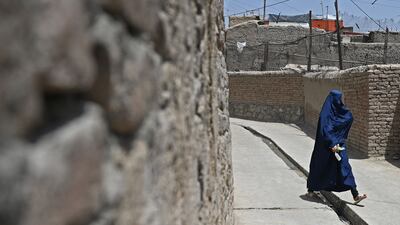
An Afghan woman in an alley in Kabul's old quarter. -
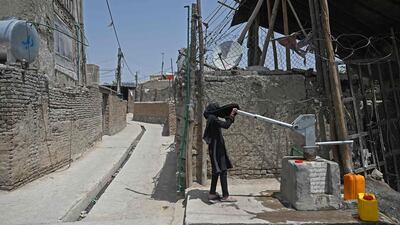
A girl uses a hand pump to fill a container with drinking water in Kabul, Afghanistan. -

A young girl in the old quarter of Kabul. -
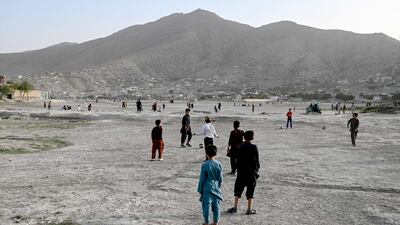
Children play football on a dried-up lake bed in Kabul. -

An Afghan security official searches a vehicle at a check point in Lashkar Gah, the provincial capital of Helmand province, Afghanistan. -
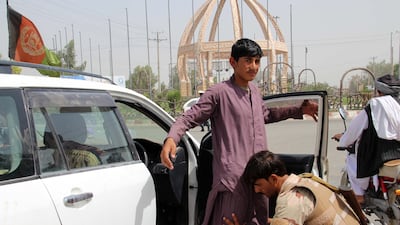
A security official checks people at a check point in Lashkar Gah, in Helmand province, Afghanistan. -

Afghan National Army soldiers at a roadside check point in Herat, the provincial capital of Herat province in Afghanistan. -
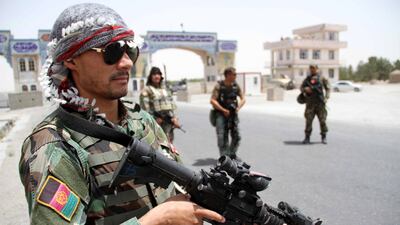
Afghan soldiers stand guard at a check point in Herat, Afghanistan.


Recent offensives against key border crossings, including the seizure of Islam Qala in Herat and Spin Boldak in Kandahar, have given the Taliban control over major trade routes into the country, while threatening the security on the borders of the neighbouring nations.
Mr Nadery, who is also the chairman of the Independent Administrative Reform and Civil Services Commission, on Thursday released figures on the damage caused by recent weeks of fighting.
“The extent of intentional destruction of public property including public administration, district administration buildings is appalling. One estimate is at least 260 buildings that are fully or partially destroyed. To just put it in numbers, it is at least $500 million that a poor country like us lost,” he said.
Mr Nadery said it was difficult to build a dialogue with a group that is causing suffering and harm to the people of Afghanistan.
“But they are a reality and we need to negotiate with them. They need to start talking seriously about a meaningful shared future,” he said.
Mr Nadery said the Afghan government would still consider any potential ceasefire or reduction in violence, if it was “a genuine proposal, and not a tactical one”.
“If it is a real for peaceful settlement, then we would assess and we will do everything to make sure that this war is ended. There is no reluctance on our part to look at and discuss a serious proposal,” he said.
“We will not accept a tactical, short-term promise that will not be met as it was not met in the past and our people will not allow us to do that,” he said.
But Mr Ibrahimi said the government may need to offer something to the Taliban in exchange for the ceasefire.
“For instance, resumption of service delivery in areas under the Taliban control, perhaps finding ways to release fewer numbers of their prisoners but with mechanisms in place that they don’t go to the battlefield, and discussing delisting during the 90-day period in exchange for a political settlement."
The Afghan security official, however, remained sceptical.
“It was not about the number of districts lost, but with their dramatic offensives the Taliban caught the attention of the world, and attempted to show the Afghan government as incompetent." he said.
"The region doesn’t think we have the right to rule Afghanistan, and the Taliban are trying show themselves as a better alternative. A pause in fighting will advance their narratives.”

