

Ethiopia has announced an end to eight months of conflict with an immediate ceasefire in its Tigray region, state media reported on Monday.
Hours earlier, witnesses reported federal government troops were seen leaving Tigray's capital Mekele in large numbers.
The ceasefire “will enable farmers to till their land, aid groups to operate without any military movement around and engage with remnants [of Tigray’s former ruling party] who seek peace", the Ethiopian government said.
It will last until the end of the planting season in Tigray in September, Ethiopia said, to battle a famine threatening the region.
“The government has the responsibility to find a political solution to the problem,” the head of the interim administration, Abraham Belay, said in calling for the ceasefire, AFP reported.
Mr Belay said that some elements within Tigray’s former ruling party were willing to engage with the federal government.
The Tigray People's Liberation Front (TPLF), and Tigray Defence Forces are yet to comment on the announced ceasefire.
Experts said the ceasefire was well overdue, but fragile.
"If the government is committed to ending hostilities, this ceasefire may be an important step, but it is still only an initial step," Aly Verjee, senior advisor to the US Institute of Peace's Africa programme, told The National.
"It is a tragedy that the ceasefire has only come after thousands of civilian lives have been lost, with hundreds of thousands of more people still facing the severe jeopardy of hunger.
He added it is as yet unclear how the ceasefire will function, if Tigrayan forces have agreed to the truce and whether it will apply to Eritrean forces fighting alongside the Ethiopian army.
-
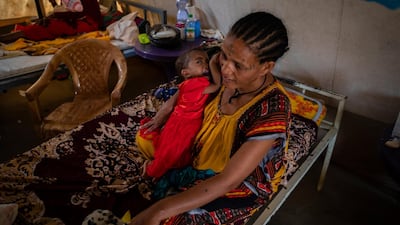
Mother Roman Kidanemariam, 35, holds her malnourished daughter, Merkab Ataklti, 22 months old, in the treatment tent of a medical clinic in the town of Abi Adi, in the Tigray region of northern Ethiopia. AP Photo -
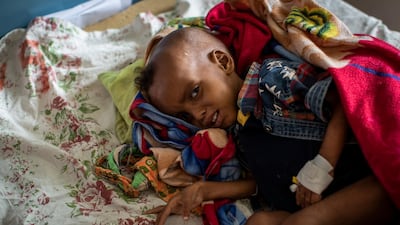
Gebre Kidan Gebrehiwet, 2, is treated for malnutrition after fleeing from the town of Abi Adi with his mother, Abeba Tesfay, at the Ayder Referral Hospital in Mekele, in the Tigray region of northern Ethiopia. AP Photo -
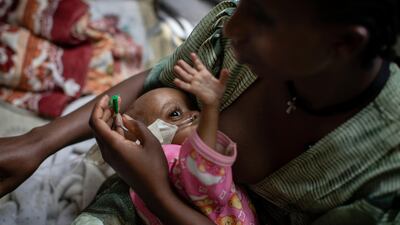
Birhan Etsana, 27, from Dengelat, uses a nasogastric tube to feed her malnourished baby, Mebrhit, who at 17 months old weighs just 5.2 kilograms (11 pounds and 7 ounces), at the Ayder Referral Hospital in Mekele, in the Tigray region of northern Ethiopia. AP Photo -
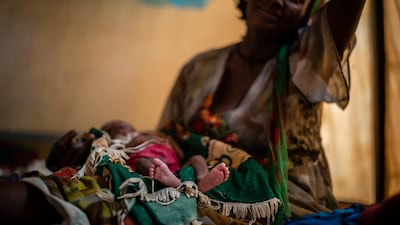
Abeba Gebru, 37, from the village of Getskimilesley, sits with her malnourished daughter, Tigsti Mahderekal, 20 days old, in the treatment tent of a medical clinic in the town of Abi Adi, in the Tigray region of northern Ethiopia. AP Photo -

An Ethiopian woman scoops up portions of yellow split peas to be allocated to waiting families after it was distributed by the Relief Society of Tigray in the town of Agula, in the Tigray region of northern Ethiopia. AP Photo -
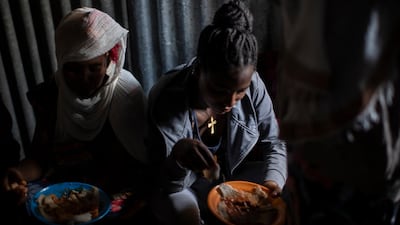
Displaced Tigrayan women sit in a metal shack to eat food donated by local residents at a reception center for the internally displaced in Mekele, in the Tigray region of northern Ethiopia. AP Photo -
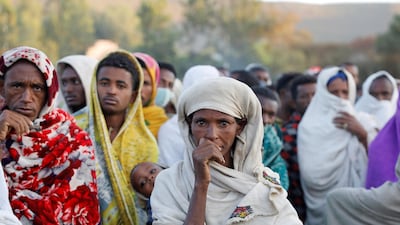
A woman stands in line to receive food donations at the Tsehaye primary school, which was turned into a temporary shelter for people displaced by conflict, in the town of Shire, Tigray region. Reuters -
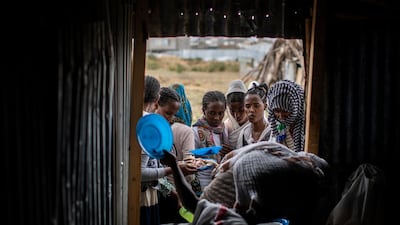
Tigrayans stand in line to receive food donated by local residents at a reception center for the internally displaced in Mekele, in the Tigray region of northern Ethiopia. AP Photo -
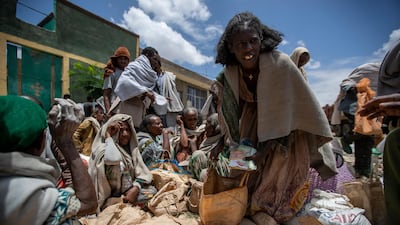
An Ethiopian woman leaves with a portion of yellow split peas after it was distributed by the Relief Society of Tigray in the town of Agula, in the Tigray region of northern Ethiopia. AP Photo -
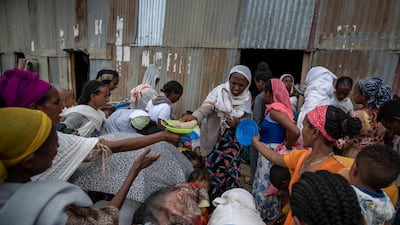
Displaced Tigrayans queue to receive food donated by local residents at a reception center for the internally displaced in Mekele, in the Tigray region of northern Ethiopia. AP Photo


"Given its unilateral nature and without any mechanism to de-escalate tensions or monitor the truce, the ceasefire may quickly run into challenges," Mr Verjee said.
The halt in fighting came as Tigrayan forces looked to have the upper hand in intense fighting against the government.
"The ceasefire announcement appears to be a reaction to the Ethiopian federal military suffering recent major battlefield defeats and then today losing control of the regional capital, Mekele, to the Tigray Defence Forces," William Davison, a senior analyst on the country from Crisis Group told The National.
Residents of Mekele told Reuters there was dancing in the streets on Monday as Tigrayan forces entered the city for the first time since November. Shortly before, government troops were seen packing up equipment.
But UN children's agency Unicef accused federal troops of dismantling satellite equipment their office in Tigray's capital as they left.
"This act violates UN privileges and immunities and the rules of International Humanitarian Law regarding respect for humanitarian relief objects," the group's Executive Director Henrietta Fore said in a statement shared on Twitter.
Located more than 600 kilometres from the capital Addis Ababa, Tigray is the northernmost of Ethiopia's 10 regions, which are administered under a system of "ethnic federalism" broadly dividing the country according to ethnicity and language.
The Tigrayan people account for less than six per cent of Ethiopia's population of 110 million.
The conflict began in November, when Prime Minister Abiy Ahmed sent troops to the northern region to put down dissident leaders.
Mr Abiy said the move was sparked by TPLF attacks on federal forces, but Tigrayans claim tension had been escalating for months. The fighting pulled in troops from Eritrea to the north and the neighbouring region of Amhara to the south in support of the federal government.
Despite promising a swift victory, the conflict raged for eight months, eventually leaving 350,000 people in the region facing famine, the UN said.
More than 40,000 have fled over the border to Sudan, where they are living in dire conditions.
A University of Ghent study found more than 2,500 civilians have died in 232 massacres linked to the conflict and thousands more remain unaccounted for. Reports of sexual violence and torture are widespread.
Humanitarian agencies have decried a lack of access and on Saturday, three Medecins Sans Frontieres employees were murdered in Tigray.
UN Secretary General Antonio Guterres said he was "hopeful" of an end to the conflict.
"Recent events in the Tigray region of Ethiopia are extremely worrisome," Mr Guterres said, adding he had just spoken to Mr Abiy.
"They demonstrate once again that there is no military solution to the crisis. I am hopeful that an effective cessation of hostilities will take place.
"It is essential that civilians are protected, humanitarian aid reach the people in need and a political solution is found."
Ethiopia recently held what Mr Abiy hailed as its first "free and fair" elections, despite a fifth of the electorate being unable to vote.
Tigray was excluded from voting entirely and other regions delayed until later in the year. Results of the poll are expected in coming days.
Agencies contributed to this report

