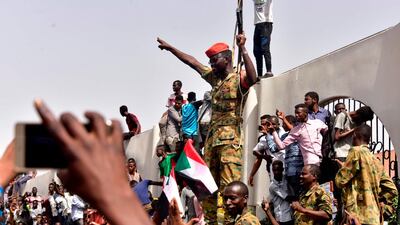

A year after the toppling of dictator Omar Al Bashir, Sudan is in roughly the state it has been for most of the 64 years since independence: perilously unstable and deep in political uncertainty.
Sudan has made little progress towards overcoming its problems since Al Bashir’s generals removed him from power on April 11, 2019, after months of nationwide protests against his 29-year rule.
Al Bashir was detained shortly after his removal and sentenced to two years in jail after being convicted of corruption. He is likely to face separate trials for ordering the fatal shooting of protesters and for overthrowing a democratically elected government in a military coup he led in 1989. Sudan’s transitional rulers have indicated that he could also be tried before the International Criminal Court on charges of genocide and crimes against humanity in the western Darfur region in the 2000s.
But the prospect of Al Bashir, 75, spending the rest of his days behind bars is little comfort to a country still facing the hardships that sparked the uprising against him in December 2018.
The continuing shortages of bread and fuel, power cuts, the rapid depreciation of the currency and double-digit unemployment are slowly chipping away at the patience shown so far by Sudan's 40 million people towards their new rulers. Peace with a host of rebel groups that have been fighting government forces for years in the south and west of Sudan remains elusive despite months of negotiations. The uneasy partnership between the military and the opposition alliance that led the anti-Al Bashir protests, established under a power-sharing agreement signed in August, appears at times to be close to unravelling.

“What is clear a year after the removal of Al Bashir is the absence of a detailed plan toward the transition to democratic rule,” said Rasha Awad, editor in chief of the Sudanese online news service Al Taghyeer. “The transition to democratic rule is not just holding elections. So many steps are needed before that,” she explained, citing a long list of issues on which progress has been slow. These include reforming the judiciary, purging security agencies, civil service and the military of Al Bashir loyalists, reaching peace agreements with rebel groups and arresting the deterioration of the economy.
Sudan, a vast Afro-Arab nation with massive untapped natural resources, has alternated between authoritarian military regimes and elected civilian governments since 1956, with the latter consistently proving ineffective and short lived. Ethnically and religiously diverse, Sudan has moreover been torn apart for most of its post-independence years by civil wars, famine and economic crises. In the past year alone there have been at least two coup attempts and an assassination attempt against the transitional prime minister, Abdalla Hamdok.
The revolt against Al Bashir was part of a second wave of Arab uprisings that included Algeria, Iraq and Lebanon. Unlike those of the first wave a decade ago, the latest uprisings were driven by economic inequality and social disparities not regime change. The Sudanese activists behind the "December Revolution" say they have learnt from the mistakes of other uprisings, when in fact their movement has been bogged down by shortcomings that, while unique to Sudan, are nevertheless pushing the country deeper into an uncertain future.

Amany Al Taweel, a Sudan expert from Egypt’s Al Ahram Centre for Political and Strategic Studies, attributes much of the political instability to tensions between the military and civilian wings of the transitional government. The military, she said, viewed the civilians in light of their track record as ineffective rulers, unable to tackle the country’s major challenges. The civilians, on their part, are wary of domination by the generals.
“The interactions between the two main planks of power – the military and civilians – remain unstable and fraught with suspicion,” she said.
Unfortunately for Sudan, the coronavirus pandemic and the resultant global economic downturn have undermined Khartoum’s chances of cashing in on the country’s new image as a genuine aspiring democracy, with hopes of debt forgiveness and foreign investment, pending the removal of its name from the US list of state sponsors of terrorism, now shelved.
The pandemic also threatens to push Sudan's battered health sector to collapse if the number of cases continues to grow. The country had only 15 cases with two deaths as of April 10, according to figures compiled by John Hopkins University.
“Definitely, no one has the time now to deal with Sudan,” said Hany Raslan, another Sudan expert from Egypt’s Al Ahram Centre for Political and Strategic Studies. “Now the economic crisis is deepening and it is taking a toll on the people … but everyone is bearing up because they will be thrown into the unknown if they cease to support the government.”
But the people's support has its limits, according to Mrs Awad, the editor of Al Taghyeer.
“People remain happy to this day that Al Bashir was removed and the government continues to enjoy legitimacy despite its failings,” she said.
“But the government must realise this legitimacy is not absolutely guaranteed because people are economically pressed and counter-revolutionaries have not given up."

