The National
HARARE // Robert Mugabe’s decades-long grip on power appeared to be over on Wednesday as Zimbabwe's military took control of the country and placed the president under house arrest.
The country’s generals denied staging a coup but scenes in the capital Harare suggested otherwise.
Military vehicles blocked roads outside the parliament and senior soldiers delivered a late-night television address to the nation.
"The president... and his family are safe and sound and their security is guaranteed," Major General Sibusiso Moyo said, slowly reading out a statement.
"We are only targeting criminals around him who are committing crimes... As soon as we have accomplished our mission we expect that the situation will return to normalcy."
Gen Moyo added: "This is not a military takeover of government".
____________________
Read more
The disastrous rule of Robert Mugabe
Robert Mugabe through the years - in pictures
WHO chief reverses Mugabe ambassador appointment
____________________

But the military’s actions seemed to be bringing the curtain down on the reign of 93-year-old Mugabe, who has ruled Zimbabwe since independence from Britain in 1980.
South Africa's President Jacob Zuma, one of Mugabe's closest allies, said he had spoken to the veteran leader by telephone.
Mugabe "indicated that he was confined to his home but said that he was fine," the South African government said in a statement that called for calm and restraint.
Tensions between Mugabe and the military, which has long helped prop up his authoritarian rule, erupted over recent weeks.
The ruling Zanu-PF party on Tuesday accused army chief General Constantino Chiwenga of "treasonable conduct" after he criticised Mugabe for sacking vice president Emmerson Mnangagwa.
Mr Mnangagwa's dismissal left Mugabe's wife Grace, 52, in prime position to succeed her husband as the next president - a succession strongly opposed by senior ranks in the military.
As the situation deteriorated overnight on Tuesday, prolonged gunfire was heard near Mugabe's private residence.
On Wednesday, the TV state broadcaster played liberation struggle songs, while many citizens in Harare shopped at markets and drove to work despite the turmoil.
Armed Soldiers in armoured personnel carriers stationed themselves at key points in Harare, while Zimbabweans formed long lines at banks in order to draw the limited cash available, a routine chore in the country's ongoing financial crisis.
The US embassy warned its citizens in the country to "shelter in place" due to "ongoing political uncertainty".
South Africa urged Zimbabwe to resist any "unconstitutional changes" of government, and said it was sending envoys to Harare on behalf of the SADC bloc of southern African nations to help resolve the impasse.
-
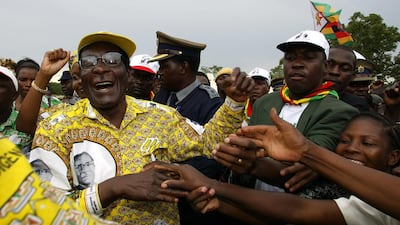
Zimbabwe president Robert Mugabe and leader of the ruling party ZANU PF greets a crowd of about 15,000 people at a golf course in Chinhoyi town 120Km northwest of Harare during a pre-election rally in 2002. Alexander Joe / AFP -
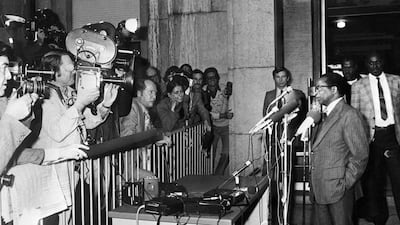
Patriotic Front leader Robert Mugabe, right, gives a press conference, on October 29, 1976 in Geneva. AFP -
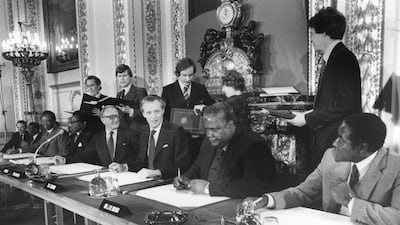
The leaders of the Patriotic Front, Robert Mugabe and Joshua Nkomo, Lord Carrington the British foreign secretary, Sir Ian Gilmore and Bishop Abel Muzorewa the prime minister of Zimbabwe-Rhodesia, at Lancaster House. The occasion is the signing of the agreement on the independence of Zimbabwe on December 21, 1979. Central Press / Getty Images -
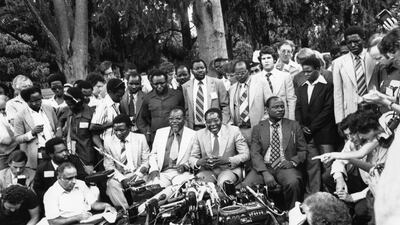
Robert Mugabe, newly elected president of Zimbabwe, holds a press conference in his garden in Mount Pleasant, Salisbury on March 6, 1980. Keystone / Getty Images -
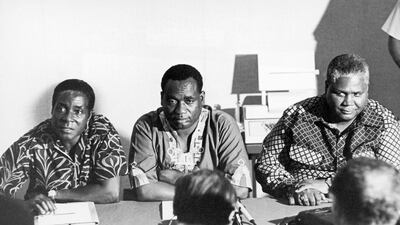
From left: Robert Mugabe, secretary for information and deputy of the African National Congress (Anc) George Silundika, and leader of the Zapu Party (Zimbabwe African People Union) Joshua Nkomo at a meeting in Dar Es Salaam, Tanzania in the 1960s. Keystone-France / Gamma-Keystone via Getty Images -
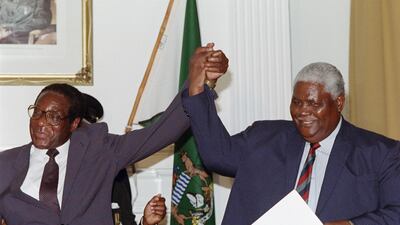
Zimbabwe's president Robert Mugabe, left, and former president of Zimbabwe African People's Union (ZAPU) Joshua Nkomo raise their fists on December 22, 1987 in Nairobi. Mugabe, Zimbabwean first Premier in 1980 and president in 1987, was born in Kutama in 1924, formerly Southern Rhodesia. Largely self-educated, he became a teacher. After short periods in the National Democratic Party and ZAPU, he co-founded the Zimbabwe African National Union (ZANU). After a 10-year detention in Rhodesia (1964-74), he spent five years in Mozambique gathering support in preparation for independence in 1980. Alexander Joe / AFP -
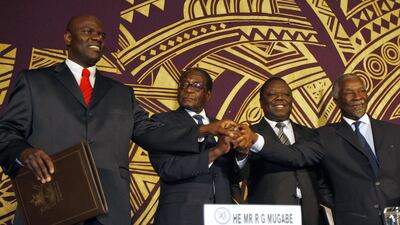
From left: Zimbabwean MDC (Movement for Democratic Change) breakaway faction leader Arthur Mutambara, Zimbabwe's president Robert Mugabe, opposition's leader Morgan Tsvangirai and South African Thabo Mbeki pose after signing the power-sharing accord on September 15, 2008 in Harare. Mbeki said the region and Africa had to extend a helping hand to Zimbabwe and that getting seeds, fertilizer and fuel to the country was a matter of urgency with rains approaching. Desmond Kwande / AFP -
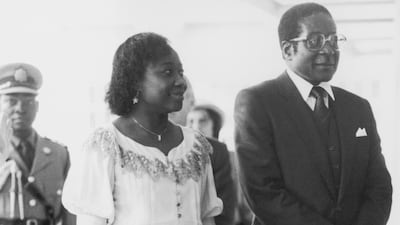
Robert Mugabe, the prime minister of Zimbabwe, visits Queen Elizabeth at Buckingham Palace in London with his wife Sally on May 20, 1982. Rob Taggart / Central Press / Hulton Archive / Getty Images -
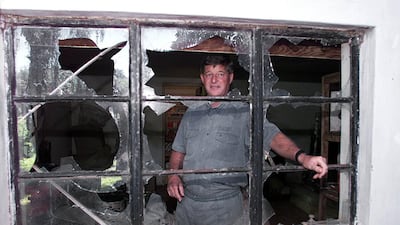
Zimbabwean farmer Paul Retzlaff stands on April 12, 2000 in front of a broken window at his home in Arcturus, Gormonzi district, 30 km east of Harare, a day after clashes broke out at his farm when drunken would-be squatters invaded the property before being repelled by black farm workers. Retzlaff said shots had been fired by the invaders, including a leading veteran of the war against white rule in the 1970s. The couple was saved after black farm workers from neighbouring farms responded to a call for help over ham radio. His wife Liz said the invaders were shouting that they had president Robert Mugabe's permission to invade the property. Alexander Joe / AFP


Mugabe and his wife made no public comment and their exact whereabouts was not known, while government and army spokesmen were not available to comment.
"The government's silence on the military deployments seem to confirm that President Mugabe has lost control of the situation," Robert Besseling, of the London-based EXX Africa risk consultancy, said.
Mugabe is the world's oldest head of state, but his poor health has fuelled a bitter succession battle as potential replacements jockey for position.
In speeches this year, Mugabe has often slurred his words, mumbled and paused for long periods.
His lengthy rule has been marked by brutal repression of dissent, mass emigration, vote-rigging and economic collapse since land reforms in 2000.

Speculation has been rife in Harare that Mugabe had sought to remove army chief Chiwenga, who is seen as an ally of the ousted vice president.
Mr Mnangagwa, 75, was previously one of Mugabe's most loyal lieutenants, having worked alongside him for decades.
Earlier this year Zimbabwe was gripped by a bizarre spat between Mrs Mugabe and Mr Mnangagwa that included an alleged ice-cream poisoning incident that laid bare the pair's rivalry.
Mrs Mugabe - 41 years younger than her husband - has become increasingly active in public life in what many say was a process to help her eventually take the top job.
She was granted diplomatic immunity in South Africa in August after she allegedly assaulted a model at an expensive Johannesburg hotel where the couple's two sons were staying.
As the economy collapsed since 2000, Zimbabwe was engulfed by hyperinflation and was forced to abandon its own currency in 2009 in favour of the US dollar.
The country, which has an unemployment rate of more than 90 per cent, is due to hold elections next year with Mugabe pledging to stand for office again.
The army has been praised by the nation's war veterans for carrying out "a bloodless correction of gross abuse of power". The military will return Zimbabwe to "genuine democracy" and make the country a "modern model nation," Chris Mutsvangwa, chairman of the war veterans' association, said.
Mr Mutsvangwa and the war veterans are staunch allies of Mr Mnangagwa.Some staff at ZBC, the national broadcaster, were manhandled when soldiers took over their offices in Harare late on Tuesday evening.
Workers were told that they "should not worry", a source added, and that soldiers were only there to protect the site.
The head of Zanu-PF's youth wing accused the army chief of subverting the constitution. Mrs Mugabe has developed a strong following in the powerful youth wing.
"Defending the revolution and our leader and president is an ideal we live for and if need be it is a principle we are prepared to die for," Kudzai Chipanga, who leads the Zanu-PF Youth League, said at the party's headquarters in Harare.
Decades ago, Zimbabwe had one of Africa's promising economies thanks in part to its agricultural exports.
With Associated Press and Agence France-Presse

