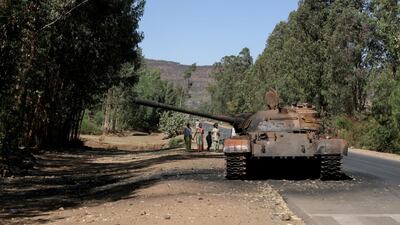

Top UN humanitarian Mark Lowcock described a deepening crisis in northern Ethiopia on Thursday and said that Eritrea was not answering global calls to withdraw its troops from the turbulent Tigray region.
Addressing closed-door UN Security Council talks, Mr Lowcock said 4.5 million people out of about 6 million in Tigray need humanitarian assistance as the conflict “is not over and things are not improving”.
Various armed groups have been accused of committing human rights abuses in Tigray since Ethiopia’s federal army ousted the former regional ruling party, the Tigray People’s Liberation Front (TPLF), from the capital Mekelle in November.
"Without a ceasefire, this already grave humanitarian crisis is only going to get a lot worse," said a draft copy of Mr Lowcock's comments to the council, which was obtained by The National.
"Since the conflict began, civilians have endured indiscriminate shelling of towns, targeted violence, mass killings and executions and systematic sexual violence as a weapon of war."
An attack by Eritrean troops that left at least nine civilians dead in the Ethiopian town of Adwa on Monday showed the continued Eritrean military presence in Tigray despite promises last month that forces would withdraw.
“Neither the UN nor any of the humanitarian agencies we work with have seen proof of Eritrean withdrawal,” said Mr Lowcock.
“We have, however, heard some reports of Eritrean soldiers now wearing Ethiopian Defence Force uniforms. And regardless of uniform or insignia, humanitarian staff continue to report new atrocities which they say are being committed by Eritrean Defence Forces.”
The meeting, held at the request of the US, marked the council’s fifth debate on the violence in Tigray. Permanent members Russia and China have blocked calls for action by Western powers on what they consider to be an internal Ethiopian matter.
The New York-based campaign group Human Rights Watch on Thursday bashed Moscow and Beijing for blocking sanctions and other UN action to tackle the atrocities unfolding in the region.
“The council should hold a public session and condemn the rights abuses and humanitarian disaster unfolding before their eyes,” the group said in a statement.
“It should voice clear support for independent oversight of humanitarian assistance and an independent, international investigation into alleged crimes committed by all parties with the aim of paving the way for a credible accountability process.”
-

Tigrayan refugees wait in line to receive food from Muslim Aid at Hamdeyat Transition Center near the Sudan-Ethiopia border, eastern Sudan, on Wednesday. AP -

Janez Lenarcic, fifth right, the European Commissioner for Crisis Management, arrives to visit Um Raquba camp for Ethiopian refugees who fled the Tigray conflict, in eastern Sudan's Gedaref state on December 3, 2020. AFP -
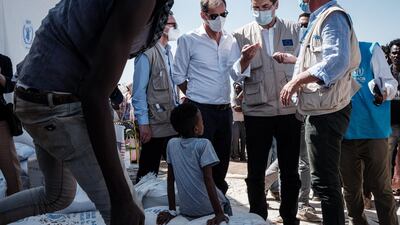
Janez Lenarcic, second right, the European Commissioner for Crisis Management, arrives to visit Um Raquba reception camp for Ethiopian refugees who fled the Tigray conflict, in eastern Sudan's Gedaref state on December 3, 2020. AFP -
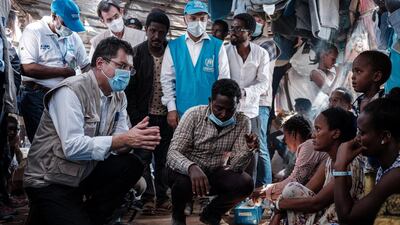
Janez Lenarcic, left, the European Commissioner for Crisis Management, speaks with Ethiopian refugees who fled the Tigray conflict during his visit to Um Raquba reception camp in Sudan on December 3, 2020. AFP -
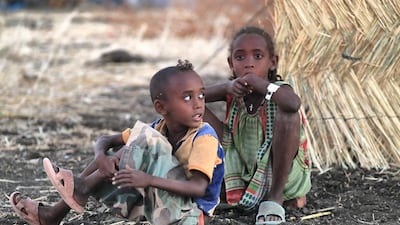
Ethiopian children sit outside their family's tent at Um Raquba refugee camp in Gedaref, eastern Sudan, on January 6, 2021. AFP -
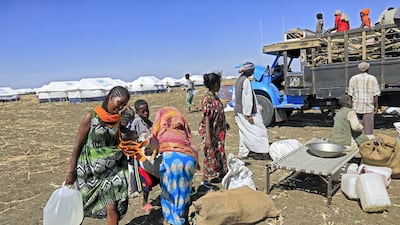
Ethiopian refugees, who fled the Tigray conflict, gather their belongings upon their arrival at the Tenedba camp in Mafaza, eastern Sudan on January 8, 2021. AFP -
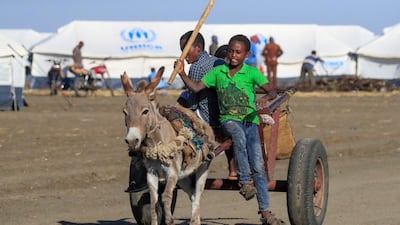
Ethiopian refugees, who fled the Tigray conflict, at the Tenedba camp in Mafaza, eastern Sudan on January 8, 2021. AFP -
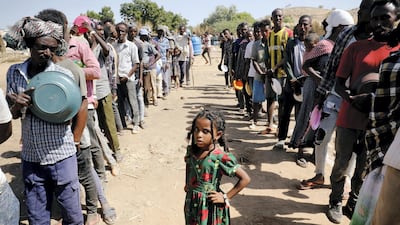
Ethiopian refugees wait in line for a meal at Sudan's Um Raquba camp which houses Ethiopian refugees who fled the fighting in the Tigray region, November 28, 2020. Reuters -
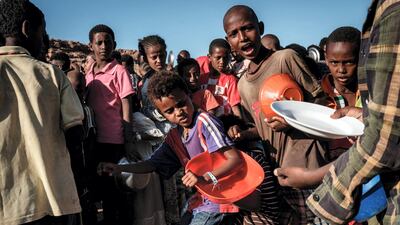
Ethiopian refugee children who fled the Tigray conflict have a play-fight as they wait for food from Muslim Aid at the Um Raquba camp in eastern Sudan's Gedaref state on December 12, 2020. AFP -
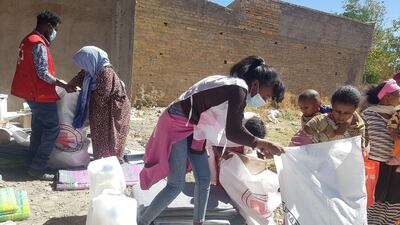
Red Cross workers and volunteers distribute supplies to civilians in the Tigray region of Ethiopia, January 6, 2021. Reuters


Fighting broke out in Tigray last November when Ethiopian and Eritrean troops along with allied militias launched an offensive against the TPLF, the regional ruling party that was increasingly at odds with Addis Ababa.
US Secretary of State Anthony Blinken has described what is happening in Tigray as "ethnic cleansing", but efforts by Washington to pressure Ethiopia's Prime Minister Abiy Ahmed into a full cessation of hostilities have not gained traction.
Mr Ahmed, who was awarded the Nobel Peace Prize in 2019, acknowledged last month the presence of Eritrean forces and militias in Tigray that were backing his offensive and promised the withdrawal of the foreign troops.
The G7 group of the US, Britain and other major powers this month said it was "strongly concerned" by reports of human rights abuses in Tigray region, called for investigations and for those responsible to be held to account.

