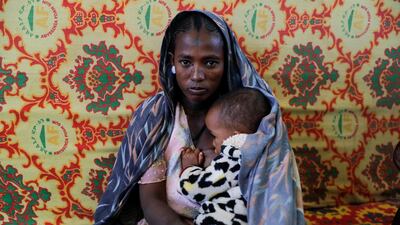

A new report issued this week by the World Peace Foundation (WPF) exposes the use of starvation as a war weapon in the Ethiopian region of Tigray and speaks of an emergency situation that will worsen through September if the conflict is not resolved.
The 66-page report published by WPF, an affiliate of Tufts University in Massachusetts, calls for urgent humanitarian attention to the crisis in Tigray.
The conflict broke out in the Ethiopian region last November when Ethiopian and Eritrean troops along with allied militias launched an offensive against the Tigray People's Liberation Front.
The fighting has already displaced about one million civilians and left 4.5 million in need of aid, according to the UN.
Medecins Sans Frontieres and Amnesty International reported in the last month on alleged massacres, extrajudicial killings, rape and torture perpetrated by forces aligned with Addis Ababa.
But now, this new report is shedding light on starvation being used as a weapon in the crisis.
“Ethiopian and Eritrean belligerents in the war in Tigray have comprehensively dismantled the region’s economy and food system,” the WFP report declares.
It describes a systematic process of starving the local population and says there is a risk of “mass starvation and a risk of famine” in the coming months, with sustained food insecurity and dependence on external assistance in the longer term.
“Our stark conclusion is that the governments of Ethiopia and Eritrea are starving the people of Tigray. Circumstantial evidence suggests that this is intentional, systematic and widespread," the report says.
The report states that invading forces are depriving civilians of food, destroying crops and denying locals access to farm animals and healthcare, as well as targeting markets and disrupting water infrastructure in an attempt to starve the Tigray region.
The Famine Early Warning Systems Network said last month that at least 20 per cent of the population of central and eastern Tigray as well as several sections of north-western and south-eastern Tigray were experiencing emergency (IPC Phase 4) levels of food insecurity. This situation is projected to continue through September 2021, even as the UN pressures the Ethiopian government to grant more access to aid groups.
“These shocking events are not only human rights violations in their own right, but also, as this report shows, are contributing to destitution and starvation,” former prime minister of New Zealand Helen Clark wrote in the prologue of the WFP report.
US Secretary of State Anthony Blinken has described what is happening in Tigray as "ethnic cleansing", but efforts by Washington to pressure Ethiopia's Prime Minister Abiy Ahmed into a full cessation of hostilities have not materialised.
Mr Ahmed, who was awarded the Nobel Peace Prize in 2019, acknowledged last month the presence of Eritrean forces and militias in Tigray that were backing his offensive. He promised the withdrawal of these troops but reports from the ground indicate their continued presence.
-

Tigrayan refugees wait in line to receive food from Muslim Aid at Hamdeyat Transition Center near the Sudan-Ethiopia border, eastern Sudan, on Wednesday. AP -

Janez Lenarcic, fifth right, the European Commissioner for Crisis Management, arrives to visit Um Raquba camp for Ethiopian refugees who fled the Tigray conflict, in eastern Sudan's Gedaref state on December 3, 2020. AFP -
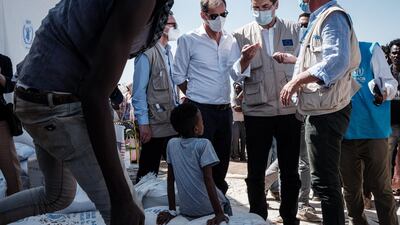
Janez Lenarcic, second right, the European Commissioner for Crisis Management, arrives to visit Um Raquba reception camp for Ethiopian refugees who fled the Tigray conflict, in eastern Sudan's Gedaref state on December 3, 2020. AFP -
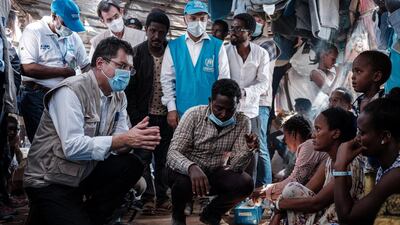
Janez Lenarcic, left, the European Commissioner for Crisis Management, speaks with Ethiopian refugees who fled the Tigray conflict during his visit to Um Raquba reception camp in Sudan on December 3, 2020. AFP -
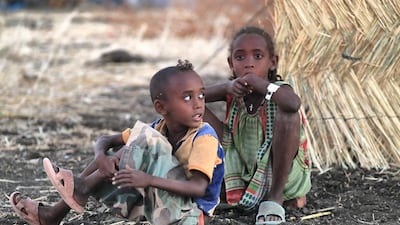
Ethiopian children sit outside their family's tent at Um Raquba refugee camp in Gedaref, eastern Sudan, on January 6, 2021. AFP -
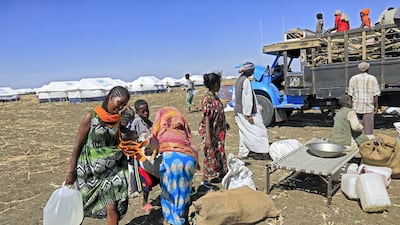
Ethiopian refugees, who fled the Tigray conflict, gather their belongings upon their arrival at the Tenedba camp in Mafaza, eastern Sudan on January 8, 2021. AFP -
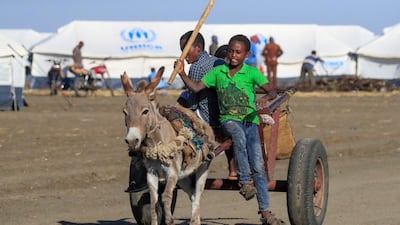
Ethiopian refugees, who fled the Tigray conflict, at the Tenedba camp in Mafaza, eastern Sudan on January 8, 2021. AFP -
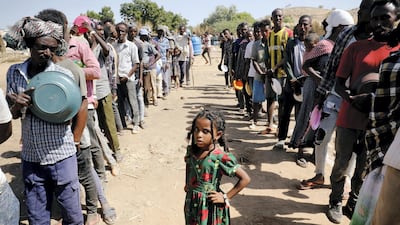
Ethiopian refugees wait in line for a meal at Sudan's Um Raquba camp which houses Ethiopian refugees who fled the fighting in the Tigray region, November 28, 2020. Reuters -
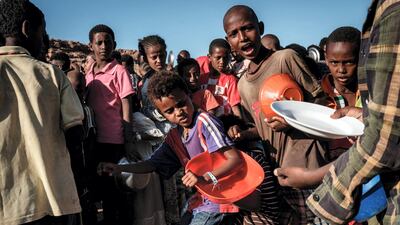
Ethiopian refugee children who fled the Tigray conflict have a play-fight as they wait for food from Muslim Aid at the Um Raquba camp in eastern Sudan's Gedaref state on December 12, 2020. AFP -
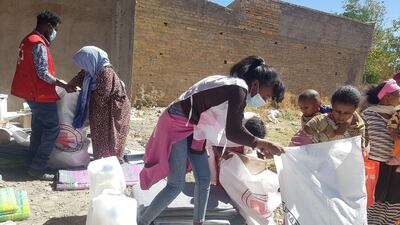
Red Cross workers and volunteers distribute supplies to civilians in the Tigray region of Ethiopia, January 6, 2021. Reuters


On Thursday, the White House announced that National Security Adviser Jake Sullivan had spoken on Wednesday with Demeke Mekonnen, Ethiopia's deputy prime minister.
"Mr Sullivan expressed the [administration of US President Joe Biden]'s grave concern about the continued humanitarian and human rights crisis in the Tigray region," National Security Council spokeswoman Emily Horne said.
The two discussed critical steps to address the crisis in Tigray, including “expanded humanitarian access, cessation of hostilities, departure of foreign troops and independent investigations into atrocities and human rights violations”.
The US on Thursday also announced more than $152 million in humanitarian aid to the Tigray region.
Contacted by The National, the Ethiopian embassy in Washington was not immediately available for comment.

