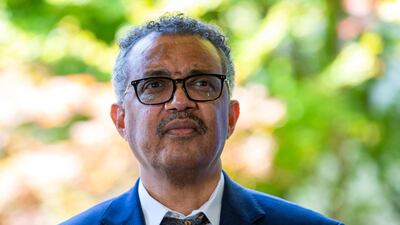
Ethiopia's army chief on Thursday accused World Health Organisation boss Tedros Adhanom Ghebreyesus – the country's highest-profile Tigrayan abroad – of lobbying to send arms and support to leaders in the dissident region.
Gen Birhanu Jula told reporters on Wednesday that the WHO director general had urged unnamed neighbours to “oppose the war and for [the Tigray People’s Liberation Front] to get arms.”
Gen Jula offered no evidence for his claims and there was no immediate response from WHO headquarters.
Ethiopian forces are moving forward and closing in on the capital of Tigray, the government said on Thursday, after fighting for two-weeks against the province's rulers and it's armed wing.
Prime Minister Abiy Ahmed unleashed a military campaign against the northern region on November 4 with the declared aim of unseating its ruling party, the Tigray People's Liberation Front (TPLF), which he accuses of defying his government and seeking to destabilise it.
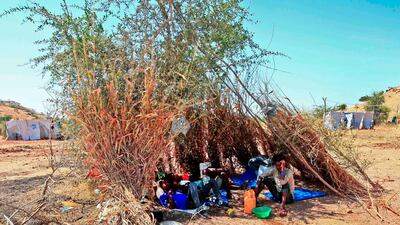
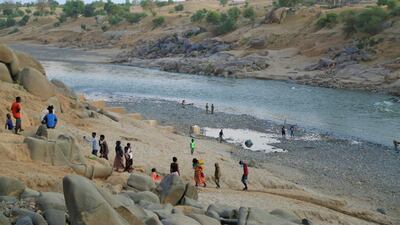
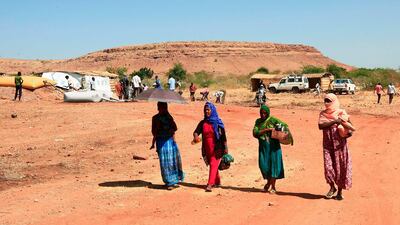
A statement from Mr Abiy’s task force for the Tigray conflict added that the government plans to bring back refugees who have fled to Sudan and was sending missions to the northern region to assess humanitarian needs.
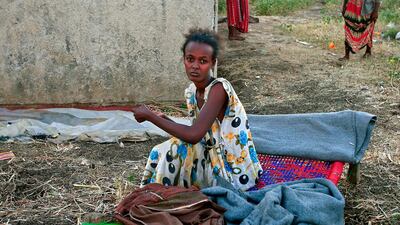
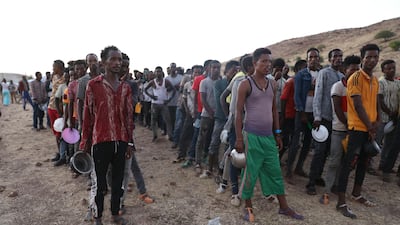
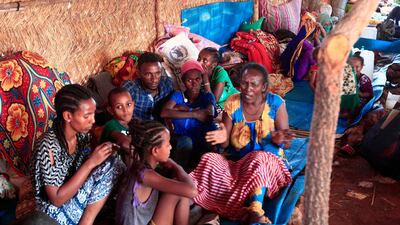
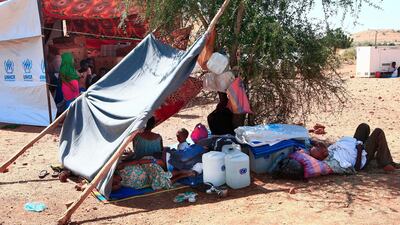
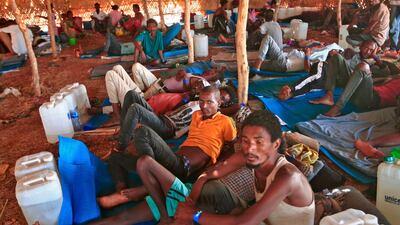
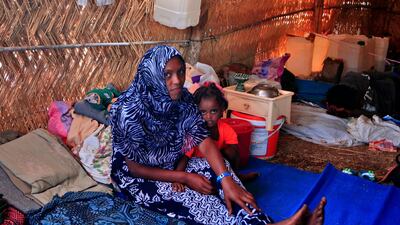
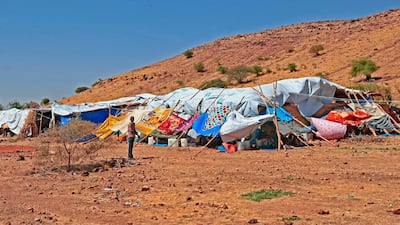
The two-week conflict has killed hundreds, sent 30,000 refugees into Sudan and called into question whether Prime Minister Abiy Ahmed, Africa's youngest leader and last year's Nobel Peace Prize winner, can hold his fractured nation together before national elections next year.
Hundreds of foreign aid workers have left Tigray, warning of a spiralling crisis in an area where hundreds of thousands of people relied on food aid even before the fighting.
US President-elect Joe Biden's foreign policy aide on Thursday urged an end to the fighting.
"Deeply concerned about the humanitarian crisis in Ethiopia, reports of targeted ethnic violence, and the risk to regional peace and security," tweeted Antony Blinken, a veteran diplomat and longtime confidant of Mr Biden.
Ethiopia is a major US ally whose soldiers serve in peacekeeping missions in South Sudan and Somalia. Its military and intelligence services are among the most capable in Africa.
"The TPLF and Ethiopian authorities should take urgent steps to end the conflict, enable humanitarian access, and protect civilians," added Mr Blinken, who is expected to play a senior role in the incoming US administration.
The northern Tigray People's Liberation Front (TPLF) effectively ruled Ethiopia for decades as the strongest force in a multi-ethnic coalition, until Mr Abiy took power two years ago.
On the ground, the TPLF leader said his soldiers still held the important town of Axum, though they had lost Shire as federal troops aimed for the state capital Mekelle.
Assertions by all sides have been impossible to verify because internet and phone connections to Tigray have been suspended and the government has restricted access.

Ten tax points to be aware of in 2026
1. Domestic VAT refund amendments: request your refund within five years
If a business does not apply for the refund on time, they lose their credit.
2. E-invoicing in the UAE
Businesses should continue preparing for the implementation of e-invoicing in the UAE, with 2026 a preparation and transition period ahead of phased mandatory adoption.
3. More tax audits
Tax authorities are increasingly using data already available across multiple filings to identify audit risks.
4. More beneficial VAT and excise tax penalty regime
Tax disputes are expected to become more frequent and more structured, with clearer administrative objection and appeal processes. The UAE has adopted a new penalty regime for VAT and excise disputes, which now mirrors the penalty regime for corporate tax.
5. Greater emphasis on statutory audit
There is a greater need for the accuracy of financial statements. The International Financial Reporting Standards standards need to be strictly adhered to and, as a result, the quality of the audits will need to increase.
6. Further transfer pricing enforcement
Transfer pricing enforcement, which refers to the practice of establishing prices for internal transactions between related entities, is expected to broaden in scope. The UAE will shortly open the possibility to negotiate advance pricing agreements, or essentially rulings for transfer pricing purposes.
7. Limited time periods for audits
Recent amendments also introduce a default five-year limitation period for tax audits and assessments, subject to specific statutory exceptions. While the standard audit and assessment period is five years, this may be extended to up to 15 years in cases involving fraud or tax evasion.
8. Pillar 2 implementation
Many multinational groups will begin to feel the practical effect of the Domestic Minimum Top-Up Tax (DMTT), the UAE's implementation of the OECD’s global minimum tax under Pillar 2. While the rules apply for financial years starting on or after January 1, 2025, it is 2026 that marks the transition to an operational phase.
9. Reduced compliance obligations for imported goods and services
Businesses that apply the reverse-charge mechanism for VAT purposes in the UAE may benefit from reduced compliance obligations.
10. Substance and CbC reporting focus
Tax authorities are expected to continue strengthening the enforcement of economic substance and Country-by-Country (CbC) reporting frameworks. In the UAE, these regimes are increasingly being used as risk-assessment tools, providing tax authorities with a comprehensive view of multinational groups’ global footprints and enabling them to assess whether profits are aligned with real economic activity.
Contributed by Thomas Vanhee and Hend Rashwan, Aurifer
EPL's youngest
- Ethan Nwaneri (Arsenal)
15 years, 181 days old
- Max Dowman (Arsenal)
15 years, 235 days old
- Jeremy Monga (Leicester)
15 years, 271 days old
- Harvey Elliott (Fulham)
16 years, 30 days old
- Matthew Briggs (Fulham)
16 years, 68 days old
Prop idols
Girls full-contact rugby may be in its infancy in the Middle East, but there are already a number of role models for players to look up to.
Sophie Shams (Dubai Exiles mini, England sevens international)
An Emirati student who is blazing a trail in rugby. She first learnt the game at Dubai Exiles and captained her JESS Primary school team. After going to study geophysics at university in the UK, she scored a sensational try in a cup final at Twickenham. She has played for England sevens, and is now contracted to top Premiership club Saracens.
----
Seren Gough-Walters (Sharjah Wanderers mini, Wales rugby league international)
Few players anywhere will have taken a more circuitous route to playing rugby on Sky Sports. Gough-Walters was born in Al Wasl Hospital in Dubai, raised in Sharjah, did not take up rugby seriously till she was 15, has a master’s in global governance and ethics, and once worked as an immigration officer at the British Embassy in Abu Dhabi. In the summer of 2021 she played for Wales against England in rugby league, in a match that was broadcast live on TV.
----
Erin King (Dubai Hurricanes mini, Ireland sevens international)
Aged five, Australia-born King went to Dubai Hurricanes training at The Sevens with her brothers. She immediately struck up a deep affection for rugby. She returned to the city at the end of last year to play at the Dubai Rugby Sevens in the colours of Ireland in the Women’s World Series tournament on Pitch 1.
The alternatives
• Founded in 2014, Telr is a payment aggregator and gateway with an office in Silicon Oasis. It’s e-commerce entry plan costs Dh349 monthly (plus VAT). QR codes direct customers to an online payment page and merchants can generate payments through messaging apps.
• Business Bay’s Pallapay claims 40,000-plus active merchants who can invoice customers and receive payment by card. Fees range from 1.99 per cent plus Dh1 per transaction depending on payment method and location, such as online or via UAE mobile.
• Tap started in May 2013 in Kuwait, allowing Middle East businesses to bill, accept, receive and make payments online “easier, faster and smoother” via goSell and goCollect. It supports more than 10,000 merchants. Monthly fees range from US$65-100, plus card charges of 2.75-3.75 per cent and Dh1.2 per sale.
• 2checkout’s “all-in-one payment gateway and merchant account” accepts payments in 200-plus markets for 2.4-3.9 per cent, plus a Dh1.2-Dh1.8 currency conversion charge. The US provider processes online shop and mobile transactions and has 17,000-plus active digital commerce users.
• PayPal is probably the best-known online goods payment method - usually used for eBay purchases - but can be used to receive funds, providing everyone’s signed up. Costs from 2.9 per cent plus Dh1.2 per transaction.