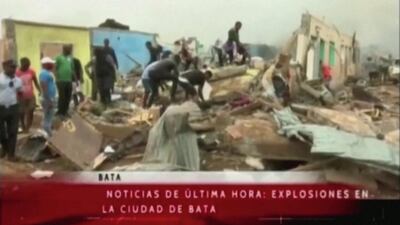
• People search through rubble following explosions at a military base, according to local media, in Bata, Equatorial Guinea. Reuters
    People search through rubble following explosions at a military base, according to local media, in Bata, Equatorial Guinea. Reuters
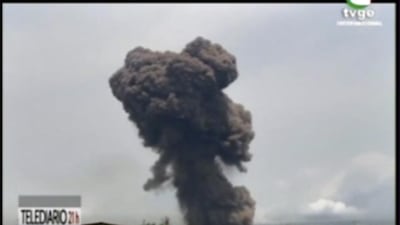
  • This TVGE made from video shows smoke rising over the blast site at a military barracks in Bata, Equatorial Guinea. AP Photo
    This TVGE made from video shows smoke rising over the blast site at a military barracks in Bata, Equatorial Guinea. AP Photo
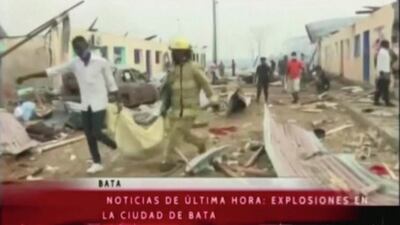
  • People carry a body in a sheet following explosions at a military base, according to local media, in Bata, Equatorial Guinea. Reuters
    People carry a body in a sheet following explosions at a military base, according to local media, in Bata, Equatorial Guinea. Reuters
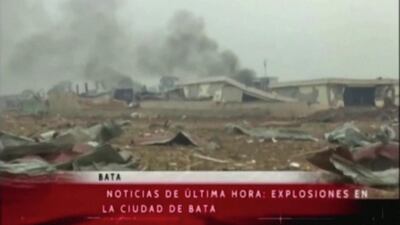
  • Smoke rises from destroyed structures following explosions at a military base, according to local media, in Bata, Equatorial Guinea. Reuters
    Smoke rises from destroyed structures following explosions at a military base, according to local media, in Bata, Equatorial Guinea. Reuters
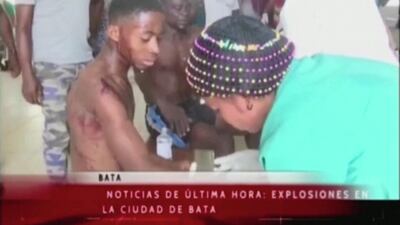
  • People receive aid at a hospital, following explosions at a military base, according to local media, in Bata, Equatorial Guinea. Reuters
    People receive aid at a hospital, following explosions at a military base, according to local media, in Bata, Equatorial Guinea. Reuters
  • An injured man lies on the floor of a hospital, following explosions at a military base, according to local media, in Bata, Equatorial Guinea. Reuters
    An injured man lies on the floor of a hospital, following explosions at a military base, according to local media, in Bata, Equatorial Guinea. Reuters

Equatorial Guinea explosions: before and after images reveal devastating impact of blasts


  • English
  • Arabic

New satellite images show the devastation caused by explosions at a military camp in Equatorial Guinea on Monday.

At least 20 people were killed and hundreds injured after four accidental explosions ripped through the Nkoa Ntoma camp in and obliterated neighbouring residential areas.

Footage broadcast by the TVGE channel showed buildings burnt and flattened in a wide radius around the camp in the economic capital Bata, with a thick plume of black smoke rising into the sky.

Children and adults were seen being pulled from the rubble. There were chaotic scenes at the hospital in Bata, with the wounded lying on the floor awaiting treatment.

The health ministry said on Twitter that many residents could still be buried under the wreckage.

President Teodoro Obiang Nguema said the accident had occurred after local farmers allowed a fire in the area to burn out of control, setting alight explosives that had been badly stored by soldiers at the military camp.

"The city of Bata has been the victim of an accident caused by the negligence of the unit in charge of storing explosives, dynamite and ammunition at the Nkoa Ntoma military camp," Mr Obiang Nguema said in a statement.

"These caught fire due to stubble-burning by farmers in their fields which ultimately made these depots explode in succession."

The defence ministry put the death toll at at least 20, with about 600 people injured.

It said the "high calibre" explosives set off by the fire caused "shockwaves" which razed many houses.

Mr Obiang Nguema issued a plea for international aid.

He said the disaster came at an already difficult time for Equatorial Guinea, "due to the economic crisis caused by falling petrol prices, and the Covid-19 pandemic".

  • People search through rubble following explosions at a military base, according to local media, in Bata, Equatorial Guinea. Reuters
    People search through rubble following explosions at a military base, according to local media, in Bata, Equatorial Guinea. Reuters
  • This TVGE made from video shows smoke rising over the blast site at a military barracks in Bata, Equatorial Guinea. AP Photo
    This TVGE made from video shows smoke rising over the blast site at a military barracks in Bata, Equatorial Guinea. AP Photo
  • People carry a body in a sheet following explosions at a military base, according to local media, in Bata, Equatorial Guinea. Reuters
    People carry a body in a sheet following explosions at a military base, according to local media, in Bata, Equatorial Guinea. Reuters
  • Smoke rises from destroyed structures following explosions at a military base, according to local media, in Bata, Equatorial Guinea. Reuters
    Smoke rises from destroyed structures following explosions at a military base, according to local media, in Bata, Equatorial Guinea. Reuters
  • People receive aid at a hospital, following explosions at a military base, according to local media, in Bata, Equatorial Guinea. Reuters
    People receive aid at a hospital, following explosions at a military base, according to local media, in Bata, Equatorial Guinea. Reuters
  • An injured man lies on the floor of a hospital, following explosions at a military base, according to local media, in Bata, Equatorial Guinea. Reuters
    An injured man lies on the floor of a hospital, following explosions at a military base, according to local media, in Bata, Equatorial Guinea. Reuters

Bata is the largest city in the oil and gas-rich central African nation, with about 800,000 of the nation's 1.4 million population living there, most of them in poverty.

While Bata sits on the mainland, the capital Malabo is on Bioko, one of the country's islands off the west African coast. Telephone communication between the two cities was virtually cut off for several hours after the explosions.

Spain, the former colonial power, urged its citizens via its Malabo embassy to stay at home after the blasts.

The Nkoa Ntoma camp, where the explosions struck in the early afternoon, houses among others elements of the army's special forces and the paramilitary gendarmerie.

The president's jet-setting son Teodoro Nguema Obiang Mangue, vice president with responsibility for defence and security, appeared in television footage at the scene inspecting the damage, accompanied by his Israeli bodyguards.

Teodorin, as he is known, is increasingly seen as the president's designated successor.

Equatorial Guinea has been ruled by 78-year-old Mr Obiang Nguema for 42 years. The authoritarian leader has seen off at least half a dozen assassination or coup attempts to become Africa's longest-serving president.

Opposition figures and international organisations have accused him of human-rights abuses.

The%C2%A0specs%20
%3Cp%3E%0D%3Cstrong%3EEngine%3A%20%3C%2Fstrong%3E6-cylinder%2C%204.8-litre%20%0D%3Cbr%3E%3Cstrong%3ETransmission%3A%20%3C%2Fstrong%3E5-speed%20automatic%20and%20manual%0D%3Cbr%3E%3Cstrong%3EPower%3A%20%3C%2Fstrong%3E280%20brake%20horsepower%20%0D%3Cbr%3E%3Cstrong%3ETorque%3A%20%3C%2Fstrong%3E451Nm%20%0D%3Cbr%3E%3Cstrong%3EPrice%3A%20%3C%2Fstrong%3Efrom%20Dh153%2C00%0D%3Cbr%3E%3Cstrong%3EOn%20sale%3A%20%3C%2Fstrong%3Enow%3C%2Fp%3E%0A
How to apply for a drone permit
  • Individuals must register on UAE Drone app or website using their UAE Pass
  • Add all their personal details, including name, nationality, passport number, Emiratis ID, email and phone number
  • Upload the training certificate from a centre accredited by the GCAA
  • Submit their request
What are the regulations?
  • Fly it within visual line of sight
  • Never over populated areas
  • Ensure maximum flying height of 400 feet (122 metres) above ground level is not crossed
  • Users must avoid flying over restricted areas listed on the UAE Drone app
  • Only fly the drone during the day, and never at night
  • Should have a live feed of the drone flight
  • Drones must weigh 5 kg or less

White hydrogen: Naturally occurring hydrogenChromite: Hard, metallic mineral containing iron oxide and chromium oxideUltramafic rocks: Dark-coloured rocks rich in magnesium or iron with very low silica contentOphiolite: A section of the earth’s crust, which is oceanic in nature that has since been uplifted and exposed on landOlivine: A commonly occurring magnesium iron silicate mineral that derives its name for its olive-green yellow-green colour