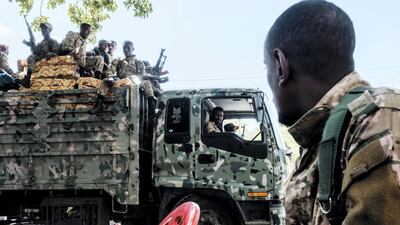
Members of the Amhara Special Forces sit on the top of a truck while another member looks on in the city of Alamata, Ethiopia. AFP

Domestic pressures in Sudan and Ethiopia whet appetite for war


Hamza Hendawi
  • English
  • Arabic

Sudan and Ethiopia may be inching towards an all-out conflict sparked by their border dispute. If that happens, that war will have just as much to do with domestic politics as their territorial tussle.

In recent weeks, deadly clashes, a war of words and the amassing of troops near the border fuelled tension between the two African neighbours, whose relations have over the years been defined by a mix of close social and economic ties as well as lengthy bouts of enmity.

Gen Abdel Fattah Al Burhan, Sudan’s de facto head of state, has taken the lead in escalating tension on the border, employing fiery, anti-Ethiopian rhetoric laced with patriotism as he repeatedly spoke about the need to liberate every inch of Sudanese territory.

He further stoked tensions with a widely-publicised visit last week to the border region following a cross-border raid blamed on an Ethiopian government-backed militia that killed at least five women and a child.

At the root of the border crisis are pockets of fertile farmland just inside the Sudanese border which have long been settled by members of Ethiopia’s ethnic Amhara group.

Sudanese troops in late December wrested back control of several of these areas, a move that Addis Ababa labelled as unwarranted aggression.

“Sudan does not want to go to war with Ethiopia or any other neighbouring country, but will not surrender a single inch of its territory,” Gen Al Burhan, addressing senior army officers, was quoted as saying by state media on Wednesday.

Analysts described the latest verbal escalation by Sudan’s leader as part of a drive to boost the military’s image as the sole protector of the nation and its people.

“It is very clear that the military is more enthusiastic about a confrontation with Ethiopia than anyone else in Sudan,” said Rasha Awad, a Sudanese political analyst.

“The military is milking the public’s sympathy as the defender of Sudan’s territory,” she added.

Gen Al Burhan heads the 11-member Sovereignty Council that has acted as the country’s collective presidency under a power-sharing agreement between the generals who removed dictator Omar Al Bashir in April 2019 and the pro-democracy movement that orchestrated months of street protests against the former president’s rule.

But the civilian government, led by career UN economist Abdallah Hamdok, appears to be not in favour of a conflict with any of Sudan’s neighbours at a time when the country’s transition to democratic rule is fraught with uncertainty. The government’s popularity also is believed to be eroding by persisting poor economic conditions.

“The government is facing an impasse as it cannot order a halt to military operations when a foreign country is occupying Sudanese land. This decision is tantamount to political suicide,” said Mrs Awad.

'Sudan does not want to go to war with Ethiopia or any other neighbouring country, but will not surrender a single inch of its territory,"

In Ethiopia, Prime Minister Abiy Ahmed is facing pressure from the Amhara to confront Sudan’s efforts to wrest back control of border areas lying within the Sudanese border and settled for decades by farmers from the powerful ethnic group.

The Amhara also have historical claims on Sudan’s eastern breadbasket region, which will make any concessions by the prime minister to avoid war politically costly.

This comes as Mr Ahmad is in the middle of a major military campaign to crush a separatist rebellion in the northern Tigray region.

“He is heavily relying on militias from Amhara in the fighting to remove Tigray’s rebel government,” explained William Davison, the International Crisis Group’s Ethiopia expert. “Success there is key to his political survival.”

But fighting two simultaneous wars will not be a wise decision to take by the Ethiopian leader, he said.

“Mr Abiy is not in a good position to open another front with Sudan that in turn will have a bearing on the Tigray conflict,” Mr Davison said.

Ethiopia's PM Abiy Ahmed is facing pressure from Amhara Ethnic group to confront Sudan's efforts to wrest back control of border areas

The Amhara’s political elite were already in an “assertive” mood, he added, seeking redress for what they see as years of discrimination against them under Ethiopia’s ethnic federal system that Tigray’s ruling party was instrumental in designing.

In November, for example, factions from the powerful Amhara ethnic group took advantage of the fighting in Tigray to pour into western areas on the Sudanese border that they have long claimed, creating a de facto situation on the ground there.

“The Amhara elite and nationalists are at the ascendancy, claiming lands in both Tigray and Benishangul-Gumuz regions,” said the ICG’s expert reached in Nairobi, Kenya. “That would make it politically tricky for Abiy’s government to prioritise accommodation with Sudan on this issue, even if it was minded to.”

The Ethiopian leader is also under further pressure at home not to offer concessions in negotiations with Egypt and Sudan on the running of a massive Nile dam Addis Ababa is building.

The Grand Ethiopian Renaissance Dam, or GERD, is fuelling tension with the two downstream nations and is undermining stability in the entire region.

Last year, Sudan abandoned its perceived pro-Ethiopian stand in the negotiations over the GERD and has in recent weeks repeatedly expressed its anger over its neighbour’s reluctance to enter a legally-binding deal on the operation of the hydroelectric dam.


Tamkeen's offering
  • Option 1: 70% in year 1, 50% in year 2, 30% in year 3
  • Option 2: 50% across three years
  • Option 3: 30% across five years 
Ruwais timeline

1971 Abu Dhabi National Oil Company established

1980 Ruwais Housing Complex built, located 10 kilometres away from industrial plants

1982 120,000 bpd capacity Ruwais refinery complex officially inaugurated by the founder of the UAE Sheikh Zayed

1984 Second phase of Ruwais Housing Complex built. Today the 7,000-unit complex houses some 24,000 people.  

1985 The refinery is expanded with the commissioning of a 27,000 b/d hydro cracker complex

2009 Plans announced to build $1.2 billion fertilizer plant in Ruwais, producing urea

2010 Adnoc awards $10bn contracts for expansion of Ruwais refinery, to double capacity from 415,000 bpd

2014 Ruwais 261-outlet shopping mall opens

2014 Production starts at newly expanded Ruwais refinery, providing jet fuel and diesel and allowing the UAE to be self-sufficient for petrol supplies

2014 Etihad Rail begins transportation of sulphur from Shah and Habshan to Ruwais for export

2017 Aldar Academies to operate Adnoc’s schools including in Ruwais from September. Eight schools operate in total within the housing complex.

2018 Adnoc announces plans to invest $3.1 billion on upgrading its Ruwais refinery 

2018 NMC Healthcare selected to manage operations of Ruwais Hospital

2018 Adnoc announces new downstream strategy at event in Abu Dhabi on May 13

Source: The National

At Eternity’s Gate

Director: Julian Schnabel

Starring: Willem Dafoe, Oscar Isaacs, Mads Mikkelsen

Three stars

Stuck in a job without a pay rise? Here's what to do

Chris Greaves, the managing director of Hays Gulf Region, says those without a pay rise for an extended period must start asking questions – both of themselves and their employer.

“First, are they happy with that or do they want more?” he says. “Job-seeking is a time-consuming, frustrating and long-winded affair so are they prepared to put themselves through that rigmarole? Before they consider that, they must ask their employer what is happening.”

Most employees bring up pay rise queries at their annual performance appraisal and find out what the company has in store for them from a career perspective.

Those with no formal appraisal system, Mr Greaves says, should ask HR or their line manager for an assessment.

“You want to find out how they value your contribution and where your job could go,” he says. “You’ve got to be brave enough to ask some questions and if you don’t like the answers then you have to develop a strategy or change jobs if you are prepared to go through the job-seeking process.”

For those that do reach the salary negotiation with their current employer, Mr Greaves says there is no point in asking for less than 5 per cent.

“However, this can only really have any chance of success if you can identify where you add value to the business (preferably you can put a monetary value on it), or you can point to a sustained contribution above the call of duty or to other achievements you think your employer will value.”


MATCH INFO

Uefa Champions League semi-finals, second leg:

Liverpool (0) v Barcelona (3), Tuesday, 11pm UAE

Game is on BeIN Sports

Top financial tips for graduates

Araminta Robertson, of the Financially Mint blog, shares her financial advice for university leavers:

1. Build digital or technical skills: After graduation, people can find it extremely hard to find jobs. From programming to digital marketing, your early twenties are for building skills. Future employers will want people with tech skills.

2. Side hustle: At 16, I lived in a village and started teaching online, as well as doing work as a virtual assistant and marketer. There are six skills you can use online: translation; teaching; programming; digital marketing; design and writing. If you master two, you’ll always be able to make money.

3. Networking: Knowing how to make connections is extremely useful. Use LinkedIn to find people who have the job you want, connect and ask to meet for coffee. Ask how they did it and if they know anyone who can help you. I secured quite a few clients this way.

4. Pay yourself first: The minute you receive any income, put about 15 per cent aside into a savings account you won’t touch, to go towards your emergency fund or to start investing. I do 20 per cent. It helped me start saving immediately.

The President's Cake

Director: Hasan Hadi

Starring: Baneen Ahmad Nayyef, Waheed Thabet Khreibat, Sajad Mohamad Qasem 

Rating: 4/5

I Care A Lot

Directed by: J Blakeson

Starring: Rosamund Pike, Peter Dinklage

3/5 stars

MATCH INFO

Manchester City 6 Huddersfield Town 1
Man City: Agüero (25', 35', 75'), Jesus (31'), Silva (48'), Kongolo (84' og)
Huddersfield: Stankovic (43')