A crocodile such as this one at Dubai Crocodile Park was stolen from a farm in South Africa. AFP

Large crocodile worth $1,300 stolen from farm in South Africa


  • English
  • Arabic

Three men have been arrested in South Africa after a large Nile crocodile worth hundreds of dollars was stolen.

Police said the 2.5-metre reptile — estimated to be worth $1,300 — was taken from a crocodile farm in the Hartbeesfontein area in the country's North West province.

Those arrested were aged 20 to 35.

They are believed to have used a pickup truck to take the crocodile from a farm about 200km west of Johannesburg, AP reported.

The animal was found tied up with rope and wire and covered with tree branches in an abandoned farmhouse.

The men, who were arrested last week, were due to appear in court on Monday.

Police spokeswoman Adele Myburgh said officers were investigating how the heavy crocodile had been removed from the farm.

“How did they slip this animal out?" she said. “It's not a baby crocodile by any means.”

The crocodile back in the swimming pool at the farm it was stolen from. Photo: South African Police Service

Ms Myburgh said the crocodile was badly dehydrated when it was found by a team of police officers and animal conservation officials.

The crocodile has been “returned to its rightful owner”, police said. They released a photo of it swimming in its pool at the farm.

While South Africa has a problem with poaching, crocodiles are not usually targeted because of how dangerous they can be.

Mr Myburgh said the motive was still under investigation but crocodile body parts such as the skin, nails and teeth do have value and those responsible might have been planning to kill the animal to sell those parts.

Ten crocodile mummies discovered in Egypt — in pictures

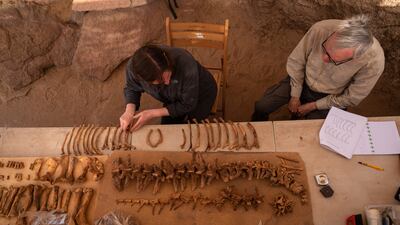
  • Researchers Bea De Cupere and Wim Van Neer of the Royal Belgian Institute of Natural Sciences measuring and studying the specimens on site. Photo: Patricia Mora Riudavets
    Researchers Bea De Cupere and Wim Van Neer of the Royal Belgian Institute of Natural Sciences measuring and studying the specimens on site. Photo: Patricia Mora Riudavets
  • The specimens were found at the foot of an ancient rock tomb. Photo: Patricia Mora Riudavets
    The specimens were found at the foot of an ancient rock tomb. Photo: Patricia Mora Riudavets
  • Researchers believe the crocodiles had been laid in sand, which allowed the bodies to dry out naturally. Photo: Patricia Mora Riudavets
    Researchers believe the crocodiles had been laid in sand, which allowed the bodies to dry out naturally. Photo: Patricia Mora Riudavets
  • The skull of one of the largest crocodiles found at Qubbat al-Hawa. Photo: Bea De Cupere, RBINS
    The skull of one of the largest crocodiles found at Qubbat al-Hawa. Photo: Bea De Cupere, RBINS
  • The crocodiles did not display any sign of physical injury, leading researchers to speculate they had been killed by drowning, suffocation or overheating in the hot Egyptian sun. Photo: Patricia Mora Riudavets
    The crocodiles did not display any sign of physical injury, leading researchers to speculate they had been killed by drowning, suffocation or overheating in the hot Egyptian sun. Photo: Patricia Mora Riudavets
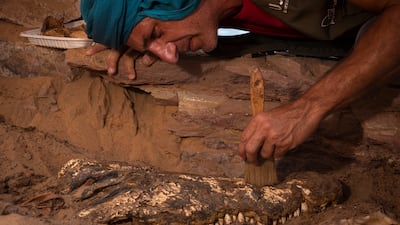
  • Archaeologist Vicente Barba Colmenero excavating a crocodile skull from the tomb. Photo: Patricia Mora Riudavets
    Archaeologist Vicente Barba Colmenero excavating a crocodile skull from the tomb. Photo: Patricia Mora Riudavets
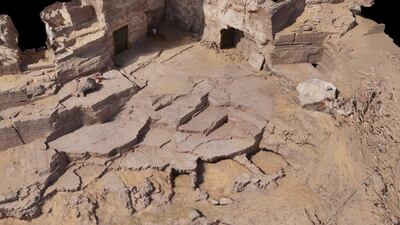
  • An overview of some of the Qubbat al-Hawa tombs, including the crocodile crypt on the right. Photo: Jose Luis Perez Garcia
    An overview of some of the Qubbat al-Hawa tombs, including the crocodile crypt on the right. Photo: Jose Luis Perez Garcia
  • It is thought the ancient Egyptians used the bodies as gifts to the crocodile Gods, such as the reptile-headed Sobek. Photo: Patricia Mora Riudavets
    It is thought the ancient Egyptians used the bodies as gifts to the crocodile Gods, such as the reptile-headed Sobek. Photo: Patricia Mora Riudavets
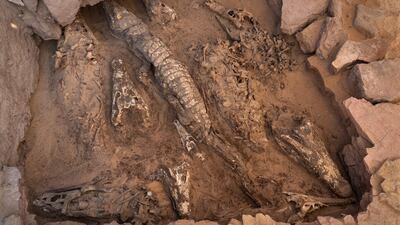
  • The amazing find in the undisturbed tomb. Photo: Patricia Mora Riudavets
    The amazing find in the undisturbed tomb. Photo: Patricia Mora Riudavets
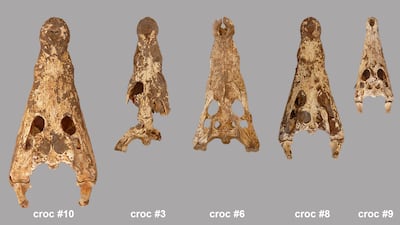
  • Five isolated skulls. From these it was calculated that the crocodiles were between 1.85m and 3.33m long. Photo: Bea De Cupere, RBINS
    Five isolated skulls. From these it was calculated that the crocodiles were between 1.85m and 3.33m long. Photo: Bea De Cupere, RBINS

Mercer, the investment consulting arm of US services company Marsh & McLennan, expects its wealth division to at least double its assets under management (AUM) in the Middle East as wealth in the region continues to grow despite economic headwinds, a company official said.

Mercer Wealth, which globally has $160 billion in AUM, plans to boost its AUM in the region to $2-$3bn in the next 2-3 years from the present $1bn, said Yasir AbuShaban, a Dubai-based principal with Mercer Wealth.

Within the next two to three years, we are looking at reaching $2 to $3 billion as a conservative estimate and we do see an opportunity to do so,” said Mr AbuShaban.

Mercer does not directly make investments, but allocates clients’ money they have discretion to, to professional asset managers. They also provide advice to clients.

“We have buying power. We can negotiate on their (client’s) behalf with asset managers to provide them lower fees than they otherwise would have to get on their own,” he added.

Mercer Wealth’s clients include sovereign wealth funds, family offices, and insurance companies among others.

From its office in Dubai, Mercer also looks after Africa, India and Turkey, where they also see opportunity for growth.

Wealth creation in Middle East and Africa (MEA) grew 8.5 per cent to $8.1 trillion last year from $7.5tn in 2015, higher than last year’s global average of 6 per cent and the second-highest growth in a region after Asia-Pacific which grew 9.9 per cent, according to consultancy Boston Consulting Group (BCG). In the region, where wealth grew just 1.9 per cent in 2015 compared with 2014, a pickup in oil prices has helped in wealth generation.

BCG is forecasting MEA wealth will rise to $12tn by 2021, growing at an annual average of 8 per cent.

Drivers of wealth generation in the region will be split evenly between new wealth creation and growth of performance of existing assets, according to BCG.

Another general trend in the region is clients’ looking for a comprehensive approach to investing, according to Mr AbuShaban.

“Institutional investors or some of the families are seeing a slowdown in the available capital they have to invest and in that sense they are looking at optimizing the way they manage their portfolios and making sure they are not investing haphazardly and different parts of their investment are working together,” said Mr AbuShaban.

Some clients also have a higher appetite for risk, given the low interest-rate environment that does not provide enough yield for some institutional investors. These clients are keen to invest in illiquid assets, such as private equity and infrastructure.

“What we have seen is a desire for higher returns in what has been a low-return environment specifically in various fixed income or bonds,” he said.

“In this environment, we have seen a de facto increase in the risk that clients are taking in things like illiquid investments, private equity investments, infrastructure and private debt, those kind of investments were higher illiquidity results in incrementally higher returns.”

The Abu Dhabi Investment Authority, one of the largest sovereign wealth funds, said in its 2016 report that has gradually increased its exposure in direct private equity and private credit transactions, mainly in Asian markets and especially in China and India. The authority’s private equity department focused on structured equities owing to “their defensive characteristics.”

Tips%20for%20holiday%20homeowners
%3Cp%3EThere%20are%20several%20factors%20for%20landlords%20to%20consider%20when%20preparing%20to%20establish%20a%20holiday%20home%3A%3C%2Fp%3E%0A%3Cul%3E%0A%3Cli%3E%3Cstrong%3ERevenue%20potential%20of%20the%20unit%3A%3C%2Fstrong%3E%20location%2C%20view%20and%20size%3C%2Fli%3E%0A%3Cli%3E%3Cstrong%3EDesign%3A%20furnished%20or%20unfurnished.%3C%2Fstrong%3E%20Is%20the%20design%20up%20to%20standard%2C%20while%20being%20catchy%20at%20the%20same%20time%3F%3C%2Fli%3E%0A%3Cli%3E%3Cstrong%3EBusiness%20model%3A%3C%2Fstrong%3E%20will%20it%20be%20managed%20by%20a%20professional%20operator%20or%20directly%20by%20the%20owner%2C%20how%20often%20does%20the%20owner%20wants%20to%20use%20it%20for%20personal%20reasons%3F%3C%2Fli%3E%0A%3Cli%3E%3Cstrong%3EQuality%20of%20the%20operator%3A%3C%2Fstrong%3E%20guest%20reviews%2C%20customer%20experience%20management%2C%20application%20of%20technology%2C%20average%20utilisation%2C%20scope%20of%20services%20rendered%3C%2Fli%3E%0A%3C%2Ful%3E%0A%3Cp%3E%3Cem%3ESource%3A%20Adam%20Nowak%2C%20managing%20director%20of%20Ultimate%20Stay%20Vacation%20Homes%20Rental%3C%2Fem%3E%3C%2Fp%3E%0A
RESULT

Shabab Al Ahli Dubai 0 Al Ain 6
Al Ain: Caio (5', 73'), El Shahat (10'), Berg (65'), Khalil (83'), Al Ahbabi (90' 2)

HEADLINE HERE
  • I would recommend writing out the text in the body 
  • And then copy into this box
  • It can be as long as you link
  • But I recommend you use the bullet point function (see red square)
  • Or try to keep the word count down
  • Be wary of other embeds lengthy fact boxes could crash into 
  • That's about it
The National Archives, Abu Dhabi

Founded over 50 years ago, the National Archives collects valuable historical material relating to the UAE, and is the oldest and richest archive relating to the Arabian Gulf.

Much of the material can be viewed on line at the Arabian Gulf Digital Archive - https://www.agda.ae/en

Sole survivors
  • Cecelia Crocker was on board Northwest Airlines Flight 255 in 1987 when it crashed in Detroit, killing 154 people, including her parents and brother. The plane had hit a light pole on take off
  • George Lamson Jr, from Minnesota, was on a Galaxy Airlines flight that crashed in Reno in 1985, killing 68 people. His entire seat was launched out of the plane
  • Bahia Bakari, then 12, survived when a Yemenia Airways flight crashed near the Comoros in 2009, killing 152. She was found clinging to wreckage after floating in the ocean for 13 hours.
  • Jim Polehinke was the co-pilot and sole survivor of a 2006 Comair flight that crashed in Lexington, Kentucky, killing 49.
Updated: April 26, 2023, 10:09 AM