

Heavy fighting broke out in Ethiopia's northern Tigray region on Wednesday, disrupting a five-month ceasefire.
Both sides blamed the other for the escalation after negotiations to end the conflict, which has raged for almost two years, made little progress.
The Tigray People's Liberation Front (TPLF) said government forces and their allies had launched a “large-scale” offensive against the southern part of the territory early on Wednesday.
Getachew Reda, representative for the TPLF, said on Twitter that the government offensive has shown its campaign for peace before the international community “has now been revealed for the drama that it has always been”.
“Our forces are heroically defending our positions,” he said.
But the Government Communication Service accused the TPLF of striking first, saying it had “destroyed the truce”.
“Disregarding the numerous peace options presented by the Ethiopian government, the armed wing of the terror group TPLF, pushing with its recent provocations starting [at] 5am today, committed an attack” around southern Tigray, it said in a statement.
Ethiopia's air force said on Wednesday it had shot down a plane carrying weapons for the TPLF that had encroached into government airspace via Sudan, state media reported.
“The plane which violated our airspace from Sudan … and aimed to supply weapons to the terror group was shot down by our heroic air force,” the Ethiopian News Agency quoted armed forces Maj Gen Tesfaye Ayalew as saying.
The date of the incident, the type of aircraft and how it was taken down were not detailed.
Negotiations between the two sides have been stalled for some time, with the latest disagreement being over who should mediate the talks. The government wants the African Union's envoy Olusegun Obasanjo while the TPLF would prefer Kenya.
-
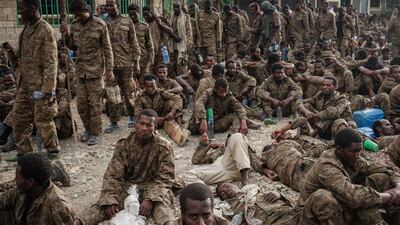
Captive Ethiopian soldiers arrive at the Mekele Rehabilitation Centre in Tigray, Ethiopia, after a four-day journey from Abdi Eshir. All photos: AFP -
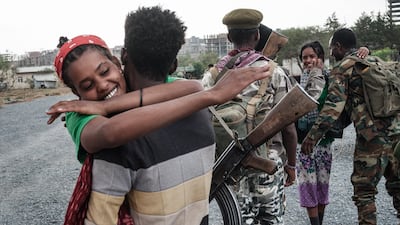
Women welcome Tigray People's Liberation Front fighters as they return to Mekele after seizing control of the city in June 2021. -
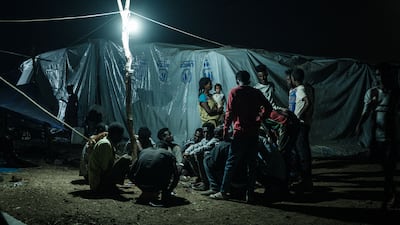
Ethiopians who fled the Tigray conflict wait to charge their phones at Um Raquba refugee camp in Gedaref, Sudan. -
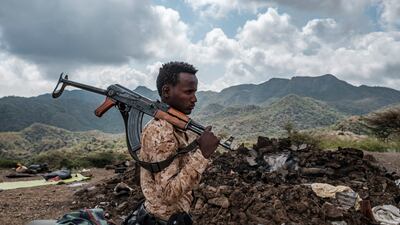
A member of the Afar Special Forces stands in front of the debris of a house on the outskirts of the village of Bisober in Tigray. -
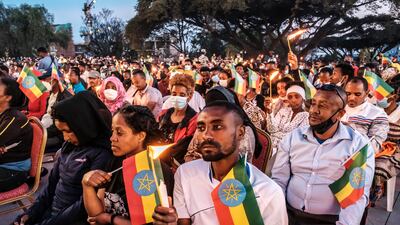
People hold candles and Ethiopian flags at a memorial service for the victims of the Tigray conflict in Addis Ababa. -

An Ethiopian refugee who fled fighting in Tigray waits behind a fence in a camp in Sudan. -
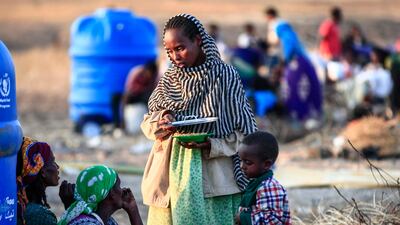
Refugees living in a camp in Sudan after fleeing violence in Tigray. -
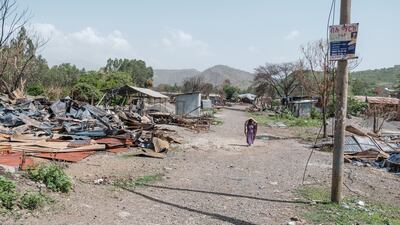
A woman walks among the remains of a destroyed factory in Ataye, Ethiopia, where more than 100 civilians died in a recent flare-up of violence. -
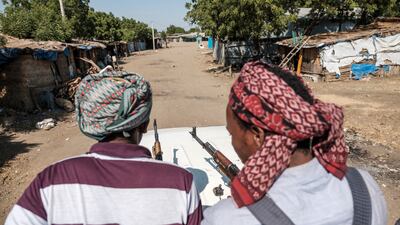
Two members of the Amhara militia ride in the back of a pick-up truck. Amharas and Tigrayans were uneasy neighbours before the current fighting, with tension over land sparking violent clashes. -

Militias from the Amhara region have been involved in the fighting in Tigray. -
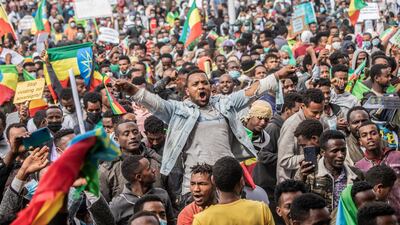
Tens of thousands of Ethiopians gather at a rally organised by the mayor of Addis Ababa to show support for the military's efforts in Tigray. -
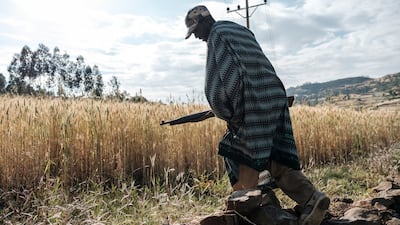
Zeleke Alabachew, farmer and militia fighter, tends to his land near the village of Tekeldengy, Ethiopia, Africa's second most populous nation. -
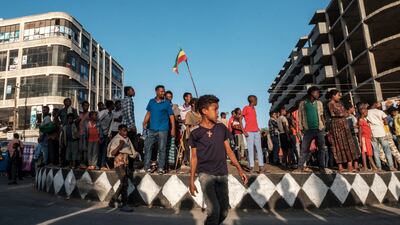
People celebrate the liberation of opposition leaders in the city of Alamata, Ethiopia. -
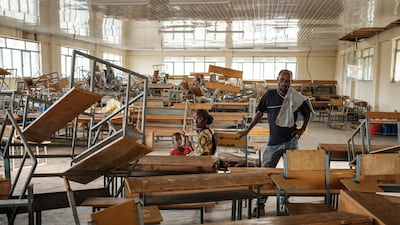
A family fleeing violence sit in a former classroom at May Weyni secondary school, now hosting 10,500 displaced people, in Mekele, capital of Tigray. -
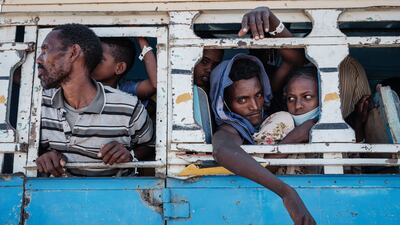
Ethiopian refugees travel to Sudan to escape violence in Tigray. -

Ethiopian refugees gather to celebrate the 46th anniversary of the Tigray People's Liberation Front at Um Raquba refugee camp in Gedaref, Sudan. The TPLF dominated Ethiopian politics before being ousted from their regional stronghold last year. -
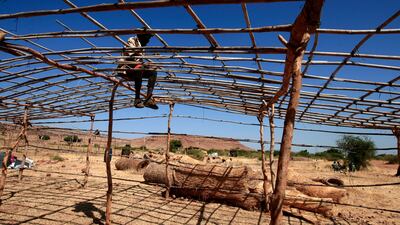
An Ethiopian refugee sets up a tent in a camp in the town of Gedaref, Sudan, after being transported from the border reception centre. -
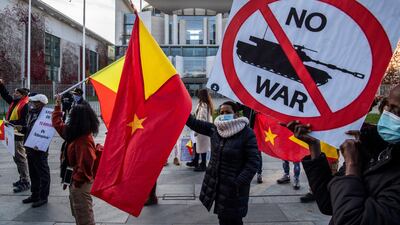
Pro-Tigrayan demonstrators display placards during a protest in front of the chancellery in Berlin. -
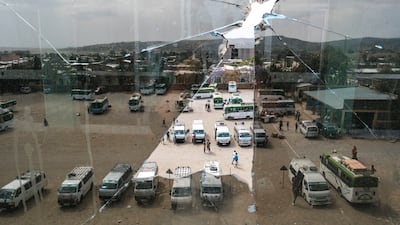
The aftermath of heavy shelling in Wukro, a city north of Mekele, in Ethiopia.


William Davison, senior Ethiopia analyst for the International Crisis Group, said the serious clashes and the claim about the downed plane could well mean this outbreak of fighting will continue.
"There's a chance that escalation is prevented and there's a renewed effort to bring the parties together for peace talks. But the reality right now is that the fighting is quite likely to escalate and we've moved further away from formal peace talks actually taking place," he told The National.
He said the lack of information about what is taking place on the ground, both within a humanitarian context and fighting, hinders the ability of international actors to assist the peace process.
"But we should also recognise that since the start of the war international powers, such as the US and EU, have been consistent with certain demands, such as for unhindered humanitarian access, a ceasefire, and negotiations, but they’ve been unable to influence the Ethiopian parties.”
Tigrayan and government troops have been accused of atrocities throughout the conflict.
The conflict and climate change-induced drought have left half of Tigray's 5.5 million people in “severe” need of food, the World Food Programme said last week.
“Hunger has deepened, rates of malnutrition have skyrocketed and the situation is set to worsen as people enter peak hunger season until this year’s harvest in October,” the report said.
This issue has worsened despite the ceasefire allowing aid to enter the region. The federal government previously said it would restore basic services such as electricity, communications and banking as a precursor to talks, but its position looks to have changed.
Ethiopia's President Abiy Ahmed deployed troops to Tigray in November 2020 to unseat the TPLF after months of tension and a Tigrayan election not recognised by the federal government.
The 2019 Nobel Peace Prize winner said the decision to send troops was in response to rebel attacks on army camps.
The TPLF mounted a comeback, recapturing Tigray and expanding into Afar and Amhara before the war reached a stalemate.
AFP contributed to this report

