
A senior Saudi Arabian minister on Tuesday condemned remarks by Iran's foreign minister implying that Riyadh played a role in the assassination of leading nuclear scientist Mohsen Fakhrizadeh.
Fakhrizadeh was killed on Friday when his car and bodyguards were hit in a bomb and gun attack on a major road outside the capital Tehran, heightening tensions between Iran and its foes.
-
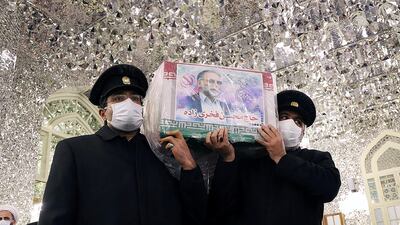
Servants of the holy shrine of Imam Reza carry the coffin of Iranian nuclear scientist Mohsen Fakhrizadeh in Mashhad, Iran. WANA via REUTERS -
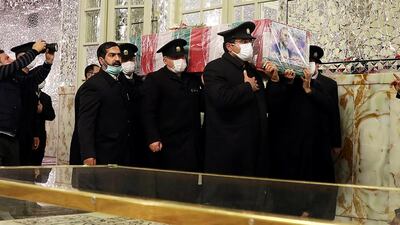
Servants of the holy shrine of Imam Reza carry the coffin of Iranian nuclear scientist Mohsen Fakhrizadeh in Mashhad, Iran. WANA via REUTERS -
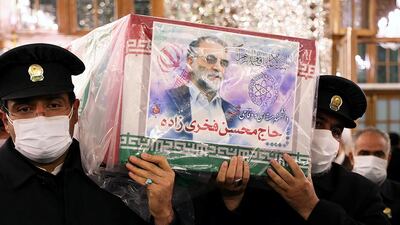
Servants of the holy shrine of Imam Reza carry the coffin of Iranian nuclear scientist Mohsen Fakhrizadeh in Mashhad, Iran. WANA via REUTERS -
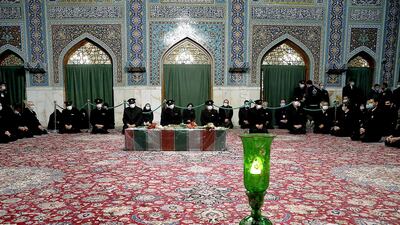
Servants of the holy shrine of Imam Reza sit near the coffin of Iranian nuclear scientist Mohsen Fakhrizadeh in Mashhad, Iran. WANA via REUTERS -
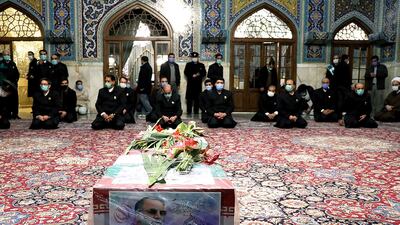
A coffin with an image of Iranian nuclear scientist Mohsen Fakhrizadeh, can be seen among the servants of the holy shrine of Imam Reza in Mashhad. WANA via REUTERS -

A coffin with an image of Iranian nuclear scientist Mohsen Fakhrizadeh, can be seen among the servants of the holy shrine of Imam Reza in Mashhad. WANA via REUTERS -
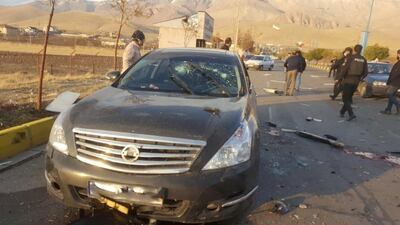
The scene of the attack that killed prominent Iranian scientist Mohsen Fakhrizadeh, outside Tehran. WANA via REUTERS -
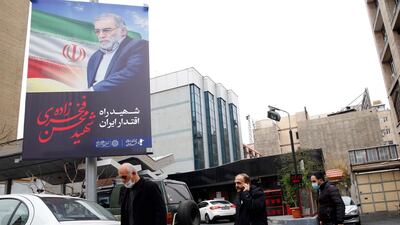
Iranians walk past next to a huge poster of Iranian nuclear scientist Mohsen Fakhrizadeh in a street in Tehran. EPA -
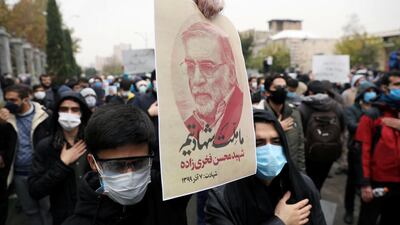
A protester holds a picture of Mohsen Fakhrizadeh, Iran's top nuclear scientist, during a demonstration against his killing in Tehran. WANA via REUTERS -

A protester holds a picture of Mohsen Fakhrizadeh, Iran's top nuclear scientist, during a demonstration against his killing in Tehran. WANA via REUTERS -
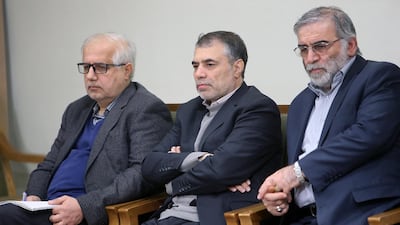
Iranian nuclear scientist Mohsen Fakhrizadeh (R) during a meeting with Iranian supreme leader (unseen) in Tehran on January 23, 2019. EPA/IRANIAN SUPREME LEADER'S OFFICE HO -

Israeli Prime Minister Benjamin Netanyahu points at a screen with an image of Iranian nuclear scientist Mohsen Fakhrizadeh during a news conference at the Defence Ministry of in Tel Aviv on April 30, 2018. Reuters -
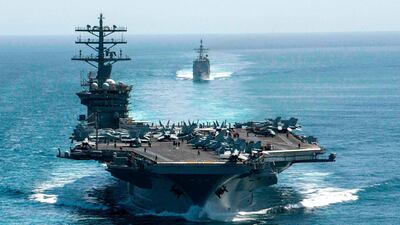
The US Navy’s USS Nimitz aircraft carrier was ordered back to the Arabian Gulf to show capability as it withdraws troops from Afghanistan and Iraq and to deter adversaries moving against the US, US Fifth Fleet said. AFP PHOTO / US NAVY


Iran's Foreign Minister Mohammad Zarif on Monday claimed on Instagram that Crown Prince Mohammed bin Salman and Israeli Prime Minister Benjamin Netanyahu had conspired to plot the assassination. Mr Zarif said that a conspiracy had occurred.
"Iranian Foreign Minister Zarif is desperate to blame the kingdom for anything negative that happens in Iran," Adel Al Jubeir, the Saudi minister of state for foreign affairs, tweeted. "Will he blame us for the next earthquake or flood?"
"It is not the policy of Saudi Arabia to engage in assassinations," he said.
Saudi Arabia has no official diplomatic ties with Israel but Israeli media claimed a meeting had taken place in Saudi Arabia between the crown prince and the Israeli prime minister, with US Secretary of State Mike Pompeo in late November. The kingdom denied that any such meeting had taken place.
The New York Times reported this week that an American official and two other intelligence officials said Israel was behind the attack on Fakhrizadeh.
Iran's President Hassan Rouhani accused Israel of trying to create chaos by assassinating the scientist but said his country will not fall into a trap.
They also pointed the finger at a radical opposition group called the People's Mojahedin Organisation of Iran. Iran has arrested dozens in the wake of the killing as it tries to find accomplices in the plot.
While UN head Antonio Guterres condemned the extrajudicial killing, the UN Security Council has made no statement.
At a minimum, the 15-member body could discuss Friday's killing behind closed doors if a member requests such a meeting or it could agree on – by consensus – a statement on the issue.
But diplomats say the call by Iran for the council to make a comment is likely to go unheeded.
South Africa's UN ambassador, Jerry Matjila, council president for December, said on Tuesday that no member had so far requested to discuss the killing or Iran in general. Diplomats also said there had been no discussion of a statement.
The Security Council is responsible for maintaining international peace and security and has the ability to authorise military action and impose sanctions. But such measures require at least nine votes in favour and no vetoes by the US, France, Britain, Russia or China.
The UN investigator on extrajudicial executions, Agnes Callamard, said on Friday that many questions surrounded the killing of Fakhrizadeh, but noted the definition of an extraterritorial targeted killing outside an armed conflict.
Ms Callamard posted on Twitter that such a killing was "a violation of international human rights law prohibiting the arbitrary deprivation of life and a violation of the UN Charter prohibiting the use of force extraterritorially in times of peace".
Iran also addressed its letter on Friday to Mr Guterres. In response, he urged restraint and condemned "any assassination or extrajudicial killing", UN spokesman Stephane Dujarric said on Saturday.
The Security Council is due to meet on December 22 for its bi-annual meeting on compliance with a resolution that enshrines a 2015 nuclear accord between world powers and Iran, which US President Donald Trump's administration quit in 2018.
Any council member or Iran could choose to raise the killing of Fakhrizadeh during that meeting.

