

The JN.1 coronavirus strain has been spreading globally, with the World Health Organisation on Tuesday classifying it as a “variant of interest”.
It is more contagious than other variants currently circulating, with cases reported in India, China, the US and Singapore.
Here’s everything we know so far:
What is the JN.1 Covid variant?
The JN.1 variant is a descendant of the BA. 2.86 variant that carries more than 30 mutations in the spike protein.
“Covid is with us permanently and we have to be vigilant about new strains like JN.1, a sub-lineage of BA. 2.86 Omicron, that appears correlated with increase in hospitalisation for respiratory illness,” said Ramanan Laxminarayan, president of health research organisation One Health Trust.
“We don’t yet know if the JN.1 strain is behind these hospitalisations. But given that Covid vaccination in India is no longer a continuing effort and JN.1 is able to avoid immune response to be able to spread rapidly, there is a possibility that lack of population immunity puts us – especially the elderly population – at risk for illness and hospitalisation,’’ he told The National.
How was it detected?
The first case of JN.1 was recorded in the US in September.
What is the threat level?
JN.1 has not shown any signs of greater severity than other Covid strains.
While there might be more cases, JN.1 doesn't pose a greater risk, Andrew Pekosz, a virologist at the Johns Hopkins Bloomberg School of Public Health, told Reuters.
The World Health Organisation (WHO) said current vaccines will continue to protect against severe disease and death from JN.1 and other Covid variants.
What does variant of interest mean?
The WHO’s definition states that a variant of interest has “genetic changes that are predicted or known to affect virus characteristics such as transmissibility, virulence, antibody evasion, susceptibility to therapeutics and detectability”.
So JN.1 is more contagious than other Covid strains at this time.
It is also “identified to have a growth advantage over other circulating variants in more than one WHO region with increasing relative prevalence alongside increasing number of cases over time, or other apparent epidemiological impacts to suggest an emerging risk to global public health”.
What happens next?
The WHO will review JN.1 for the rate it spreads, how easy it is to treat and draw comparisons with other similar variants.
Co-ordinated laboratory investigations with member states will be carried out, if deemed necessary.
Nations with reported cases will also submit complete genome sequences and associated metadata to a publicly available database.
Alongside this, field investigations will be carried out to improve public understanding of the new strain.
Global fight against Covid-19 - in pictures
-
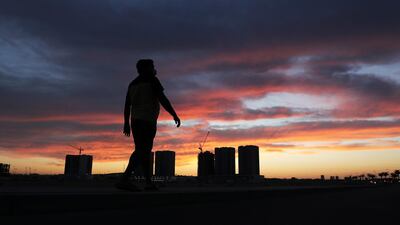
A man wearing a facemask in Dubai in April 2020, shortly after the first outbreak. Pawan Singh / The National -

Staff from the Wuhan Hygiene Emergency Response Team conduct searches on the closed Huanan Seafood Market in Wuhan, China, at the start of the outbreak on January 11, 2020. AFP -
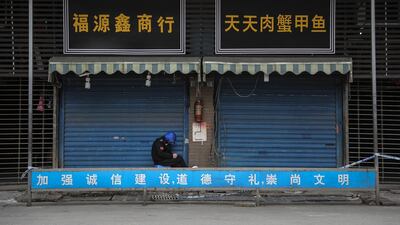
A security guard sits outside the closed Huanan market in Wuhan, Hubei province. Getty Images -
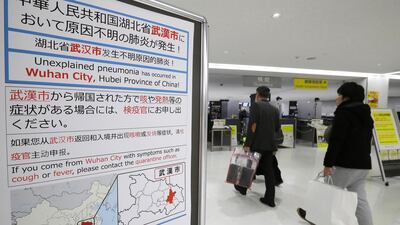
A notice displayed near a quarantine control station at Narita Airport, Japan, in January 2020. EPA -
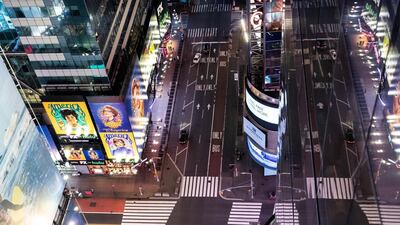
An empty Times Square after a coronavirus lockdown was ordered in New York City, March 18, 2020. Reuters -
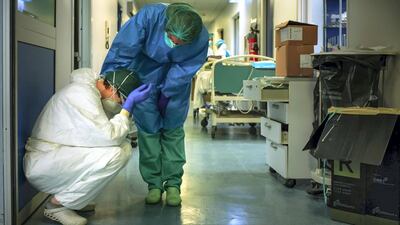
A nurse wearing PPE comforts another as they change shifts on March 13, 2020 at Cremona Hospital, north-eastern Italy. AFP -
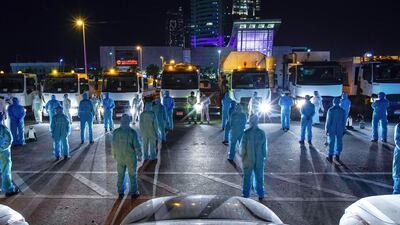
Sanitation workers from Tadweer on the first day of the UAE cleaning campaign in March 2020. Victor Besa / The National -
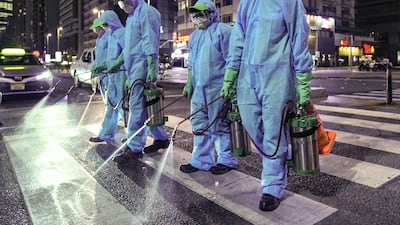
The pedestrian crossing on Hamdan and Fatima Bint Mubarak Street is sprayed on March 27, 2020. Victor Besa / The National -
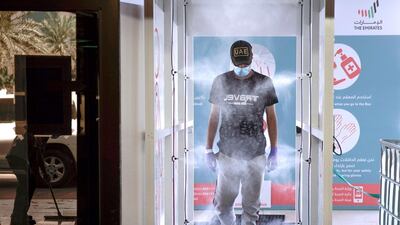
A commuter enters the sterilisation area at the entrance of the Abu Dhabi Central Bus Terminal in March 2020. Victor Besa / The National -
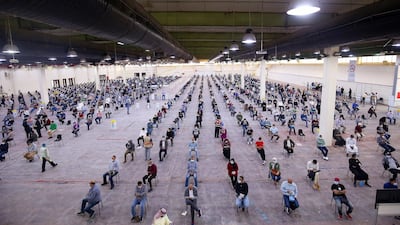
Travellers returning to Kuwait from Egypt, Syria and Lebanon arrive to be re-tested at a containment and screening zone in Kuwait City on March 16, 2020. AFP -
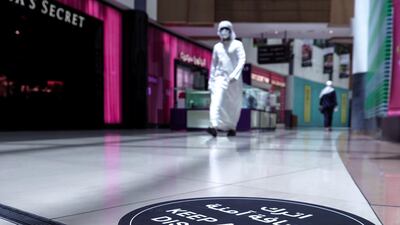
Al Wadha Mall in Abu Dhabi reopens in May 2020 with measures in place to protect shoppers. Victor Besa / The National -
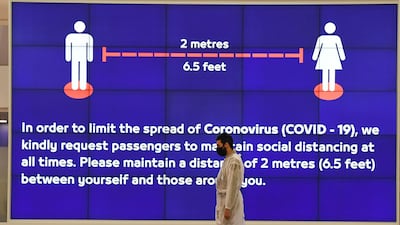
Safety reminders at Dubai International Airport after the resumption of scheduled operations by Emirates on May 22, 2020. AFP -
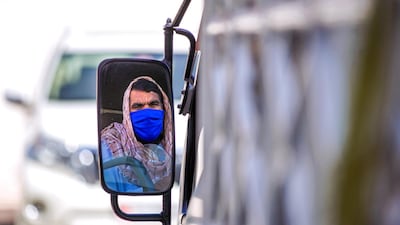
A delivery driver wearing a face mask in downtown Abu Dhabi. Victor Besa / The National -
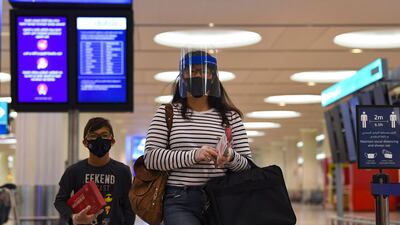
Passengers of an Emirates flight prepare to board a plan to Sydney at Dubai International Airport. AFP -
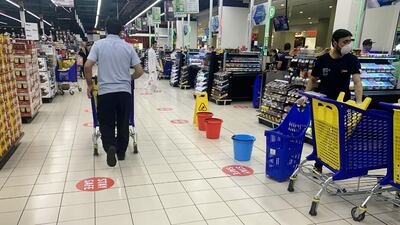
Systems put in place at a supermarket in Dubai to slow the spread of the coronavirus. AFP



