

The Taliban has carried out the first major cabinet reshuffle since retaking Afghanistan to consolidate power in a fractured movement and weaken the once-feared Haqqani Network, intelligence sources have told The National.
The group downplayed this week’s appointment of Maulvi Abdul Kabir as acting prime minister “in order to ensure there are no obstacles and delays in the affairs of the administration”, after they said leader Hasan Akhund, 78, would be taking time off to “rest due to an illness”.
While the announcement was portrayed as a simple bureaucratic move, Mr Kabir is a powerful force in the administration.
Believed to be in his early 60s, he was the last prime minister of Afghanistan before the fall of the Taliban regime as the US invaded in 200 and he played a key role in the Doha talks with the US about their withdrawal. He is understood to have considerable influence with the Taliban’s supreme leader Haibatullah Akhundzada.
He is also linked to several terrorist attacks, including the 2007 attack on the Afghan parliament that killed 50 people, including five MPs. He is under UN sanctions and reportedly has ties to Afghanistan’s lucrative drug trade.
“The promotion is a reward for his loyalty to Haibatullah,” said one former security official. “We should expect to see more such appointments where those obedient to Haibatullah are rewarded.”
“Haibatullah Akhundzada has gone with [Mr Kabir], who was part of the Taliban during Mullah Omar’s time in the late 1990s up until 2001,” said Kabir Taneja, a fellow at the Observer Research Foundation.
“This way, Akhundzada is keeping both intra-tribal issues in check and also protecting power by not allowing the ‘newer’ power brokers in Kabul,” he added.
-
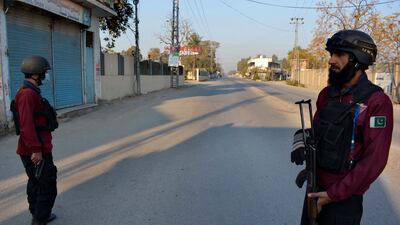
Security officers guard a road leading to a counter-terrorism centre in Bannu, a district in Pakistan's Khyber Pakhtunkhwa province. AP Photo -
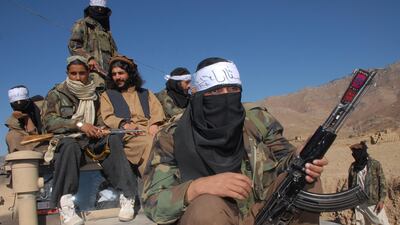
Pakistan's Taliban commander Latif Mehsud, centre, a close aide to the former chief of the Tehreek-e-Taliban Pakistan (TTP), Hakimullah Mehsud, sits on an armed vehicle in Khyber Pakhtunkhwa province. AFP -
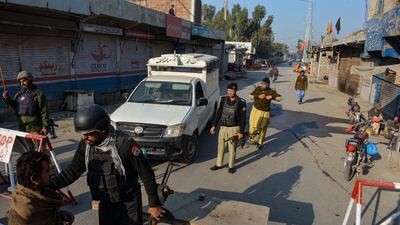
Officers stand guard along a road they blocked after Taliban militants seized a police station in Bannu. AFP -

Soldiers drive towards North Waziristan from Bannu at the start of an offensive against Pakistani Taliban militants in the restive ethnic Pashtun tribal region. Reuters -
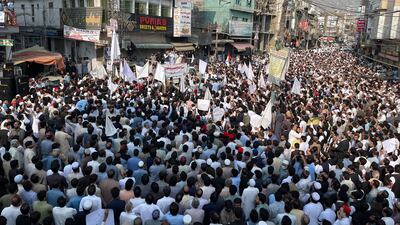
People take part in a protest a day after an attack on a school bus in Mingora, in the Swat District of Khyber Pakhtunkhwa. AFP -

Security officials and relatives attend a funeral ceremony of a slain policeman who was killed in an attack claimed by the TTP in the border town of Chaman. AFP -

Pakistani security officials check identity cards at a roadside check point in Karachi. EPA -

Pakistani security officials in Karachi. EPA -

A Pakistani security official in Karachi. EPA -

Surrendered Taliban militants at a Pakistani military compound in Swat valley on August 20, 2009. AFP -
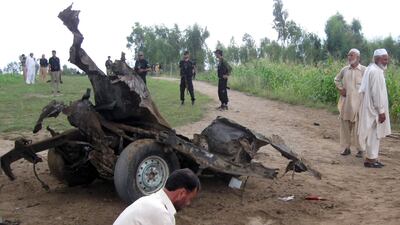
Pakistani security officials at the site of a bomb blast in Jandol town, 100km from the once Taliban-infested Swat Valley on September 16, 2012. AFP -

Armed Pakistani militiamen gather in the former Taliban stronghold area of Puchar in Swat valley on September 14, 2009. AFP -
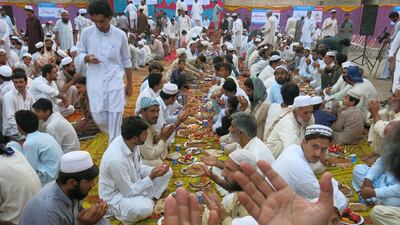
Internally displaced Pakistani civilians pray before breaking their fast during Ramadan in Bannu, northern Pakistan, on July 6, 2014. AFP -
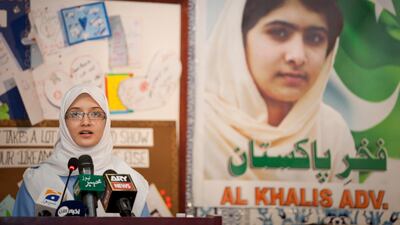
Ayesha Abdul Jalil, 16, speaks at a tribute to Malala Yousufzai, who was shot in the head by the Taliban in the Swat valley, at the Embassy of Pakistan in Abu Dhabi. Razan Alzayani / The National


Rahmatullah Nabil, a former Afghan spy chief, said the decision was a definitive move to not only reinforce control but also quell any future conflict.
“The decision of selecting a successor to Mullah Hasan seems both definitive and intricate as it aims to reduce competition among other Taliban leaders for the position that will be vacant after [Mr Akhund’s] departure,” he told The National.
“It is also a soft signal to [first deputy prime pinister] Mullah Baradar and [defence minister] Mullah Yaqoob that they are not as powerful within the Taliban movement,” he said.
However, Mr Kabir’s appointment is also indicative of fracturing fault lines within the Taliban, the analysts said.
“It showcases Akhundzada’s own paranoia and mistrust with regard to the many power centres in Kabul that are, by most accounts, frustrated by his doggedness on issues such as girls' education and other points of ideological friction,” Mr Taneja said.
"Kabir being appointed as a stand-in for the Prime Minister, instead of Mullah Baradar, who is the first deputy, gives a glimpse of how the divisions are set up within the Taliban,” he said.
Most significantly, though, Mr Kabir’s appointment is thought to be an attempt to weaken the influence of the Haqqani family, which shares power with them in the current government of Afghanistan.
-

-

Hospital security guards carry a student injured in the shootout at a school under attacked by Taliban gunmen in Peshawar, Pakistan on Tuesday. Taliban gunmen stormed a military school in the northwestern Pakistani city, killing and wounding dozens, officials said, in the latest militant violence to hit the already troubled region. Mohammad Sajjad / AP Photo -

Pakistani soldiers transport rescued school children from the site of an attack by Taliban gunmen on a school in Peshawar. A Majeed / AFP Photo -

A school boy who was injured in a Taliban attack receives medical treatment at a hospital in Peshawar. Arshad Arbab / EPA -

A Pakistani army soldier takes position on a bunker close to a school under attack by Taliban gunmen in Peshawar. Mohammad Sajjad / AP Photo -

A schoolboy who was injured in a Taliban attack receives medical treatment at a hospital in Peshawar. Arshad Arbab / EPA -

Pakistani security forces take up positions on a road leading to the Army Public School that is under attack by Taliban gunmen in Peshawar. Taliban gunmen in Pakistan took hundreds of students and teachers hostage on Tuesday in a school in the northwestern city of Peshawar, military officials said. Khuram Parvez / Reuters -

Taliban gunmen in Pakistan took hundreds of students and teachers hostage on Tuesday in a school in the northwestern city of Peshawar, military officials said. Khuram Parvez / Reuters -

A soldier escorts schoolchildren after they were rescued from the Army Public School that is under attack by Taliban gunmen in Peshawar. Khuram Parvez / Reuters -

Pakistani rescue workers take out students from an ambulance who were injured in the shootout at a school under attack by Taliban gunmen, upon arrival at a local hospital in Peshawar. Mohammad Sajjad / AP Photo -

Pakistani army troops arrive to conduct an operation at a school under attack by Taliban gunmen in Peshawar. Taliban gunmen stormed a military school in the northwestern Pakistani city, killing and wounding dozens, officials said, in the latest militant violence to hit the already troubled region. Mohammad Sajjad / AP Photo -

A Pakistani soldier stands near the debris of a house which was destroyed during a military operation against Taliban militants in the town of Miranshah in North Waziristan in this July 9, 2014 file photo. “It’s a revenge attack for the army offensive in North Waziristan,” Taliban spokesman Muhammad Umar Khorasani told Reuters following the attack at a military-run school in the northwestern Pakistani city of Peshawar on Tuesday. Maqsood Mehdi / Reuters -

Pakistani volunteers carry a student injured in the shootout at a school under attack by Taliban gunmen, at a local hospital in Peshawar. Mohammad Sajjad / AP Photo -

A Pakistani girl, who was injured in a Taliban attack in a school, is rushed to a hospital in Peshawar, Pakistan, Tuesday, Dec. 16, 2014. Taliban gunmen stormed a military-run school in the northwestern Pakistani city of Peshawar on Tuesday, killing and wounding scores, officials said, in the highest-profile militant attack to hit the troubled region in months.(AP Photo/Mohammad Sajjad)


There have been reports of a growing rift between the Taliban’s supreme leader and the Haqqani network, which was founded in the 1970s and was one of the most powerful and feared groups in the Afghan insurgency. It gave the Taliban critical support during the long insurgency against the US.
In a gathering to commemorate the anniversary of the death of the Taliban’s founder Mullah Omar last week, Sirajuddin Haqqani alluded to the reshuffle within the Taliban’s government.
“We should not monopolise the government and make it small so that only individuals from our religious seminaries see themselves involved in it. Everyone is part of this government,” he said.
Mr Kabir is from the Paktia province and belongs to the Zadran tribe, like the Haqqani family, and as such his appointment is considered to be a move to weaken their influence in the region.
“It not only aims to appease the Loy Paktia [the greater eastern region] by choosing a second-in-command from that region, but also undermines Siraj who does not enjoy a friendly relationship with Kandahar, nor with Kabir,” Mr Nabil said, referring to Sirajuddin Haqqani, who is the Interior Minister in the Taliban government and the leader of the Haqqani Network.
“This appointment could also pave the way for the replacement of the Haqqanis,” Mr Nabil suggested.

