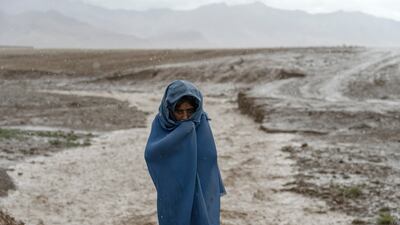
Kabul, Afghanistan, in November 2021. EPA

Taliban appoint new central bank governor as country grapples with economic collapse


  • English
  • Arabic

The Taliban has appointed a new head of the county’s central bank, which allocates funds for critical imports such as food. The movement, which took control of Afghanistan in August 2021 after a precipitous withdrawal of western troops, is presiding over a devastated economy, since the US and EU froze the country’s $9 billion worth of foreign reserves.

The US initially said the group was aligned to Al Qaeda-linked terrorists, saying the militants had broken the terms of the US withdrawal agreement, before releasing some of the funds for humanitarian needs.

But funds were frozen again when the Taliban reneged on a promise to allow girls access to education, leading to widespread international condemnation. With a population of about 40 million, Afghanistan’s budget for this year is now just $2 billion. By contrast, Iraq, with a population of 43 million, this month announced a budget of $155 billion.

The UN says half of Afghans now face acute hunger.

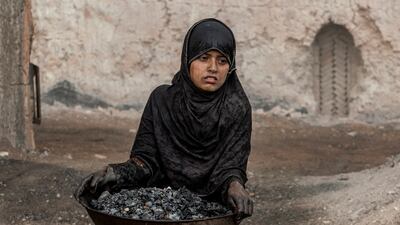
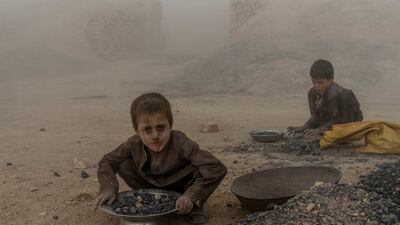
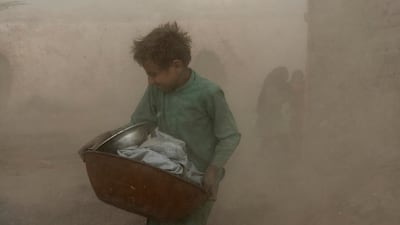
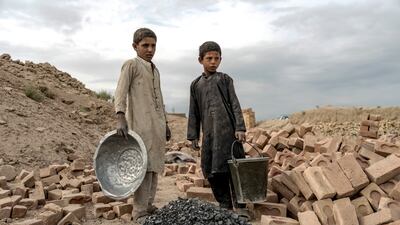
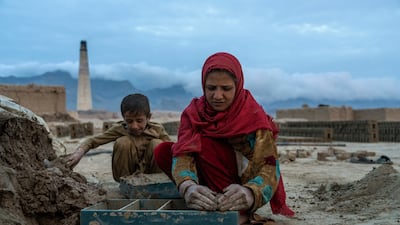
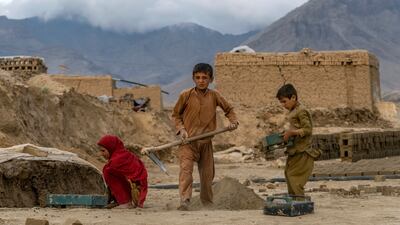
  • The number of children put to work in Afghanistan, already high, is growing, fuelled by the collapse of the economy after the Taliban took over the country and the world cut off financial aid just over a year ago. All photos: AP Photo
    The number of children put to work in Afghanistan, already high, is growing, fuelled by the collapse of the economy after the Taliban took over the country and the world cut off financial aid just over a year ago. All photos: AP Photo
  • A recent survey by Save the Children estimated that half of Afghanistan’s families send children out to work to keep food on the table as livelihoods crumble.
    A recent survey by Save the Children estimated that half of Afghanistan’s families send children out to work to keep food on the table as livelihoods crumble.
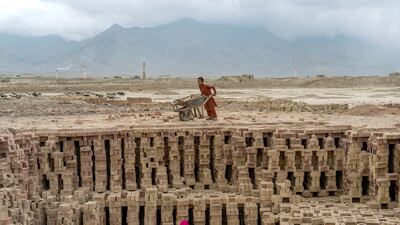
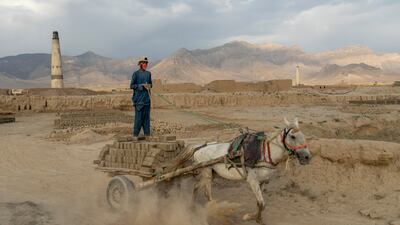
  • Nowhere is the malaise clearer than in the many brick factories on the motorway north out of the capital, Kabul.
    Nowhere is the malaise clearer than in the many brick factories on the motorway north out of the capital, Kabul.
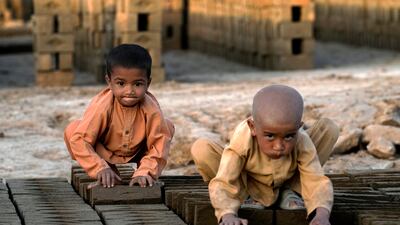
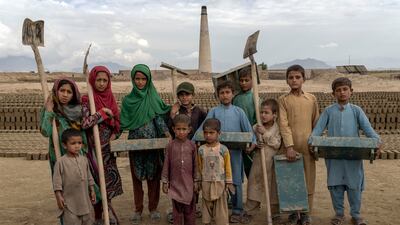
  • Conditions in the furnaces are tough even for adults. But in almost all of them, children as young as four or five toil alongside their families from early in the morning until dark in the heat of summer.
    Conditions in the furnaces are tough even for adults. But in almost all of them, children as young as four or five toil alongside their families from early in the morning until dark in the heat of summer.
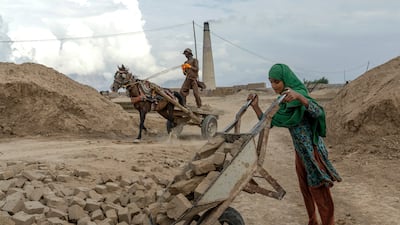
  • Children are involved in every step of the brickmaking process.
    Children are involved in every step of the brickmaking process.
  • They haul cannisters of water and carry the wooden brick moulds filled with mud to put in the sun to dry.
    They haul cannisters of water and carry the wooden brick moulds filled with mud to put in the sun to dry.
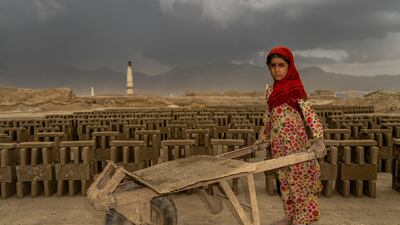
  • They load and push wheelbarrows full of dried bricks to the kiln for firing, then push back wheelbarrows full of fired bricks.
    They load and push wheelbarrows full of dried bricks to the kiln for firing, then push back wheelbarrows full of fired bricks.
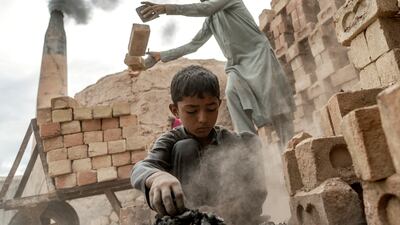
  • Everywhere they are lifting, stacking, sorting bricks.
    Everywhere they are lifting, stacking, sorting bricks.
  • They pick through the smouldering charcoal from the kilns for pieces that can still be used, inhaling the soot and singeing their fingers.
    They pick through the smouldering charcoal from the kilns for pieces that can still be used, inhaling the soot and singeing their fingers.
  • The children work with a determination and a grim sense of responsibility beyond their years, borne out of knowing little else but their families’ need.
    The children work with a determination and a grim sense of responsibility beyond their years, borne out of knowing little else but their families’ need.
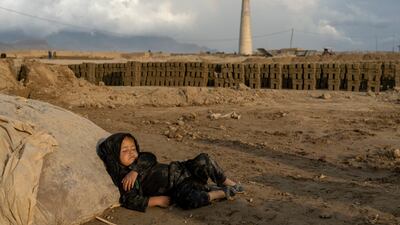
  • When asked about toys or play, they smile and shrug. Only a few have been to school.
    When asked about toys or play, they smile and shrug. Only a few have been to school.
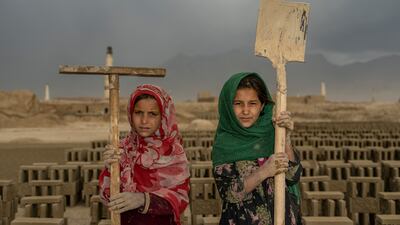
  • Nabila, 12, has been working in brick factories since she was five or six. Like many other brick workers, her family works part of the year at a kiln near Kabul, the other part at one outside Jalalabad, near the Pakistan border.
    Nabila, 12, has been working in brick factories since she was five or six. Like many other brick workers, her family works part of the year at a kiln near Kabul, the other part at one outside Jalalabad, near the Pakistan border.
  • A few years ago, she got to go to school a little in Jalalabad. She would like to go back to school but her family needs her work to survive, she said with a soft smile. 'We can’t think about anything else but work,' she said.
    A few years ago, she got to go to school a little in Jalalabad. She would like to go back to school but her family needs her work to survive, she said with a soft smile. 'We can’t think about anything else but work,' she said.
  • The landscape around the factories is bleak and barren, with the kilns’ smokestacks pumping out black, sooty smoke. Families live in dilapidated mud houses next to furnaces, each with a corner where they make their bricks. For most, a day’s meal is bread soaked in tea.
    The landscape around the factories is bleak and barren, with the kilns’ smokestacks pumping out black, sooty smoke. Families live in dilapidated mud houses next to furnaces, each with a corner where they make their bricks. For most, a day’s meal is bread soaked in tea.
  • Rahim has three children working with him at a brick kiln, ranging in age from 5 to 12. The children had been in school, and Rahim, who goes by one name, said he had long resisted putting them to work. But even before the Taliban came to power, as the war went on and the economy worsened, he said he had no choice.
    Rahim has three children working with him at a brick kiln, ranging in age from 5 to 12. The children had been in school, and Rahim, who goes by one name, said he had long resisted putting them to work. But even before the Taliban came to power, as the war went on and the economy worsened, he said he had no choice.
  • 'There’s no other way,' Rahim said. 'How can they study when we don’t have bread to eat? Survival is more important.'
    'There’s no other way,' Rahim said. 'How can they study when we don’t have bread to eat? Survival is more important.'
  • Workers get the equivalent of $4 for every 1,000 bricks they make. One adult working alone is unable to make that amount in a day, but if the children help, they can make 1,500 bricks a day, workers said.
    Workers get the equivalent of $4 for every 1,000 bricks they make. One adult working alone is unable to make that amount in a day, but if the children help, they can make 1,500 bricks a day, workers said.
  • According to surveys by Save the Children, the percentage of families saying they had a child working outside the home grew from 18 per cent to 22 per cent from December to June. That would suggest more than a million children nationwide were working. Another 22 per cent of children said they were asked to work on the family business or farm.
    According to surveys by Save the Children, the percentage of families saying they had a child working outside the home grew from 18 per cent to 22 per cent from December to June. That would suggest more than a million children nationwide were working. Another 22 per cent of children said they were asked to work on the family business or farm.
  • The surveys covered more than 1,400 children and more than 1,400 caregivers in seven provinces. They also pointed to the swift collapse in Afghans’ livelihoods. In June, 77 per cent of the surveyed families said they had lost half their income or more compared with a year ago, up from 61 per cent in December.
    The surveys covered more than 1,400 children and more than 1,400 caregivers in seven provinces. They also pointed to the swift collapse in Afghans’ livelihoods. In June, 77 per cent of the surveyed families said they had lost half their income or more compared with a year ago, up from 61 per cent in December.

Finance Minister Hidayatullah Badri was appointed as acting governor, replacing Mohammad Idris, a key fundraiser for the Taliban during its decades-long war against the US. Taliban spokesman Zabihullah Mujahed confirmed the appointment on Wednesday but gave no further details.

Even among the Taliban there are divisions on the sweeping orders to restrict women’s rights. One faction backs supreme leader Hibatullah Akhundzada who issued the conservative decrees, while another group are pushing back against his policies.

Mr Badri is from Kandahar, the birthplace of the Taliban, and was one of the closest aides to the late Mullah Mohammad Omar, the founder of the militant group. Omar’s son and the current Defence Minister, Mullah Mohammad Yaqoob, is one of the leaders driving the faction against the conservatives.

Ministry of Finance spokesman Ahmad Wali Haqmal said on Wednesday that Mullah Mohammad Nasser Akhund, a deputy minister of revenue and customs, will take charge until Mr Badri’s replacement is appointed.


Our family matters legal consultant

Name: Hassan Mohsen Elhais

Position: legal consultant with Al Rowaad Advocates and Legal Consultants.

Scoreline

Chelsea 1
Azpilicueta (36')

West Ham United 1
Hernandez (73')

Our legal consultant

Name: Dr Hassan Mohsen Elhais

Position: legal consultant with Al Rowaad Advocates and Legal Consultants.

What can victims do?

Always use only regulated platforms

Stop all transactions and communication on suspicion

Save all evidence (screenshots, chat logs, transaction IDs)

Report to local authorities

Warn others to prevent further harm

Courtesy: Crystal Intelligence

Ten tax points to be aware of in 2026

1. Domestic VAT refund amendments: request your refund within five years

If a business does not apply for the refund on time, they lose their credit.

2. E-invoicing in the UAE

Businesses should continue preparing for the implementation of e-invoicing in the UAE, with 2026 a preparation and transition period ahead of phased mandatory adoption. 

3. More tax audits

Tax authorities are increasingly using data already available across multiple filings to identify audit risks. 

4. More beneficial VAT and excise tax penalty regime

Tax disputes are expected to become more frequent and more structured, with clearer administrative objection and appeal processes. The UAE has adopted a new penalty regime for VAT and excise disputes, which now mirrors the penalty regime for corporate tax.

5. Greater emphasis on statutory audit

There is a greater need for the accuracy of financial statements. The International Financial Reporting Standards standards need to be strictly adhered to and, as a result, the quality of the audits will need to increase.

6. Further transfer pricing enforcement

Transfer pricing enforcement, which refers to the practice of establishing prices for internal transactions between related entities, is expected to broaden in scope. The UAE will shortly open the possibility to negotiate advance pricing agreements, or essentially rulings for transfer pricing purposes. 

7. Limited time periods for audits

Recent amendments also introduce a default five-year limitation period for tax audits and assessments, subject to specific statutory exceptions. While the standard audit and assessment period is five years, this may be extended to up to 15 years in cases involving fraud or tax evasion. 

8. Pillar 2 implementation 

Many multinational groups will begin to feel the practical effect of the Domestic Minimum Top-Up Tax (DMTT), the UAE's implementation of the OECD’s global minimum tax under Pillar 2. While the rules apply for financial years starting on or after January 1, 2025, it is 2026 that marks the transition to an operational phase.

9. Reduced compliance obligations for imported goods and services

Businesses that apply the reverse-charge mechanism for VAT purposes in the UAE may benefit from reduced compliance obligations. 

10. Substance and CbC reporting focus

Tax authorities are expected to continue strengthening the enforcement of economic substance and Country-by-Country (CbC) reporting frameworks. In the UAE, these regimes are increasingly being used as risk-assessment tools, providing tax authorities with a comprehensive view of multinational groups’ global footprints and enabling them to assess whether profits are aligned with real economic activity. 

Contributed by Thomas Vanhee and Hend Rashwan, Aurifer

25-MAN SQUAD

Goalkeepers: Francis Uzoho, Ikechukwu Ezenwa, Daniel Akpeyi
Defenders: Olaoluwa Aina, Abdullahi Shehu, Chidozie Awaziem, William Ekong, Leon Balogun, Kenneth Omeruo, Jamilu Collins, Semi Ajayi 
Midfielders: John Obi Mikel, Wilfred Ndidi, Oghenekaro Etebo, John Ogu
Forwards: Ahmed Musa, Victor Osimhen, Moses Simon, Henry Onyekuru, Odion Ighalo, Alexander Iwobi, Samuel Kalu, Paul Onuachu, Kelechi Iheanacho, Samuel Chukwueze 

On Standby: Theophilus Afelokhai, Bryan Idowu, Ikouwem Utin, Mikel Agu, Junior Ajayi, Valentine Ozornwafor

The smuggler

Eldarir had arrived at JFK in January 2020 with three suitcases, containing goods he valued at $300, when he was directed to a search area.
Officers found 41 gold artefacts among the bags, including amulets from a funerary set which prepared the deceased for the afterlife.
Also found was a cartouche of a Ptolemaic king on a relief that was originally part of a royal building or temple. 
The largest single group of items found in Eldarir’s cases were 400 shabtis, or figurines.

Khouli conviction

Khouli smuggled items into the US by making false declarations to customs about the country of origin and value of the items.
According to Immigration and Customs Enforcement, he provided “false provenances which stated that [two] Egyptian antiquities were part of a collection assembled by Khouli's father in Israel in the 1960s” when in fact “Khouli acquired the Egyptian antiquities from other dealers”.
He was sentenced to one year of probation, six months of home confinement and 200 hours of community service in 2012 after admitting buying and smuggling Egyptian antiquities, including coffins, funerary boats and limestone figures.

For sale

A number of other items said to come from the collection of Ezeldeen Taha Eldarir are currently or recently for sale.
Their provenance is described in near identical terms as the British Museum shabti: bought from Salahaddin Sirmali, "authenticated and appraised" by Hossen Rashed, then imported to the US in 1948.

- An Egyptian Mummy mask dating from 700BC-30BC, is on offer for £11,807 ($15,275) online by a seller in Mexico

- A coffin lid dating back to 664BC-332BC was offered for sale by a Colorado-based art dealer, with a starting price of $65,000

- A shabti that was on sale through a Chicago-based coin dealer, dating from 1567BC-1085BC, is up for $1,950

Company Fact Box

Company name/date started: Abwaab Technologies / September 2019

Founders: Hamdi Tabbaa, co-founder and CEO. Hussein Alsarabi, co-founder and CTO

Based: Amman, Jordan

Sector: Education Technology

Size (employees/revenue): Total team size: 65. Full-time employees: 25. Revenue undisclosed

Stage: early-stage startup 

Investors: Adam Tech Ventures, Endure Capital, Equitrust, the World Bank-backed Innovative Startups SMEs Fund, a London investment fund, a number of former and current executives from Uber and Netflix, among others.

Company profile

Date started: 2015

Founder: John Tsioris and Ioanna Angelidaki

Based: Dubai

Sector: Online grocery delivery

Staff: 200

Funding: Undisclosed, but investors include the Jabbar Internet Group and Venture Friends

The specs

Engine: 1.5-litre turbo

Power: 181hp

Torque: 230Nm

Transmission: 6-speed automatic

Starting price: Dh79,000

On sale: Now

THE SPECS

Engine: 1.5-litre turbocharged four-cylinder

Transmission: Constant Variable (CVT)

Power: 141bhp 

Torque: 250Nm 

Price: Dh64,500

On sale: Now

Landfill in numbers

• Landfill gas is composed of 50 per cent methane

• Methane is 28 times more harmful than Co2 in terms of global warming

• 11 million total tonnes of waste are being generated annually in Abu Dhabi

• 18,000 tonnes per year of hazardous and medical waste is produced in Abu Dhabi emirate per year

• 20,000 litres of cooking oil produced in Abu Dhabi’s cafeterias and restaurants every day is thrown away

• 50 per cent of Abu Dhabi’s waste is from construction and demolition

Dhadak 2

Director: Shazia Iqbal

Starring: Siddhant Chaturvedi, Triptii Dimri 

Rating: 1/5

Updated: March 22, 2023, 2:04 PM