An MQ-9 Reaper remotely piloted aircraft taking off on a training mission at Creech Air Force Base, US. EPA

What is the US MQ-9 reaper drone and what could happen after Russian jet crash?


Robert Tollast
  • English
  • Arabic

Tuesday evening’s collision between a Russian SU-27 fighter bomber and a US MQ-9 Reaper drone over the Black Sea has sparked fears of a dangerous escalation between the nuclear armed powers, but the interception ― and even downing of a drone ― is not unusual.

The US said on Tuesday that they believed the collision was accidental and that the $40 million Russian aircraft, code-named Flanker by Nato, had probably suffered some damage when it hit the rear propeller of the $5 million drone after dropping aviation fuel on the unmanned aircraft.

That the Russian jet suffered damage is unsurprising. The 2,000 kilogram MQ-9 has a cruising speed of 300kph and a top speed of 480kph if it was trying to evade the 16,000kg Russian jet.

US State Department spokesman Ned Price called the act, a “brazen violation of international law”, but Russia’s ministry of defence stressed that their aircraft had “not used their weapons” in the incident.

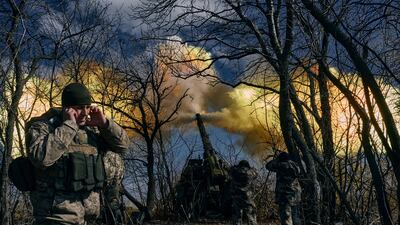
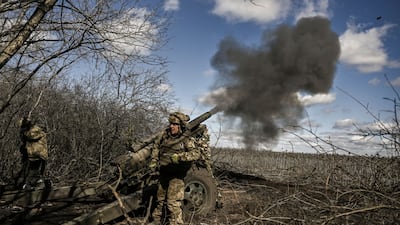
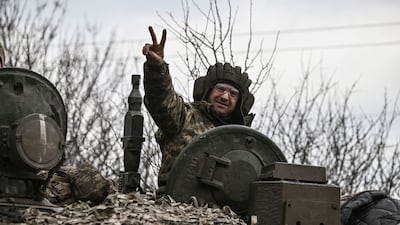
  • Ukrainian soldiers fire a howitzer towards Russian positions, near Bakhmut in Ukraine. AP
    Ukrainian soldiers fire a howitzer towards Russian positions, near Bakhmut in Ukraine. AP
  • Resident Svetlana Boiko, 66, who was wounded in recent shelling, is comforted near her destroyed house in Donetsk. Reuters
    Resident Svetlana Boiko, 66, who was wounded in recent shelling, is comforted near her destroyed house in Donetsk. Reuters
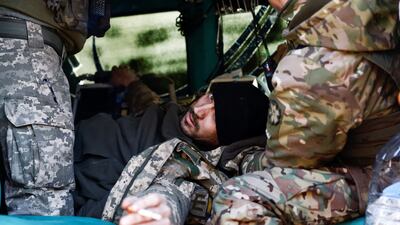
  • A wounded Ukrainian soldier is treated in a front-line stabilisation ambulance, near Kreminna. Reuters
    A wounded Ukrainian soldier is treated in a front-line stabilisation ambulance, near Kreminna. Reuters
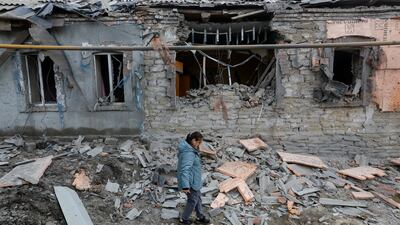
  • A house in Donetsk destroyed in recent shelling. Reuters
    A house in Donetsk destroyed in recent shelling. Reuters
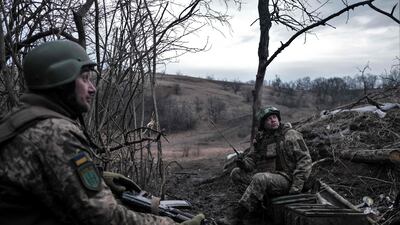
  • Ukrainian volunteer soldiers hold their positions at the front line near Bakhmut. AFP
    Ukrainian volunteer soldiers hold their positions at the front line near Bakhmut. AFP
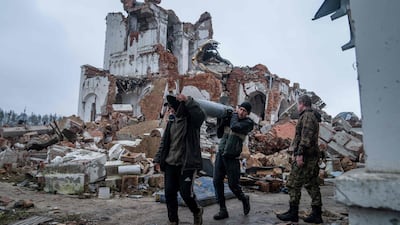
  • Volunteers carry the remains of a Uragan rocket as they clear the area around the Sviatohirsk Cave Monastery in Dolyna. AFP
    Volunteers carry the remains of a Uragan rocket as they clear the area around the Sviatohirsk Cave Monastery in Dolyna. AFP
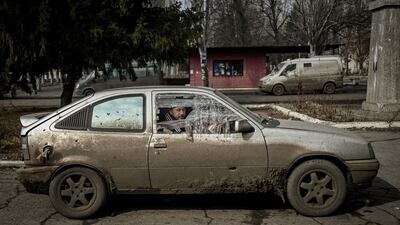
  • A man sits inside a damaged car in the village of Chasiv Yar. AFP
    A man sits inside a damaged car in the village of Chasiv Yar. AFP
  • Ukrainian servicemen fire at Russian positions in the region of Donbas. AFP
    Ukrainian servicemen fire at Russian positions in the region of Donbas. AFP
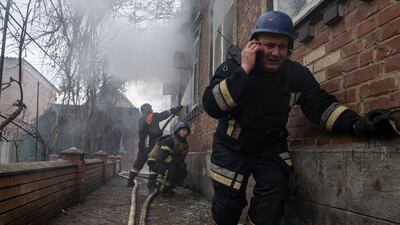
  • Rescue workers put out a fire in a house shelled by Russian forces in Kostiantynivka. AP
    Rescue workers put out a fire in a house shelled by Russian forces in Kostiantynivka. AP
  • A Ukrainian serviceman moves towards the frontline city of Bakhmut. AFP
    A Ukrainian serviceman moves towards the frontline city of Bakhmut. AFP
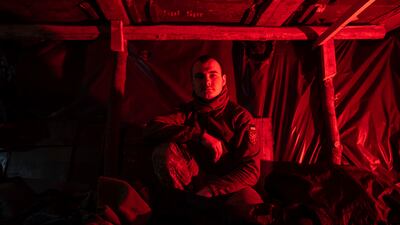
  • Vladyslav, a Ukrainian paratrooper of the 80 Air Assault brigade, rests in a dugout at the front line near Bakhmut. AP
    Vladyslav, a Ukrainian paratrooper of the 80 Air Assault brigade, rests in a dugout at the front line near Bakhmut. AP
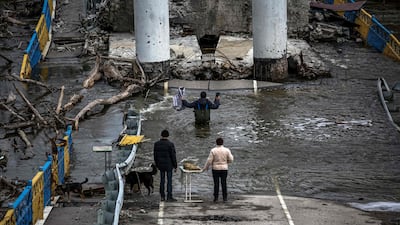
  • Residents of the village of Bohorodychne cross the Seversky Donets river to retrieve bread from the other bank. AFP
    Residents of the village of Bohorodychne cross the Seversky Donets river to retrieve bread from the other bank. AFP

Why then, has there been so much concern and what does the US military say about the loss of drones in hostile situations?

How many US drones have been shot down?

The US has lost at least six drones to enemy action, including the latest downing of the MQ-9 reaper. Only the most dramatic of these incidents, the loss of an RQ-4 to an Iranian missile in June 2019 led to the threat of retaliation.

The lumbering RQ-4, one of the largest drones in the world, was downed near the Straits of Hormuz by a Khordad surface-to-air missile at a time of high tension between the US and Iran.

The US said it was “an unprovoked attack on a US surveillance asset that had not violated Iranian airspace”. Footage of the blazing $130 million drone plummeting to earth was later released by Iran.

The RQ-4 has a wingspan of 40m, almost 10m longer than a Second World War B-17 bomber, but the loss of one of the aircraft raised questions as to how it could survive a high intensity conflict with a US adversary. The plane is designed to stay aloft for up to 30 hours, beyond the limits of most manned aircraft, and being capable of surveying up to 100,000 kilometres a day.

An RQ-4 Global Hawk unmanned aircraft like the one shown is currently flying non-military mapping missions over South, Central America and the Caribbean at the request of partner nations in the region. (U.S. Air Force photo/Bobbi Zapka)

President Donald Trump reportedly considered bombing several targets in Iran, saying that the Iranians had made “a very big mistake”, before deciding not to escalate.

Other US drones have been lost to anti-aircraft fire in Yemen and Syria, including at least one MQ-9.

Will the downing of a US drone lead to war?

While the downing of the RQ-4 near Iran provoked Mr Trump, many analysts say the entire point of an unmanned aircraft is to reduce the risk of serious escalation. This makes any US measures to retaliate against Russia unlikely.

Last year, a US Congressional Research Service report quoted US expert Michael C Horowitz, who argued that “states distinguish between the shooting down of manned and unmanned systems”, suggesting that such actions fell below the threshold of war.

Could the MQ-9 drone shoot down an SU-27 Flanker?

Tuesday’s aerial clash was a confrontation between aircraft from two different eras. First flying in 1977, the SU-27 was developed to counter the US F-14 Tomcat and the F-15 fighter-bomber. Armed with a 30mm cannon that can fire up to 1,500 explosive rounds per minute, the Flanker is more than capable of using weapons to shoot down a slow-moving MQ-9.

If the US chose, it could arm the MQ-9 with heat-seeking AIM-9 missiles, that are also capable of shooting down Russian aircraft, although the drone was most likely conducting reconnaissance from its vantage point 15km above Earth.

While the SU-27 can bristle with up to 10 air-to-air missiles and was designed to gain air superiority in a full-scale war with Nato, the MQ-9 was a product of the “war on terror”, first flying in 2001 and developed after the US saw the need for a more powerful version of the smaller Predator drone.

(FILE) - Two Russian SU-27 aircraft perform during the International Maritime Defence Show (IMDS) in St. Petersburg, Russia, 07 July 2013 (reissued 14 March 2023). The United States European Command (EUCOM) said in a statement that two Russian Su-27 aircraft 'conducted an unsafe and unprofessional intercept' with a US unmanned MQ-9 aircraft that was operating within international airspace over the Black Sea on 14 March 2023. The incident occurred at about 7:03 AM (CET) when one of the Russian aircraft struck the propeller of the MQ-9 causing US forces to bring the unmanned aircraft down in international waters, the statement added. EPA / ANATOLY MALTSEV *** Local Caption *** 50908986

The Predator, initially unarmed, first saw action in Afghanistan in October 2001, targeting suspected Al Qaeda fighters.

With greater endurance and more heavily-armed, the Reaper would not fly similar missions until 2007, also in Afghanistan and by the end of that decade, both aircraft had conducted about 300 air strikes in Iraq, Afghanistan, Yemen and most controversially, Pakistan, dropping missiles and bombs on terrorist groups and insurgents, but also causing significant civilian casualties.

The loss of the Reaper on Tuesday does not represent the loss of an important reconnaissance asset to the US ― the US air force ended the Reaper programme last year, signalling that the aircraft is close to being retired from service and replaced with an entirely new drone system.


Farage on Muslim Brotherhood

Nigel Farage told Reform's annual conference that the party will proscribe the Muslim Brotherhood if he becomes Prime Minister.
"We will stop dangerous organisations with links to terrorism operating in our country," he said. "Quite why we've been so gutless about this – both Labour and Conservative – I don't know.
“All across the Middle East, countries have banned and proscribed the Muslim Brotherhood as a dangerous organisation. We will do the very same.”
It is 10 years since a ground-breaking report into the Muslim Brotherhood by Sir John Jenkins.
Among the former diplomat's findings was an assessment that “the use of extreme violence in the pursuit of the perfect Islamic society” has “never been institutionally disowned” by the movement.
The prime minister at the time, David Cameron, who commissioned the report, said membership or association with the Muslim Brotherhood was a "possible indicator of extremism" but it would not be banned.

SNAPSHOT

While Huawei did launch the first smartphone with a 50MP image sensor in its P40 series in 2020, Oppo in 2014 introduced the Find 7, which was capable of taking 50MP images: this was done using a combination of a 13MP sensor and software that resulted in shots seemingly taken from a 50MP camera.

Jetour T1 specs

Engine: 2-litre turbocharged

Power: 254hp

Torque: 390Nm

Price: From Dh126,000

Available: Now

Mercer, the investment consulting arm of US services company Marsh & McLennan, expects its wealth division to at least double its assets under management (AUM) in the Middle East as wealth in the region continues to grow despite economic headwinds, a company official said.

Mercer Wealth, which globally has $160 billion in AUM, plans to boost its AUM in the region to $2-$3bn in the next 2-3 years from the present $1bn, said Yasir AbuShaban, a Dubai-based principal with Mercer Wealth.

Within the next two to three years, we are looking at reaching $2 to $3 billion as a conservative estimate and we do see an opportunity to do so,” said Mr AbuShaban.

Mercer does not directly make investments, but allocates clients’ money they have discretion to, to professional asset managers. They also provide advice to clients.

“We have buying power. We can negotiate on their (client’s) behalf with asset managers to provide them lower fees than they otherwise would have to get on their own,” he added.

Mercer Wealth’s clients include sovereign wealth funds, family offices, and insurance companies among others.

From its office in Dubai, Mercer also looks after Africa, India and Turkey, where they also see opportunity for growth.

Wealth creation in Middle East and Africa (MEA) grew 8.5 per cent to $8.1 trillion last year from $7.5tn in 2015, higher than last year’s global average of 6 per cent and the second-highest growth in a region after Asia-Pacific which grew 9.9 per cent, according to consultancy Boston Consulting Group (BCG). In the region, where wealth grew just 1.9 per cent in 2015 compared with 2014, a pickup in oil prices has helped in wealth generation.

BCG is forecasting MEA wealth will rise to $12tn by 2021, growing at an annual average of 8 per cent.

Drivers of wealth generation in the region will be split evenly between new wealth creation and growth of performance of existing assets, according to BCG.

Another general trend in the region is clients’ looking for a comprehensive approach to investing, according to Mr AbuShaban.

“Institutional investors or some of the families are seeing a slowdown in the available capital they have to invest and in that sense they are looking at optimizing the way they manage their portfolios and making sure they are not investing haphazardly and different parts of their investment are working together,” said Mr AbuShaban.

Some clients also have a higher appetite for risk, given the low interest-rate environment that does not provide enough yield for some institutional investors. These clients are keen to invest in illiquid assets, such as private equity and infrastructure.

“What we have seen is a desire for higher returns in what has been a low-return environment specifically in various fixed income or bonds,” he said.

“In this environment, we have seen a de facto increase in the risk that clients are taking in things like illiquid investments, private equity investments, infrastructure and private debt, those kind of investments were higher illiquidity results in incrementally higher returns.”

The Abu Dhabi Investment Authority, one of the largest sovereign wealth funds, said in its 2016 report that has gradually increased its exposure in direct private equity and private credit transactions, mainly in Asian markets and especially in China and India. The authority’s private equity department focused on structured equities owing to “their defensive characteristics.”

What can you do?

Document everything immediately; including dates, times, locations and witnesses

Seek professional advice from a legal expert

You can report an incident to HR or an immediate supervisor

You can use the Ministry of Human Resources and Emiratisation’s dedicated hotline

In criminal cases, you can contact the police for additional support

Specs

Engine: 51.5kW electric motor

Range: 400km

Power: 134bhp

Torque: 175Nm

Price: From Dh98,800

Available: Now

The National's picks

4.35pm: Tilal Al Khalediah
5.10pm: Continous
5.45pm: Raging Torrent
6.20pm: West Acre
7pm: Flood Zone
7.40pm: Straight No Chaser
8.15pm: Romantic Warrior
8.50pm: Calandogan
9.30pm: Forever Young

Islamophobia definition

A widely accepted definition was made by the All Party Parliamentary Group on British Muslims in 2019: “Islamophobia is rooted in racism and is a type of racism that targets expressions of Muslimness or perceived Muslimness.” It further defines it as “inciting hatred or violence against Muslims”.

Dr Amal Khalid Alias revealed a recent case of a woman with daughters, who specifically wanted a boy.

A semen analysis of the father showed abnormal sperm so the couple required IVF.

Out of 21 eggs collected, six were unused leaving 15 suitable for IVF.

A specific procedure was used, called intracytoplasmic sperm injection where a single sperm cell is inserted into the egg.

On day three of the process, 14 embryos were biopsied for gender selection.

The next day, a pre-implantation genetic report revealed four normal male embryos, three female and seven abnormal samples.

Day five of the treatment saw two male embryos transferred to the patient.

The woman recorded a positive pregnancy test two weeks later. 

The specs
 
Engine: 3.0-litre six-cylinder turbo
Power: 398hp from 5,250rpm
Torque: 580Nm at 1,900-4,800rpm
Transmission: Eight-speed auto
Fuel economy, combined: 6.5L/100km
On sale: December
Price: From Dh330,000 (estimate)
Updated: March 15, 2023, 4:11 PM