


Scientists are aiming to understand more about how Mars was formed by analysing data from two large meteorite impacts on the Red Planet.
Two large craters measuring upwards of 130 metres in diameter were caused when space rocks crashed into the Martian surface at different times in the latter half of 2021.
The vibrations caused by both impacts were discovered by Nasa’s InSight lander — which touched down on Mars in 2018.
These vibrations, or seismic surface waves, gave scientists insight into the structure of the Martian crust, which may hold important clues about the origin and evolution of the planet.
“This is the first time seismic surface waves have been observed on a planet other than Earth,” said Doyeon Kim, a geophysicist and senior research scientist at ETH Zurich’s Institute of Geophysics.
“Not even the Apollo missions to the Moon managed it.”
SpaceX rocket sends Nasa crew and Russian cosmonaut to International Space Station — in pictures
-

A SpaceX Falcon 9 rocket carrying the Crew Dragon capsule lifts off at the Kennedy Space Centre in Florida on Wednesday. EPA -
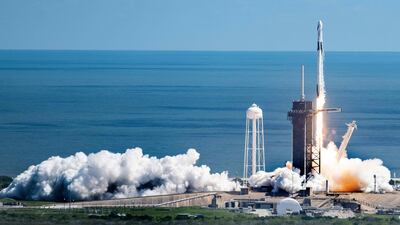
Nasa astronauts Nicole Mann and Josh Cassada, Japan Aerospace Exploration Agency astronaut Koichi Wakata and Roscosmos cosmonaut Anna Kikina were on board. AFP -

The crew will spend six months on the International Space Station. EPA -

The Crew-5 mission is the fifth ISS crew that Nasa has flown on a SpaceX craft since the rocket venture began sending US astronauts into space in May 2020. Reuters -

The launch could also be considered symbolic, with the space agencies' long-term astronaut exchange programme being maintained amid soaring tension over Russia's invasion of Ukraine. AFP -

Docking with the ISS is scheduled for Thursday at 4.57pm. Getty -

The crew poses for a picture at the Kennedy Space Centre. Reuters -

Ms Mann greets her family as she leaves the crew quarters at the Kennedy Space Centre. Reuters -

Ms Kikina is driven to the launch pad. AFP -

The launch was delayed by two days because of Hurricane Ian. AFP


The researchers used data from the Insight lander to determine the structure of the crust at depths of between about five and 30 kilometres below the surface of Mars.
They found that the crust was denser than previously thought.
The team said its new findings are “remarkable” because a planet’s crust provides important clues about how it formed and evolved billions of years ago.
The scientists said their work could also help solve a centuries-old mystery: the Martian dichotomy.
The Martian dichotomy is described as the sharp contrast between the volcanic lowlands of the northern hemisphere and a plateau covered by meteorite craters in the southern hemisphere.
Remarkable images show moment Nasa’s Dart spacecraft smashed into asteroid — in pictures
-
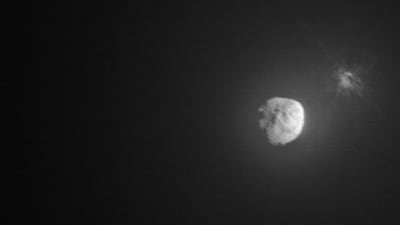
The first images that show the moment Nasa’s Dart spacecraft crashed into an asteroid have been released. Photo: Italian Space Agency / Nasa -
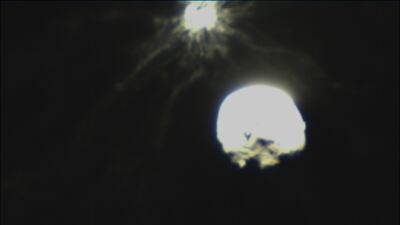
Nasa’s Double Asteroid Redirection Test (Dart) spacecraft targeted a binary asteroid system and smashed into Dimorphos – which orbits a larger asteroid, Didymos, to see if it can shift it slightly off course. Photo: Italian Space Agency / Nasa -

The pictures were captured by Italian Space Agency’s LiciaCube, a small cube satellite, that was released by the Dart spacecraft on September 11. Photo: Italian Space Agency / Nasa -
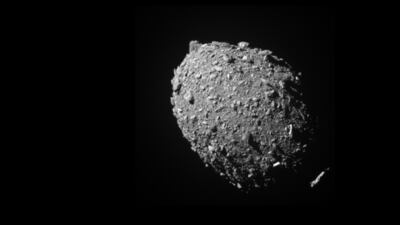
Viewers across the world got a point of view of the spacecraft the moment it crashed into the asteroid on September 27, 2022, at a speed of 24,000km an hour — fast enough to travel from New York to Paris in 15 minutes. Photo: Nasa -
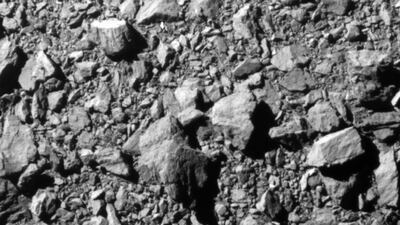
The collision on Tuesday was part of a planetary defence test by the US space agency, and the asteroid posed no threat to Earth. Photo: Nasa


“As things stand, we don’t yet have a generally accepted explanation for the dichotomy because we’ve never been able to see the planet’s deep structure,” said Domenico Giardini, ETH Zurich professor of seismology and geodynamics.
“But now we’re beginning to uncover this.”
The researchers said that their initial analysis suggests that both hemispheres may be structurally similar at lower depths, despite appearing different on surface.
They believe that, contrary to previous research, the north and the south are not likely to be composed of different materials.
Nasa rover finds possible signs of ancient life on Mars — in pictures
-
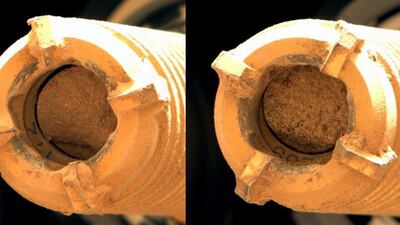
Nasa's Perseverance rover has found possible signs of ancient life on Mars in rock samples it collected from an ancient river delta in the Jezero Crater. Photo: Nasa -
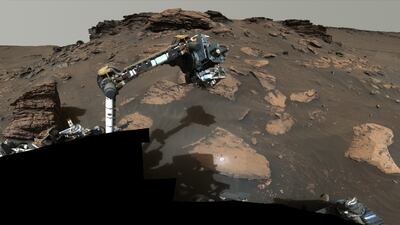
Nasa’s Perseverance rover puts its robotic arm to work at a rocky outcrop called Skinner Ridge in the Jezero Crater on Mars. Photo: Nasa -

The Perseverance Mars rover in a selfie it took over a rock nicknamed 'Rochette' on September 10, 2021. Photo: Nasa -
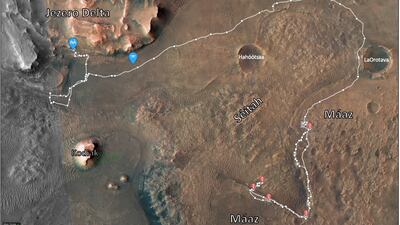
An image overlaid with the path taken by Nasa's Perseverance rover since it landed in Jezero Crater on Mars on February 18, 2021. It traces its route from an area called Seitah to Maaz and to its present location at one of the main features in the crater, identified as an ancient river delta, upper left. Red points indicate crater floor sampling locations; blue points indicate the present locations of the Perseverance Rover, left, and the Ingenuity helicopter. Photo: Nasa / Reuters -

An image taken by Perseverance that confirms Jezero Crater was once a quiet lake, fed steadily by a small river about 3.7 billion years ago. Photo: Massachusetts Institute of Technology


The findings are reported in two separate papers in the journal Science.
Meanwhile, another team of international researchers analysed data from Insight’s seismometer, which has recorded more than 1,300 marsquakes.
Based on their findings, published in the journal Nature Astronomy, the experts believe volcanic activity is still present on the planet and shaping the Martian surface, with magma — hot molten and semi-molten liquid — flowing beneath.

